

Key Takeaways:
- Real-Time Alerts: AI flags suspicious transactions instantly to reduce fraud losses and improve response speed across payment flows.
- Smarter Detection: AI finds hidden fraud patterns that static rules often miss, improving detection quality in fast-moving systems.
- Fewer False: Hits AI helps reduce false positives, so teams review fewer low-risk alerts and focus on higher-value cases faster.
- Behavioral Checks: Behavioral analysis tracks user actions over time to spot unusual payment activity before fraud causes damage.
- AML Risk: Signals AI strengthens AML monitoring by identifying suspicious flows, unusual behavior, and higher-risk transaction patterns.
- Scalable Defense: AI supports high-volume transaction monitoring without creating the same manual review burden as rule-heavy systems.
- Faster Risk Scores: Real-time risk scoring helps platforms assess transactions quickly and take smarter action before losses grow.
- Adaptive Controls: AI-driven monitoring adapts as fraud tactics change, helping financial platforms stay effective over time.
Detect risk earlier, reduce false alerts, and strengthen fraud defense with AI-driven transaction monitoring.
If you run a digital wallet, payments platform, or fintech product, fraud prevention is a constant operational priority. Monitoring systems are expected to catch suspicious activity quickly, keep false positives manageable, and support compliance without slowing down day-to-day performance. That balance is becoming harder to maintain as transaction volumes rise and fraud tactics become more sophisticated.
In this guide, we’ll look at how transaction monitoring works in modern financial platforms, where traditional rule-based approaches begin to fall short, and how AI in transaction monitoring supports faster, more adaptive, and more scalable fraud defense.
AI in Transaction Monitoring
Transaction monitoring is the ongoing review of financial activity such as payments, transfers, card usage, and account events to identify patterns that may signal fraud, money laundering, or other forms of financial crime. When implemented effectively, it serves both as a fraud prevention function and as a core part of a compliance framework.
Its value is clear across three areas:
- Fraud prevention: Helps stop scams, account takeovers, and suspicious payment behavior before losses escalate.
- Regulatory compliance: Supports AML obligations with more structured monitoring, documented decisions, and stronger reporting.
- Operational resilience: Allows teams to manage growing alert volumes without relying entirely on manual review.
The shift toward AI in transaction monitoring is driven by practical need. Financial platforms now operate continuously across regions, channels, and devices, creating far more transaction patterns than static rules can handle efficiently.
Traditional monitoring systems, which often depend on pre-set rules and manual investigation, face several common limitations:
- High false positives caused by rigid thresholds or outdated logic
- Detection gaps when fraud patterns change faster than rules can be updated
- Review delays that reduce the ability to respond before damage is done
- Scalability challenges as transaction data and alert volumes increase
This is where AI-driven transaction monitoring creates a meaningful advantage. Instead of relying only on fixed conditions, AI can learn from historical behavior, identify subtle anomalies, and support real-time monitoring decisions with greater speed and accuracy. When applied responsibly, it can also improve governance, transparency, and audit readiness.
What is Transaction Monitoring in Financial Platforms?
Transaction monitoring in banking, fintech software development, and payment systems involves the ongoing analysis of transactions and related entities (customers, merchants, devices, accounts, and counterparties). The purpose is to detect suspicious behavior and reduce financial crime risk.
Key objectives typically include:
- Detect suspicious activities that may indicate fraud, AML risk, or policy violations.
- Prevent fraud and financial crimes by identifying risk early enough to intervene.
- Ensure regulatory compliance through defensible alerts, investigations, and reporting.
Depending on your use case, transaction monitoring may drive:
- Account holds and payment declines
- Enhanced due diligence workflows
- Case management for investigations
- Escalation to AML teams or fraud ops
In short, it’s a control layer between raw financial activity and the decisions that protect users, revenue, and compliance commitments.
Challenges in Traditional Transaction Monitoring
Even well-tuned legacy systems can start to feel fragile as fraud patterns evolve and volumes rise. Here are the most common challenges I see across institutions and fintech teams doing fintech software development.
Rule-based systems generate high false positives
Rules can be effective at catching known scenarios, but they often:
- Trigger on benign behavior that merely resembles past fraud
- Overlap and stack, multiplying alerts
- Need constant maintenance as products and user behavior change
Manual review processes and delays
When alerts arrive faster than teams can investigate, you get backlogs. Delays matter because fraud is often time-sensitive. By the time a case is reviewed, the transaction may already have settled, or the damage may be done.
Inability to detect complex fraud patterns
Some schemes don’t look suspicious from a single transaction perspective. They emerge through relationships across accounts, devices, merchants, and time windows. Rule-based systems struggle when patterns become multi-dimensional.
Limited scalability with increasing transaction data
If your monitoring strategy is tied to manually authored rules, it becomes harder to scale. More data means more potential triggers and more reviewer load.
High operational costs and inefficiencies
More alerts typically mean:
- More analyst time
- More tooling and case management overhead
- More cost to sustain compliance operations

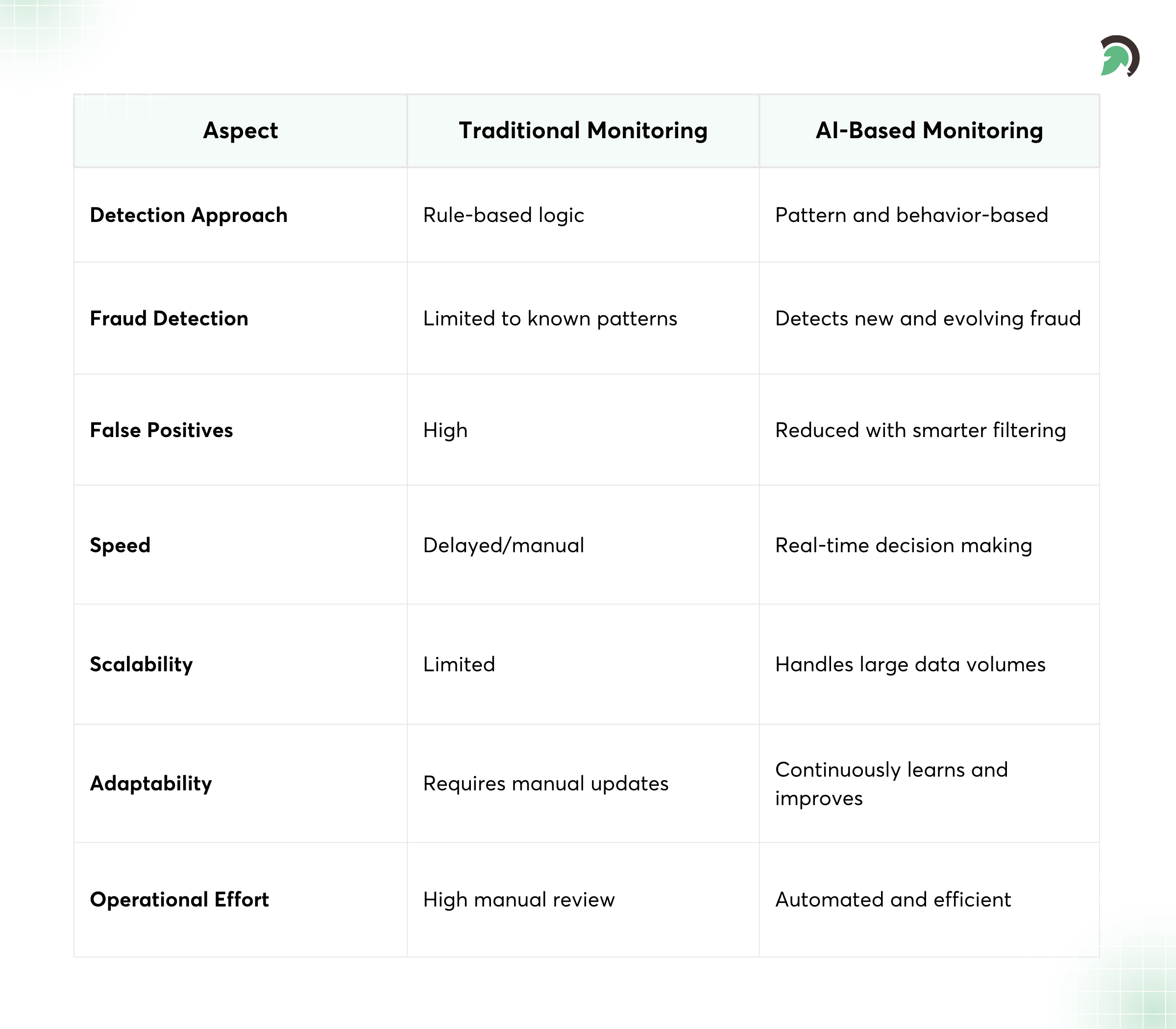
These limitations don’t mean legacy monitoring is “wrong.” It’s just optimized for a world where fraud changes slowly, and transactions are fewer. Modern platforms need a more adaptive approach, especially automated transaction monitoring.
How AI is Transforming Transaction Monitoring
The fundamental shift is moving from static rules to adaptive intelligence. With AI in transaction monitoring, risk signals are derived from patterns in data how things behave, not just whether they cross a threshold.
Here’s what that transformation looks like in practice:
- Shift from static rules to adaptive intelligence: AI updates its understanding as data evolves.
- Real-time data analysis and decision-making: models can score risk quickly so teams intervene earlier.
- Continuous learning: systems improve as new fraud and confirmed outcomes arrive.
- Improved accuracy: better separation between low-risk and high-risk activity.
Let’s break down the core AI capabilities behind this.
-
Anomaly detection
AI can flag transactions that deviate from expected behavior, even if they don’t match a known rule. This is essential for “new” fraud variants.
-
Behavioral analysis
Instead of treating each transaction in isolation, behavioral models evaluate patterns across time such as velocity changes, device shifts, or sudden changes in spending structure.
-
Pattern recognition
AI fraud detection software can learn complex combinations of features that historically correlate with suspicious outcomes.
-
Risk scoring automation
Risk scoring automation helps route cases more intelligently: high-risk alerts are prioritized, while low-risk signals can be deprioritized or handled with lighter investigation.
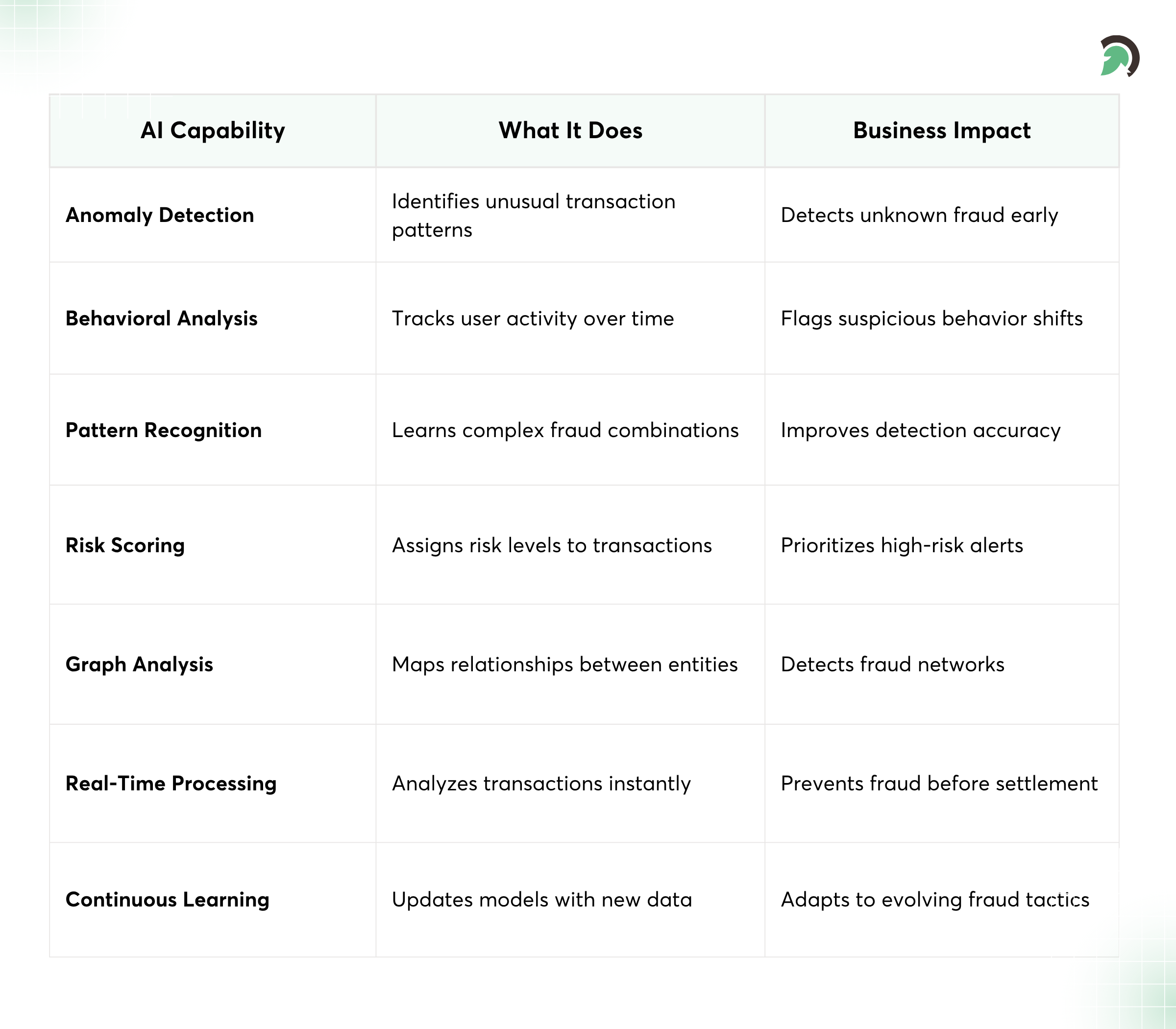
When done right, AI transaction monitoring reduces noise while increasing the chance you catch meaningful risk sooner.
Key Use Cases of AI in Transaction Monitoring
Different platforms need different capabilities, but the best implementations usually cover a few core use cases. Below are the most common areas where AI delivers measurable value.
1. Real-Time Fraud Detection
Fraudsters don’t wait for nightly batch processing. AI can help with:
- Monitoring transactions instantly so you can act before settlement, where possible
- Detecting unusual patterns and behaviors across accounts, devices, and channels
- Supporting dynamic decisions like step-up verification or temporary restrictions
This is a direct driver of real-time transaction monitoring and better customer outcomes.
2. Anti-Money Laundering (AML) Monitoring
For AML monitoring, the challenge is to detect suspicious transaction flows and hidden relationships. AI-based approaches help identify:
- Suspicious transaction flows that don’t match typical customer or merchant behavior
- Hidden relationships between entities through shared attributes or indirect connections
- Structuring patterns like split payments, unusual timing, or “layering”-like behavior
As teams build AML monitoring software, AI fraud detection software often becomes the backbone for scoring, alert prioritization, and investigative support, especially when integrated with case management workflows.
3. False Positive Reduction
One of the biggest practical wins is cutting noise. AI can filter out low-risk alerts and improve efficiency:
- Reduce unnecessary manual reviews
- Improve alert quality so investigators trust the system
- Allocate attention to cases with a higher probability of suspicious activity
This directly strengthens suspicious activity monitoring without overwhelming your team.
4. Customer Risk Profiling
Static profiles age quickly. With AI, you can assign dynamic risk scores that change as behavior changes:
- Assign dynamic risk scores based on transaction and behavior signals
- Continuously update risk profiles as new evidence arrives
- Use profile changes to trigger review thresholds appropriately
5. Network and Graph Analysis
Many fraud and AML scenarios are relationship-based. Graph-based approaches can reveal connections that rules miss:
- Detect fraud networks and connections between accounts, devices, or merchants
- Identify complex transaction relationships that emerge through multi-hop links
- Surface shared infrastructure or coordinated behavior
If you’re exploring anti-money laundering transaction monitoring, graph analysis is often one of the most valuable additions because it aligns with how investigators think about networks.
Technologies Powering AI-Based Transaction Monitoring
AI-based transaction monitoring isn’t one tool, it’s a stack. The exact blend varies by platform, but common components include:
-
Machine Learning (ML) models
ML provides risk scoring and detection logic. Typical approaches include supervised models (when you have labeled outcomes) and unsupervised or semi-supervised methods (for detecting anomalies).
-
Natural Language Processing (NLP)
NLP can help when you have unstructured evidence in alerts or case notes such as investigation summaries, customer communications, or document fields.
-
Graph analytics and network analysis
Graph analytics supports relationship discovery: links between entities, shared devices, common counterparties, and multi-hop connections.
-
Big data processing frameworks
To handle scale, platforms often rely on distributed computing for feature generation, aggregation, and model scoring pipelines.
-
Cloud computing infrastructure
Cloud infrastructure supports elasticity for peak transaction periods and helps separate dev/test from production workloads.
-
API integrations with financial systems
A monitoring engine must integrate with core banking, payment orchestration, KYC data sources, and case management. Strong API integrations keep monitoring decisions consistent across your stack.
For fintech software development teams, these components should be planned together, not bolted on later, so the system stays reliable, testable, and auditable.
Benefits of AI in Transaction Monitoring
AI delivers value in two dimensions: risk control and operational efficiency. Here are the most common benefits platforms report.
-
Faster detection of suspicious activities
Instead of waiting for a rule trigger plus review queue, AI can score and prioritize quickly, supporting earlier intervention.
-
Reduced false positives and manual reviews
Better scoring means fewer low-value alerts. Investigators spend more time on cases that matter.
-
Improved compliance with regulatory requirements
When designed with auditability in mind, AI can strengthen defensibility: consistent scoring logic, documented evidence, and traceable outcomes.
-
Real-time monitoring capabilities
AI supports real-time transaction-monitoring workflows, enabling product decisions to happen quickly.
-
Enhanced scalability for large transaction volumes
As data increases, AI models can continue operating without exponential growth in manual effort.
-
Lower operational costs
Lower false positives and improved triage can reduce cost per case and reduce the burden on compliance teams.
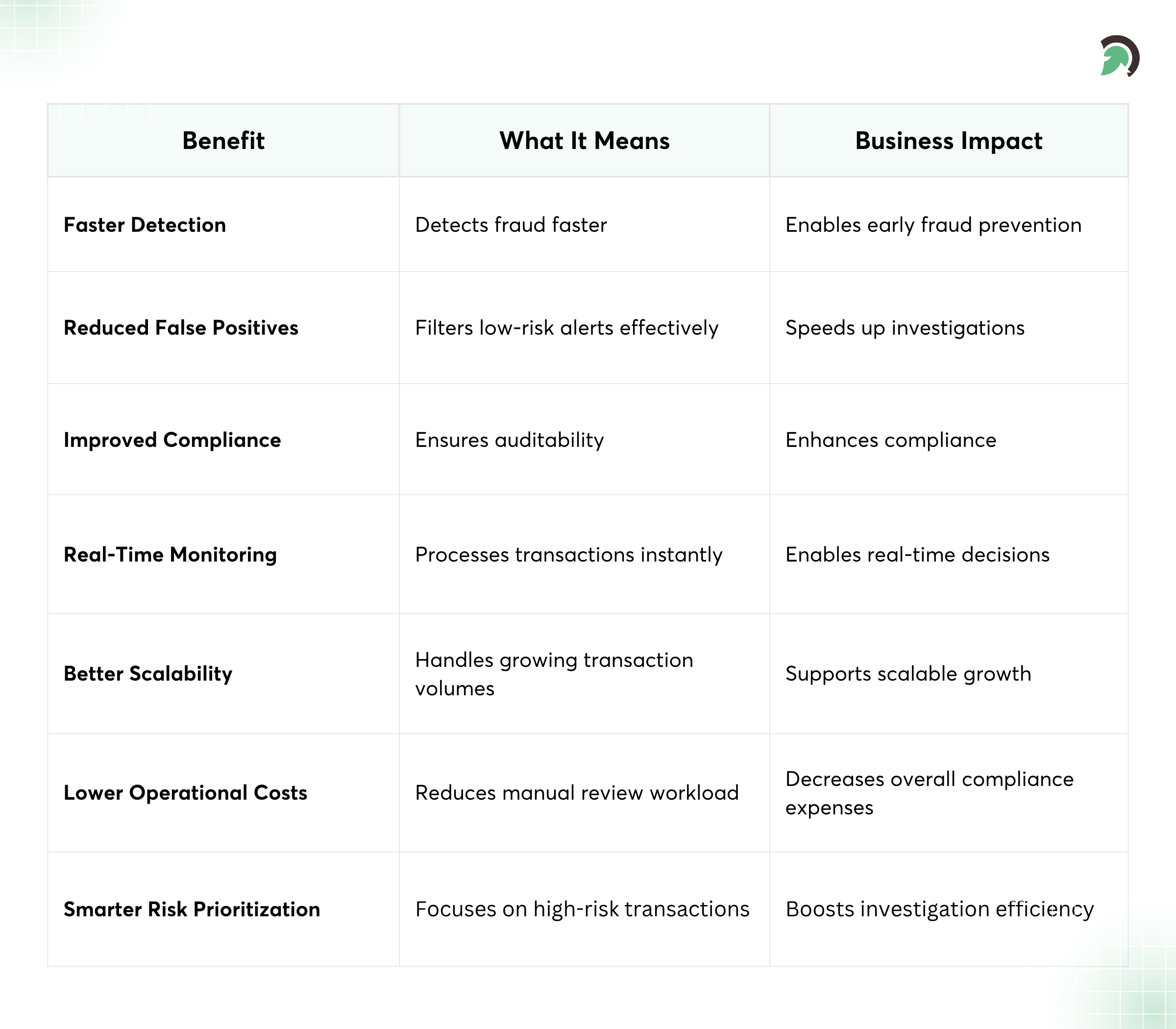
When done well, AI fraud detection software becomes not just a defense mechanism but a long-term capability upgrade.
Implementation of AI in Transaction Monitoring
Let’s get practical. If you’re planning to introduce automated analytics or upgrade to AI-driven monitoring, a staged rollout is the safest path.
Step-by-step
- Define monitoring requirements and compliance scope: Determine which risks you’re covering (fraud types, AML scenarios, account/merchant profiles).
- Collect and integrate transaction data: Bring in payments, events, customer attributes, device signals, and KYC outcomes.
- Clean and preprocess data: Handle missing values, standardize formats, and ensure labeling quality.
- Select AI models and algorithms: Align model types to your data availability and detection goals.
- Integrate with existing systems: Plug into alerting, case management, and decisioning services.
- Test for accuracy and compliance: Evaluate detection performance and run governance checks.
- Deploy and monitor in real-time: Validate scoring behavior under live load and during peak periods.
- Continuously update models: Retrain with new outcomes and adjust thresholds as fraud evolves.
One note I’d emphasize for teams doing finance software development and fintech software development: plan for feedback loops. If you can’t capture investigation outcomes, you’ll limit how much AI can improve.
Compliance and Regulatory Considerations
Even when AI improves performance, compliance still requires discipline. In most regions, transaction monitoring is tightly connected to AML and KYC frameworks.
Important considerations include:
- AML and KYC regulatory requirements: Define how alerts map to due diligence and reporting workflows.
- FATF guidelines and global compliance standards: Align your approach to widely recognized principles.
- Data privacy regulations (GDPR, regional laws): ensure lawful processing, retention limits, and security controls.
- Auditability and explainability of AI models: You need to explain decisions to compliance stakeholders and auditors.
- Risk management and governance: Assign accountability for model updates, threshold changes, and performance tracking.
Think of governance as part of the system, not a separate checklist. That’s how you avoid compliance surprises during scaling.
Challenges of AI in Transaction Monitoring
AI isn’t a magic switch. It introduces new challenges that must be handled deliberately.
-
Data quality and availability issues
AI models are only as good as their inputs. Missing or inconsistent data can degrade scoring accuracy.
-
Model bias and false negatives
If the training data underrepresents certain patterns or regions, the model may miss suspicious activity, resulting in false negatives. This can be riskier than tolerating extra false positives.
-
Integration with legacy systems
Many platforms rely on older workflows and data models. Integration work can be the slowest part, especially when case management and decisioning logic are tightly coupled.
-
Regulatory uncertainty around AI usage
Some jurisdictions are more specific than others about how AI is used and validated. You’ll need a careful approach to documentation and approvals.
-
Need for skilled data and compliance professionals
AI projects succeed when data science and compliance teams collaborate. If either side is missing, you’ll struggle with both performance and governance.
In practice, the best outcomes come from building a shared “model-to-matter” workflow that links technical scoring to investigator actions.
Best Practices for AI-Driven Transaction Monitoring
If you want automated transaction monitoring that investigators trust, adopting these best practices early is worth it.
-
Combine AI with human oversight (human-in-the-loop)
Use human review to validate uncertain cases, correct labels, and refine thresholds. This improves both accuracy and operational confidence.
-
Regularly retrain models with updated data
Fraud evolves. Retraining helps keep detection aligned with current behavior and emerging threat patterns.
-
Maintain audit logs for compliance
Document model versioning, feature sets, threshold parameters, and decision outcomes so you can reproduce results when needed.
-
Ensure data security and privacy
Lock down data access, apply encryption, and enforce retention rules. Monitoring systems contain sensitive customer and financial data.
-
Use explainable AI models
Where possible, choose approaches that provide interpretability so compliance teams understand “why” an alert was raised.
-
Continuously monitor system performance
Track drift, false positive rates, alert volumes, investigation turnaround time, and model latency. Performance should be treated like a KPI set, not a one-time evaluation.
And yes, this is where many teams benefit from partnering with experienced product and engineering groups like EvinceDev for workflow design and operational integration, especially when speed matters.
Future Trends in AI for Transaction Monitoring
The direction is clear: more real-time signals, deeper relationship analytics, and tighter compliance automation.
-
Real-time, continuous compliance monitoring
Instead of periodic reviews, platforms will increasingly adopt always-on risk monitoring that adapts in real time.
-
Advanced graph-based fraud detection
More sophisticated network methods will help detect layered networks, mule activity, and indirect relationships across entities.
-
Integration with blockchain for transparency
In some ecosystems, blockchain-based evidence can strengthen traceability. The key will be integrating that transparency into decision workflows without creating brittle dependencies.
-
Autonomous financial surveillance systems
Some components will become more autonomous, suggesting actions, triaging cases, and recommending investigations while keeping accountable human oversight.
-
Increased adoption in fintech and digital banking
Fintech software development teams are already moving toward modular monitoring capabilities that can be updated as fraud patterns shift.
If you’re planning your roadmap, treat AI in transaction monitoring as a capability platform, not a single project deliverable.
How Financial Platforms Can Get Started
You don’t have to replace everything to benefit from AI. A thoughtful starting point reduces risk and accelerates learning.
Getting started steps
- Assess current monitoring gaps: identify where you have coverage blind spots or high false positive rates.
- Identify high-impact use cases: choose one or two scenarios where better detection and triage will matter most.
- Choose appropriate AI tools or partners: decide among building internally, integrating with vendors, or a hybrid approach.
- Start with pilot implementations: run controlled trials with clear success metrics (alert reduction, investigation time, detection improvements).
- Scale with advanced analytics and automation: once performance is validated, expand coverage and refine governance.

As you scale, keep your compliance team involved to ensure the system remains defensible, understandable, and safe. That’s the path to sustainable fraud reduction.
Conclusion
AI in transaction monitoring is no longer an enhancement; it is becoming the foundation of modern fraud defense. By enabling real-time detection, adaptive risk scoring, and smarter alert prioritization, AI helps financial platforms reduce losses while improving operational efficiency. More importantly, it creates a system that evolves with emerging threats instead of reacting to them.
As transaction volumes grow and fraud tactics become more sophisticated, organizations that invest in intelligent monitoring will be better positioned to protect users, maintain compliance, and scale with confidence. The focus should now shift from static controls to continuous, data-driven decisioning.
If you are evaluating how to strengthen your fraud defense strategy, exploring AI-driven approaches with experienced teams like EvinceDev can help you design solutions that are both effective and future-ready.