

Key Takeaways:
- Faster Claims: Flow Automates claim lifecycle from submission to payment, reducing delays and improving reimbursement speed.
- Lower Denial Rates: Validates data before submission to reduce errors, rejections, and costly claim resubmission cycles.
- Real-Time Tracking: Provides live claim status updates, helping teams act quickly on approvals, denials, and pending actions.
- Better Compliance: Ensures HIPAA-ready workflows, audit trails, and secure data handling across billing operations.
- Reduced Admin Work: Minimizes manual tasks through automation, freeing staff to focus on higher-value activities.
- Data-Driven Insights: Uses analytics to identify denial patterns, optimize workflows, and improve billing performance.
The behavioral healthcare industry is undergoing a significant shift as providers face increasing pressure to manage complex billing workflows, ensure compliance, and maintain steady revenue cycles. Traditional claims processes, often dependent on manual effort, disconnected systems, and delayed verification, are no longer sufficient to handle the growing demands of modern behavioral health practices. This is where claims management software is creating a critical transformation.
Behavioral healthcare providers today must navigate session-based billing, evolving payer requirements, and detailed clinical documentation, all while ensuring faster reimbursements and reduced denial rates. Managing these challenges manually not only slows operations but also increases the risk of revenue leakage and compliance gaps. A purpose-built claims management system enables providers to move from reactive billing processes to structured, automated, and data-driven workflows.
From real-time eligibility verification to automated claim validation and denial management, modern claims management software is reshaping how behavioral healthcare organizations handle their revenue cycle. As the industry continues to evolve, adopting intelligent, integrated solutions is no longer just an operational upgrade. It is essential for financial stability, scalability, and long-term growth.
How Claims Management Software Prevents Revenue Leakage
Claims management is critical to the financial stability of behavioral health providers. When claims aren’t submitted correctly or on time, cash flow doesn’t just slow down; it becomes unpredictable. That’s especially risky for programs that rely on consistent staffing and continuity of care.
Behavioral health billing also adds complexity that generic billing tools often can’t handle well:
- Therapy sessions that require accurate duration-based billing and visit-level documentation
- Long-term care cycles with recurring services, periodic reviews, and shifting clinical needs
- Insurance variations across payers, plans, eligibility windows, and authorization rules
- Different insurer responses: rejections, denials, partial payments, and “need more info” loops
When manual processes lead the workflow, the system tends to break in predictable places:
- Delays from waiting on eligibility confirmations, missing forms, or rework after submission
- Denials caused by coding or documentation mismatches
- Revenue loss when follow-up is inconsistent or when denials aren’t tracked with discipline
That’s why a purpose-built approach, often built around behavioral health claims management software principles, can improve accuracy, speed, and compliance without turning your clinical team into unpaid billing support.
Where Behavioral Health Claims Processes Break Down
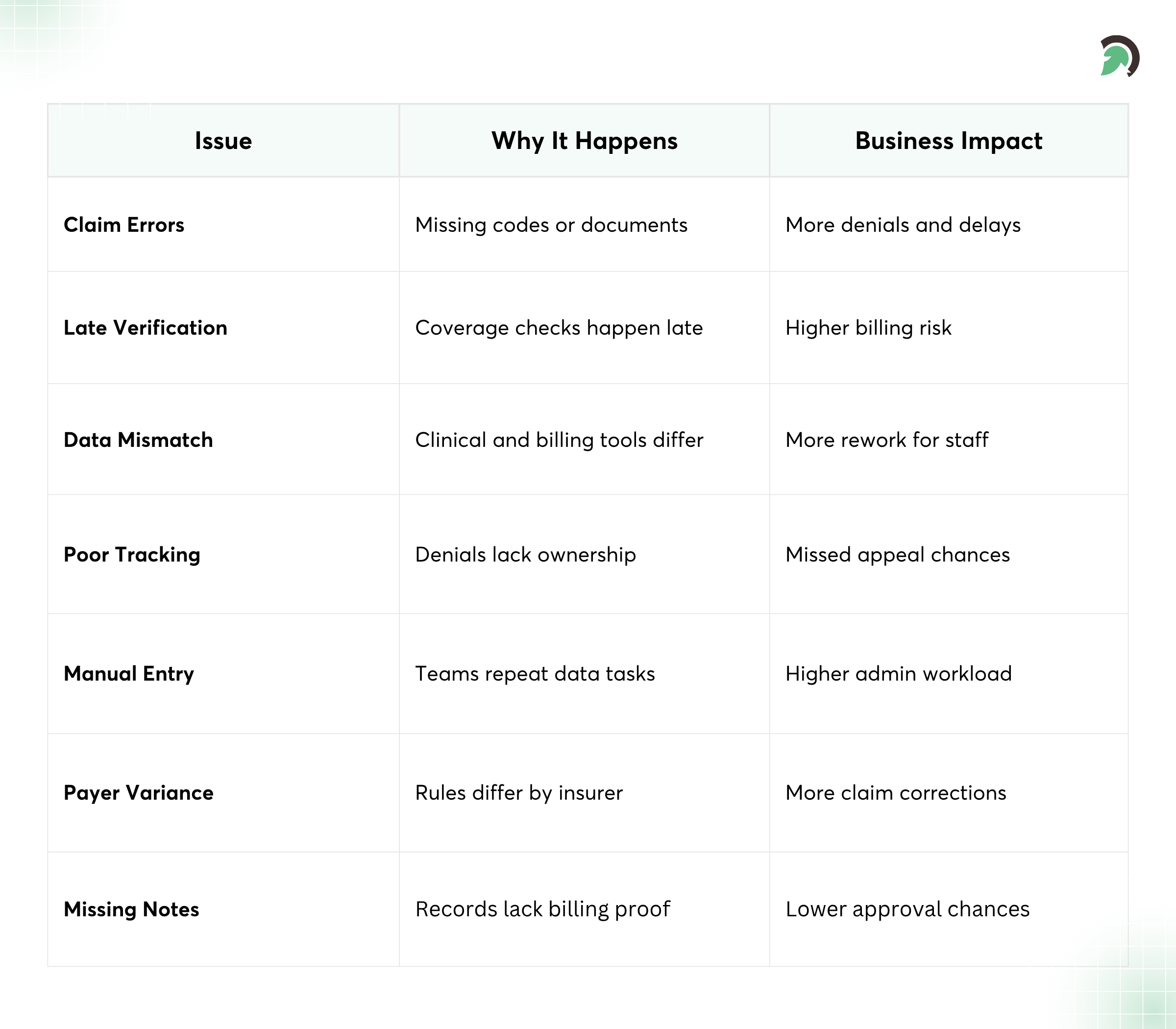
Incomplete or Incorrect Claim Submissions
Most teams can name the culprit behind a bad claim: missing detail, wrong code, or documentation that doesn’t match what was billed. The issue is that those problems often aren’t discovered until after the claim hits the insurer portal.
Common reasons claims get rejected or denied include:
- Missing documentation (authorization details, progress notes, service location, or required supporting elements)
- Coding errors (CPT/ICD mismatches, improper modifiers, incorrect diagnosis linkage, or session duration issues)
- Form inconsistencies (patient identifiers, provider NPI/TIN fields, or taxonomy alignment problems)
- Eligibility-time confusion (services provided outside coverage windows)
High rejection rates aren’t just frustrating; they’re expensive. Every rejected claim drains staff time and creates downstream delays in billing cycles.
Delayed Insurance Verification
If eligibility checks happen after services are already delivered, or worse, only after a claim is rejected, you’re starting the billing process with avoidable risk. The result is a predictable pattern: treatment provided without confirmed coverage, then a scramble to correct or resubmit.
In practical terms, delay often comes from:
- Lack of real-time eligibility checks
- Manual payer calls or slow batch processes
- Unclear rules for when to re-check eligibility (coverage changes, plan renewals, new authorizations)
In a world where therapy sessions happen every day, the timing of insurance verification matters as much as the verification itself.
Disconnected Clinical and Billing Systems
Behavioral healthcare is documentation-heavy for a reason: the clinical record has to support medical necessity. But if therapy notes live in one system and claims data is collected elsewhere, mismatches are inevitable.
When systems are disconnected, teams experience:
- Data mismatch between therapy notes and claims requirements
- Increased administrative workload (copy/paste errors, duplicate data entry, manual reconciliation)
- Rework cycles where clinicians update notes after billing has already happened
The bigger risk? Your billing team becomes reactive instead of proactive.
Poor Denial Tracking and Follow-Up
Denials aren’t one-and-done. They require a structured follow-up workflow, documentation review, reason code analysis, correction, resubmission, and escalation when needed. Without that process, denials silently drain revenue.
Where workflows commonly break:
- No structured process for resubmissions
- Lack of a denial “home base” (where reasons, actions, and outcomes are stored)
- Missed deadlines due to inconsistent task management
- Lost revenue opportunities when high-likelihood denials never get appealed

How Claims Management Software Transforms the Workflow
End-to-End Claim Lifecycle Automation
The fastest way to stop revenue leakage is to reduce manual handoffs. Modern claims management workflows can move from intake to final reimbursement with automation that’s grounded in real operational needs not generic checklists.
Think of it as a “claim lifecycle”:
- Patient intake triggers required eligibility steps
- Clinical documentation is mapped to billing requirements
- Claims are prepared with validation rules before submission
- Payer responses update claim status automatically
- Corrected resubmissions are routed without starting from scratch
When done well, this is the heart of healthcare claims processing software that doesn’t just submit claims; it manages outcomes.
Real-Time Data Validation
Real-time validation helps teams catch avoidable errors before the claim leaves the organization. This is where healthcare claim management software becomes operationally valuable: it prevents preventable mistakes.
Validation can include:
- Field completeness checks (required payer/provider/patient elements)
- Code and modifier consistency checks
- Documentation completeness mapping (what note sections support billing)
- Eligibility coverage window logic (service date vs. coverage dates)
Centralized Claim Tracking
One of the most underrated benefits is visibility. Centralized tracking turns “Where is this claim?” into a quick status check.
With a single claim view, teams can quickly answer:
- Was the claim accepted, rejected, or partially paid?
- Which denial reason code was applied?
- What correction was required, and has it been applied?
- What is the next action, owner, and due date?
This reduces administrative churn and helps billing leaders make decisions faster.
Faster Reimbursement Cycles
Automated workflows reduce delays by shrinking the time between events. Instead of waiting for a daily batch, staff get immediate triggers when payer responses arrive, and resubmission steps can run on schedule.
For many providers, that’s how reimbursement timelines improve even when payer processing speeds don’t change.
Core Components of Claims Management Software
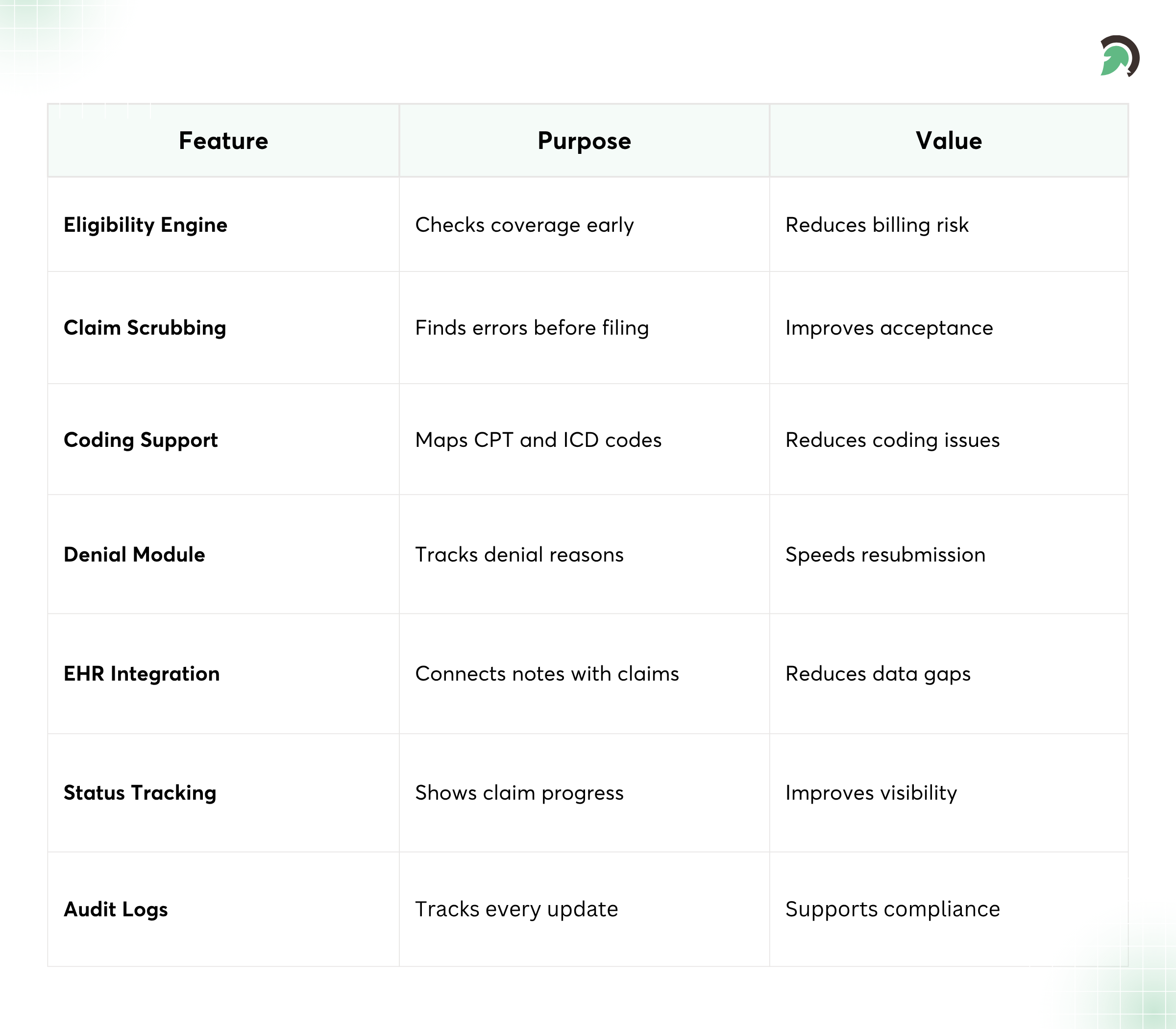
Patient Eligibility and Verification Engine
Before billing, you need confidence. An eligibility engine verifies payer coverage details ahead of service delivery and helps reduce the “provided without confirmed coverage” scenario.
Key capabilities typically include:
- Eligibility requests by patient and service date
- Coverage rules and authorization requirements
- Flagging coverage lapses and prompting a next-step action
- Audit logging so you can trace what was verified and when
Coding and Documentation Module
Claims fail for clinical reasons as much as administrative reasons. A strong coding and documentation module supports accurate CPT/ICD mapping and ties it to the evidence in the record.
In practice, it helps with:
- Accurate CPT/ICD coding support aligned to service type
- Documentation-to-claim integration (so the billed event is supported)
- Consistent modifier logic and diagnosis linkage checks
- Workflow reminders for missing note elements
When you choose or build medical billing and claims software, make sure documentation rules are not treated as “optional configuration.” They should be embedded into how billing is generated.
Claims Submission System
Submitting claims is more than sending files. A robust submission system supports error checks, version control, and confirmation of receipt.
Look for:
- Electronic claim filing workflows
- Automated pre-submission error checks (edits/scrubbing)
- Tracking submission outcomes and payer response events
- Controlled retries and correction routing
Denial Management Module
Denials need structure. A denial module organizes reason codes, required actions, and resubmission workflows so you don’t rely on memory or spreadsheets.
A high-performing denial management software healthcare approach typically includes:
- Reason-code classification (rejection vs. denial vs. underpayment)
- Guided correction steps mapped to the cause
- Automated resubmission workflows with deadlines
- Clear accountability (who owns the fix and when it’s due)
Behavioral Health-Specific Requirements
Session-Based Billing Complexity
Behavioral health billing often follows session-level reality rather than billing-the-month theory. That means software has to handle multiple therapy sessions and their details, duration, frequency, provider assignments, and note evidence.
Good systems support:
- Multiple sessions per patient within a claim window
- Correct handling of session durations and service date logic
- Mapping of visit documentation fields to claims elements
- Consistency checks that reduce avoidable errors
Compliance with Mental Health Regulations
Beyond HIPAA, behavioral health programs may face additional region-specific privacy and billing rules. Claims management must respect privacy constraints and maintain governance for who can view or modify sensitive elements.
Build for:
- Role-based access controls
- Minimum necessary data access patterns
- Clear audit logging for edits and claim updates
Integration with Treatment Plans
If your billing output isn’t aligned with clinical outcomes and treatment plan documentation, the risk of denial rises. Integration helps ensure billing follows the clinical narrative.
Practically, this means your workflow can connect:
- Treatment plan requirements to claim-ready documentation
- Service types to expected clinical evidence
- Clinical progress notes to billing timing requirements
Support for Long-Term Care Cycles
Long-term care isn’t a one-time claim event. It’s recurring and evolving, often requiring periodic updates.
Software should support recurring cycles by:
- Scheduling recurring billing events with rule-based triggers
- Tracking authorizations and documentation updates over time
- Ensuring consistent coding practices across claim series
Integration Ecosystem for Claims Management
Electronic Health Records (EHR)
If your clinical record is the source of truth, your billing workflows must connect directly to it. EHR integration syncs clinical data with billing requirements and reduces manual copying.
When this works well, teams get:
- Fewer discrepancies between notes and claims
- Less rework when documentation is missing
- More confidence during submission
Practice Management Systems
Practice management systems hold scheduling and operational data. Integrating them with billing helps unify scheduling, billing, and reporting, ensuring your claim details match the actual service delivered.
Internal linking suggestion: link to your page on practice management workflows or scheduling-to-billing automation right after this paragraph if you have content that covers it.
Insurance Provider Systems
Insurance provider systems power eligibility checks and claim status updates. When integrated, the workflow can move faster because it reacts to insurer events as they happen.
That’s where insurance claims automation in healthcare becomes tangible, with less portal clicking and more event-driven processing.
Payment Gateways
Claims management doesn’t end at submission. Payment gateways help coordinate patient payments, co-pays, and adjustments so your revenue cycle reporting is accurate.
This also supports:
- Faster posting of patient responsibility
- Clearer reconciliation between payer payments and balances
- Cleaner reporting for finance teams
Key Features That Drive Financial Efficiency
Automated Claim Scrubbing
Automated scrubbing is about preventing issues rather than fixing them. The system reviews claims fields and documentation readiness before they go out.
Strong scrubbing includes:
- Rule-based edits that catch missing fields and inconsistent coding
- Support for payer-specific requirements
- Clear “what to fix” messaging for billing staff
Real-Time Claim Status Tracking
Status tracking keeps you from guessing. Instead of waiting for end-of-week reporting, you can watch acceptance, rejection, and payment events as they occur.
Analytics and Reporting
Analytics turns claim activity into revenue intelligence. You can see patterns such as the most common denial reasons, turnaround times by payer, and the performance of coding/documentation workflows.
This is key for leaders who need to answer:
- Which payer issues are costing the most?
- Where do claims get stuck?
- Are we improving first-pass acceptance?
Workflow Automation
Automation is what reduces manual intervention. It should route tasks, trigger reminders, and support resubmission flows based on structured rules rather than ad-hoc emails.
When this is done right, behavioral billing becomes a system rather than a fire drill, especially for revenue cycle management behavioral health teams who operate under tight staffing constraints.
Measurable Impact on Behavioral Healthcare Providers
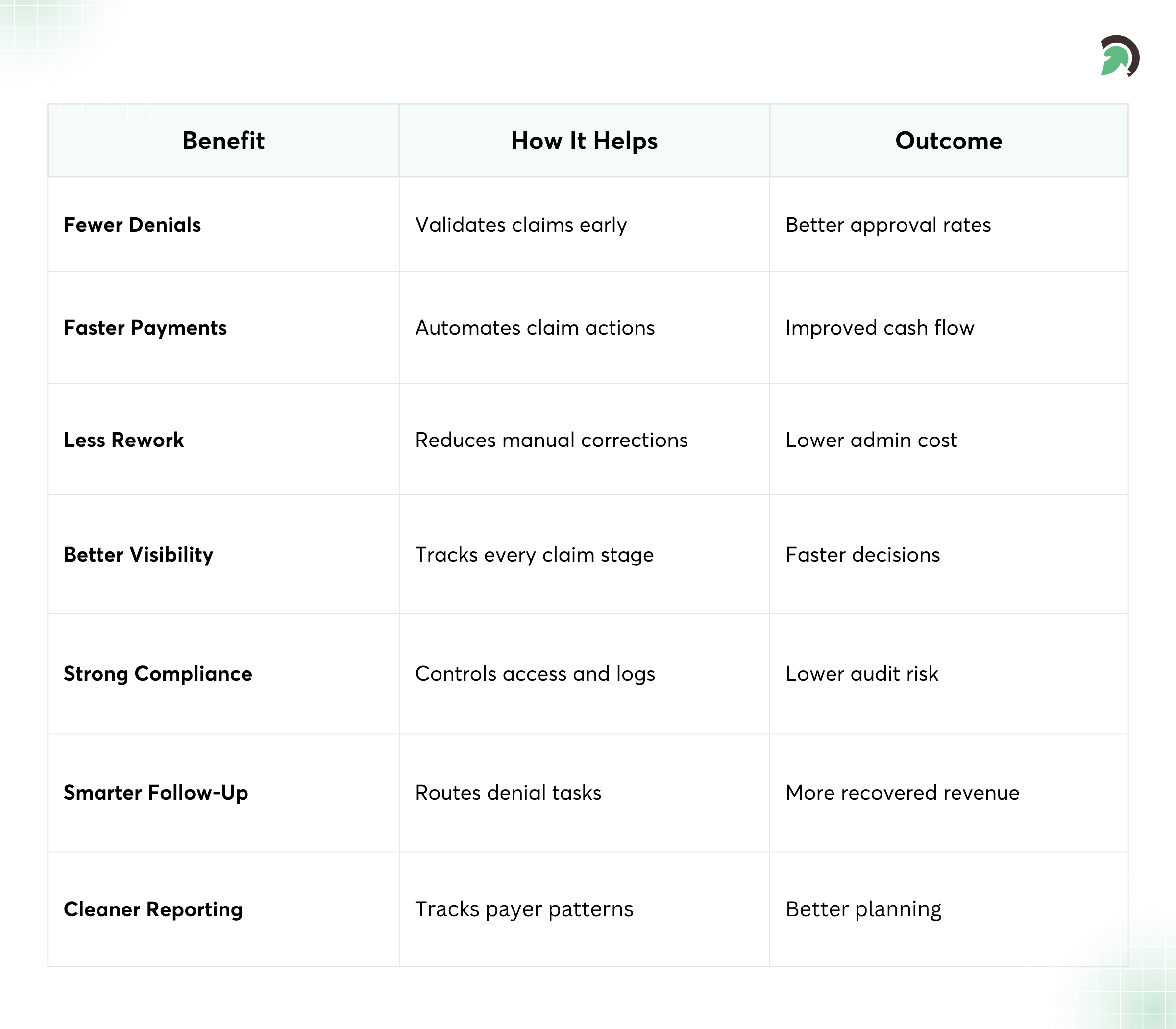
Reduced Claim Denial Rates
Software reduces avoidable denials by improving accuracy before submission and by making denial follow-up systematic. When billing teams aren’t guessing, first-pass acceptance tends to rise.
- Fewer missing fields and documentation gaps
- Less coding variance between sessions
- Better alignment between claims and the supporting record
Faster Revenue Realization
Shorter billing cycles improve cash flow stability. Automated triggers and status tracking help teams address issues sooner, so reimbursements don’t stall waiting on someone to notice a payer response.
Lower Administrative Costs
Lower costs often come from less rework. When your billing workflow is integrated and validated, staff time shifts from “fixing claims” to “managing exceptions,” which is the work humans do best.
Most teams see administrative cost improvement through:
- Reduced manual data entry
- Fewer resubmission loops
- Less time spent searching claim statuses
Improved Financial Visibility
Clear insights into revenue streams help leadership make faster decisions about staffing, payer relationships, and documentation standards.
This is where behavioral healthcare software becomes more than operational support; it becomes a financial command center.
Common Development Pitfalls to Avoid
Ignoring Behavioral Health Billing Nuances
One of the biggest mistakes is building generic billing logic and hoping it “fits” behavioral health. Therapy-based billing has its own cadence, documentation expectations, and coding patterns. If you ignore those realities, you’ll recreate the same leakage you meant to stop.
Weak Integration Strategy
If integration is treated as a late-stage feature, you’ll likely end up with siloed data. That creates reconciliation work and raises error risk, especially when clinical notes and billing requirements evolve.
A good development plan prioritizes:
- Clear data ownership (which system is the source of truth)
- Field mapping and transformation rules
- Reliable sync cadence and error handling
Lack of Automation in Denial Handling
Denial workflows require more than “tracking.” They need automation that routes tasks, pulls the right evidence, and standardizes resubmission steps based on reason codes. Without it, denials become a long-term drag on revenue.
Insufficient Compliance Controls
When compliance is an afterthought, risk compounds quickly. You need role-based access, encryption, and traceability for claims and updates.
If you’re selecting medical software development services, ask how they approach healthcare-grade governance, not just how they implement screens.
Security and Compliance Considerations
Patient Data Protection
Claims management touches sensitive patient information, so data protection must be built into the architecture. Strong security reduces risk and supports trust with clinicians, finance teams, and payers.
- Encryption in transit and at rest
- Access controls based on roles and responsibilities
- Secure handling of uploaded documents and attachments
- Operational monitoring for unusual activity
Regulatory Compliance
HIPAA and regional healthcare laws shape how you store, share, and manage information. Your claims management platform should support compliant workflows and data handling practices from day one.
Practical compliance readiness includes:
- Clear audit trail support
- Document retention and deletion policies (where applicable)
- Access governance for billing staff and clinical teams
Audit Trails
Audit trails are the “proof layer” behind claims operations. Every change to a claim should be traceable to who made it, what changed, and why. That traceability reduces disputes and supports internal review.
This becomes especially important during denial appeals and documentation investigations.
Future Trends in Claims Management for Behavioral Healthcare
AI-Based Claim Prediction
AI can help predict the likelihood of approval by learning from historical claim outcomes, payer patterns, and documentation completeness signals. Rather than treating claims as a binary outcome, prediction enables smarter prioritization.
- Flag claims are likely to face a denial risk
- Recommend what evidence is missing
- Improve staffing by routing high-risk items first


Automated Coding Assistance
Automated coding assistance can reduce manual errors by suggesting codes, validating diagnosis linkages, and highlighting likely mismatches. The best implementations treat AI suggestions as “decision support,” not an excuse to skip clinical review.
Real-Time Insurance Integration
Future systems will push even more insurer integration into real-time workflows: instant eligibility checks and faster claim-processing loops. That means fewer coverage surprises and a quicker path to correction when a response arrives.
Data-Driven Revenue Optimization
Analytics will become more prescriptive. Teams won’t just track metrics, they’ll use insights to improve documentation templates, payer strategies, and billing timing rules.
As a result, the billing process becomes a performance feedback loop, not just a transaction pipeline.
Conclusion
Behavioral health claims management is no longer just about submitting claims accurately. It is about building a system that supports compliance, reduces denials, and creates predictable revenue cycles. As payer requirements evolve and care models become more complex, relying on manual processes or fragmented tools will continue to limit efficiency and financial stability. A well-designed claims management platform brings structure, automation, and visibility into every stage of the billing lifecycle, helping providers focus more on care delivery and less on administrative friction.
Looking ahead, organizations that invest in purpose-built solutions will be better positioned to adapt, scale, and optimize their financial performance. From real-time validation to smarter denial management, the right technology creates a measurable impact across operations. If you are exploring ways to strengthen your claims workflows, consider how tailored solutions from EvinceDev can align with your long-term goals and support sustainable growth in behavioral healthcare.