

The financial services industry is undergoing a fundamental transformation driven by rapid technological advancement, growing data volumes, and changing customer expectations. Traditional systems built on manual processes, siloed data, and delayed insights are no longer equipped to handle today’s dynamic financial environment. This is where AI in financial services is creating a meaningful shift.
Financial institutions today are expected to make faster decisions, manage risks more effectively, and deliver highly personalized experiences. Achieving all of this at scale is nearly impossible without intelligent systems. The rise of artificial intelligence in financial services is enabling organizations to move from reactive operations to proactive, predictive, and automated decision-making models.
From real-time fraud detection to intelligent investment strategies, AI in financial services is becoming deeply embedded in how financial ecosystems function. As competition intensifies and digital transformation accelerates, adopting AI is no longer just about innovation. It is about long-term survival and sustainable growth.
Quick Stat:
According to Gartner, around 59% of finance leaders are already using AI in their finance functions, highlighting how rapidly AI in financial services is becoming mainstream.
Why AI Adoption Is Accelerating in Financial Services
The rapid growth of AI in financial services is not accidental. It is the result of several strong industry drivers that are pushing organizations toward intelligent systems.
Explosion of Financial Data
Financial institutions deal with enormous volumes of structured and unstructured data, including transactions, customer behavior, market data, and regulatory reports. Extracting actionable insights from this data manually is inefficient and error-prone. AI for finance enables institutions to process and analyze this data at scale, uncovering patterns that would otherwise go unnoticed.
Need for Real-Time Decision Making
Modern financial environments demand instant responses. Whether it is approving a loan, detecting fraud, or adjusting investment strategies, delays can lead to missed opportunities or financial losses. AI enables real-time analytics and decision-making, making operations more agile.
Rising Fraud and Security Threats
As digital transactions increase, so do security risks. Traditional rule-based systems are no longer sufficient to detect sophisticated fraud patterns. AI systems continuously learn from data, making them more effective at identifying anomalies and preventing fraud.
Demand for Personalization
Customers now expect tailored financial experiences similar to what they receive from digital platforms. AI for fintech services allows institutions to personalize offerings, recommendations, and communication based on individual behavior and preferences.
Regulatory Pressure
Financial services operate in a highly regulated environment. AI helps automate compliance processes, reduce human error, and ensure accurate reporting, making regulatory management more efficient.
These combined factors are accelerating the adoption of AI in financial services across the industry.
Core Areas Where AI Is Transforming Financial Services
The influence of AI in financial services spans across multiple sectors, each benefiting from improved efficiency, accuracy, and scalability.
1. Banking
Banks are leveraging AI to modernize core operations and improve customer experience. AI-driven systems can monitor transactions in real time to detect fraud, assess creditworthiness using alternative data sources, and automate loan approvals. This reduces processing time and enhances decision accuracy.
2. Insurance
In insurance, artificial intelligence in financial services is streamlining traditionally slow and manual processes. Claims processing, which once took days or weeks, can now be completed in minutes. AI also improves underwriting by analyzing risk more accurately, helping insurers offer better pricing and coverage.
3. Payments and Transactions
The payments ecosystem relies on speed, security, and reliability. Ai for finance enhances transaction monitoring, prevents fraud in real time, and optimizes payment routing. These capabilities are critical for supporting the growing demand for digital and cross-border payments.
4. Wealth Management
Wealth management is becoming more data-driven with AI-powered tools such as robo-advisors and portfolio optimization platforms. AI for fintech services enables financial advisors to deliver personalized investment strategies while managing large volumes of client data efficiently.
5. Financial Planning (Brief Overview)
Financial planning is another area where AI in financial services is making an impact by improving forecasting accuracy and enabling more dynamic financial strategies. However, it represents just one component of the broader transformation happening across the financial ecosystem.
Key Use Cases of AI Across Financial Services
Beyond specific sectors, AI in financial services is delivering value through a wide range of practical applications that enhance operational efficiency and customer experience.
Fraud Detection and Prevention
AI systems analyze transaction data in real time to identify unusual patterns and flag potential fraud. Unlike traditional systems, AI adapts continuously, making it highly effective against evolving threats.
Credit Risk Assessment
Traditional credit scoring models often rely on limited data. Ai for finance incorporates alternative data sources such as transaction history and behavioral patterns, resulting in more accurate and inclusive risk assessments.
Algorithmic Trading
AI-driven trading systems analyze vast amounts of market data to identify trends and execute trades at optimal times. This improves speed, accuracy, and profitability.
Customer Support and Chatbots
AI-powered chatbots and virtual assistants handle routine customer queries, providing instant responses and reducing operational workload for support teams.
Document Processing and Automation
AI simplifies processes such as KYC verification, onboarding, and document analysis by automating data extraction and validation.
Regulatory Compliance (RegTech)
Compliance processes are complex and time-consuming. AI for fintech services automates monitoring, reporting, and risk assessment, ensuring adherence to regulatory requirements.
Technologies Powering AI in Financial Services
The effectiveness of AI in financial services depends on a combination of advanced technologies working together to deliver intelligent outcomes.
Machine Learning
Machine learning algorithms analyze historical and real-time data to identify patterns, make predictions, and improve decision-making over time.
Natural Language Processing (NLP)
NLP enables AI systems to understand and process human language, making it useful for analyzing documents, customer interactions, and market sentiment.
Computer Vision
Computer vision is used for tasks such as identity verification and document authentication, enhancing security and reducing fraud.
Robotic Process Automation (RPA)
RPA automates repetitive and rule-based tasks, freeing up human resources for more strategic activities.
Big Data and Cloud Computing
These technologies provide the infrastructure needed to store, process, and analyze large volumes of data, enabling AI systems to operate at scale.
Together, these technologies form the backbone of AI in financial services, enabling smarter and faster operations.
Benefits of AI in Financial Services

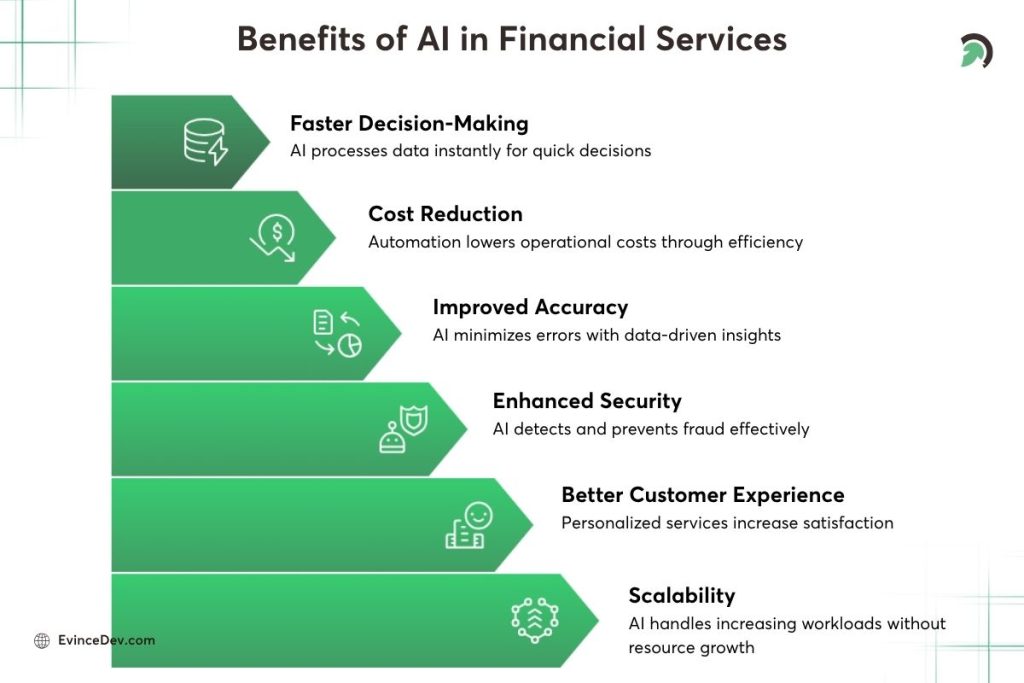
The adoption of AI in financial services provides significant advantages that improve both operational efficiency and customer outcomes.
Faster Decision-Making
AI processes large datasets instantly, enabling quicker and more informed decisions across financial operations.
Cost Reduction
Automation reduces reliance on manual processes, lowering operational costs and improving efficiency.
Improved Accuracy
AI minimizes human errors by relying on data-driven insights and predictive models.
Enhanced Security
AI systems detect and prevent fraudulent activities more effectively than traditional methods.
Better Customer Experience
Personalized services and faster response times lead to higher customer satisfaction and engagement.
Scalability
AI systems can handle increasing workloads without requiring proportional increases in resources.
These benefits highlight why AI in financial services is becoming a core component of modern financial strategies.
Quick Stat:
AI is expected to generate massive economic value, with estimates suggesting that banks could save between $200 and $340 billion annually through AI-driven efficiencies, as per the report.
Challenges and Risks of AI in Financial Services
While the advantages are significant, implementing AI in financial services comes with its own set of challenges.
Data Privacy and Security
Financial data is highly sensitive, and protecting it requires strong security frameworks and compliance with regulations.
Regulatory Complexity
Different regions have varying regulatory requirements, making compliance a complex task for global financial institutions.
Bias in AI Models
AI systems can produce biased outcomes if trained on incomplete or skewed datasets, particularly in areas like lending.
Integration with Legacy Systems
Many financial institutions rely on outdated infrastructure, making it difficult to integrate modern AI solutions.
Lack of Transparency
Some AI models operate as black boxes, making it challenging to understand how decisions are made.
Addressing these challenges is essential to fully realize the potential of artificial intelligence in financial services.
Strategic Adoption of AI in Financial Institutions
Successfully implementing AI in financial services requires a strategic and well-planned approach rather than isolated experimentation.
-
Start with High-Impact Use Cases
Organizations should begin with areas that offer immediate value, such as fraud detection or process automation.
-
Build a Strong Data Foundation
High-quality, well-structured data is essential for effective AI implementation.
-
Ensure Compliance from the Start
Regulatory considerations should be integrated into AI strategies from the beginning.
-
Combine AI with Human Expertise
AI should enhance human decision-making, not replace it entirely.
-
Partner with Experts
Many organizations collaborate with providers offering fintech software development services to build custom AI solutions. Understanding broader trends in AI in fintech also helps organizations align their strategies with industry advancements.
Future of AI in Financial Services
The future of AI in financial services is centered on deeper integration, greater autonomy, and more advanced capabilities.
Autonomous Financial Systems
AI will increasingly manage financial operations with minimal human intervention, improving efficiency and accuracy.
Hyper-Personalization
Financial services will become more tailored, offering highly customized experiences to individual users.
AI-Powered Compliance
Regulatory processes will become more automated, reducing complexity and improving accuracy.
Integrated Financial Ecosystems
AI will connect different financial systems into a unified, intelligent platform.
Convergence with Emerging Technologies
AI will work alongside technologies such as blockchain and IoT to create more secure and efficient financial ecosystems.
As these trends evolve, AI in financial services will continue to redefine how the industry operates.
Quick Stat:
The global AI in finance market is projected to grow from around $38 billion today to over $190 billion by 2030, reflecting strong long-term investment in AI technologies.
The rise of AI in financial services represents a major shift in how the financial industry operates, competes, and serves customers. By enabling faster decision-making, stronger security, smarter automation, and personalized experiences, AI is helping financial institutions build more efficient and future-ready systems.
While challenges such as data privacy, regulatory compliance, and system integration remain, the long-term value of AI adoption is clear. Organizations that invest in AI for finance and intelligent technologies will be better positioned to adapt, innovate, and scale in a changing market.
As AI for fintech services continues to evolve, businesses need the right technology partner to turn AI opportunities into practical solutions. At EvinceDev, we help financial organizations build scalable fintech platforms, AI-powered solutions, and custom digital products that improve efficiency, customer experience, and long-term business growth.