


Key Takeaways:
- AI Pricing Is a Strategic Advantage: Retail pricing now drives growth, margins, and customer trust, making it a core competitive function, not just rate-setting.
- Data Quality Drives Pricing Success: Even the best AI models rely on clean, timely, well-structured data across sales, inventory, costs, and competitor activity.
- Dynamic Pricing Needs Guardrails: Dynamic pricing works best when guided by clear rules around margins, price floors, and frequency of changes.
- Competitive Awareness Should Be Selective: Retailers should monitor competitor pricing continuously, but respond only when it aligns with their broader pricing strategy.
- Human Oversight Still Matters: AI improves pricing speed and accuracy, but human judgment remains essential to protect brand value, fairness, and long term goals.
Retail pricing has never been simple, but it has become dramatically more complex in the last decade. What was once a seasonal or quarterly decision has evolved into a constantly moving target shaped by consumer behavior, supply chain volatility, digital marketplaces, and aggressive competition. In this environment, AI pricing optimization is no longer just a financial lever. It is a strategic capability that can decide whether a retailer wins or loses.
As shoppers compare prices instantly and competitors adjust offers in minutes, retailers face a critical question: how do you stay competitive without sacrificing margins, brand perception, or long-term customer trust?
This is where AI pricing optimization enters the picture, not as a buzzword, but as a practical approach to turning pricing into a living, adaptive system rather than a static rulebook.
Market Insight:
According to McKinsey, generative AI could unlock $240 billion to $390 billion in value for retailers, with the potential to lift industry margins by 1.2 to 1.9 percentage points, underscoring why AI-led pricing is becoming a strategic priority.
Why Pricing Has Become One Of Retail’s Hardest Problems
Retailers today operate in an environment defined by speed and transparency. Customers expect competitive prices, consistent experiences across channels, and timely promotions that feel relevant rather than desperate.
A few forces have made pricing especially challenging: competition moves faster than teams can react, assortments are too large for manual control, margins are fragile, and omnichannel expectations create pressure for consistency even when channel economics differ. When all of this happens at once, traditional pricing workflows break.
The Limits Of Traditional Pricing Approaches
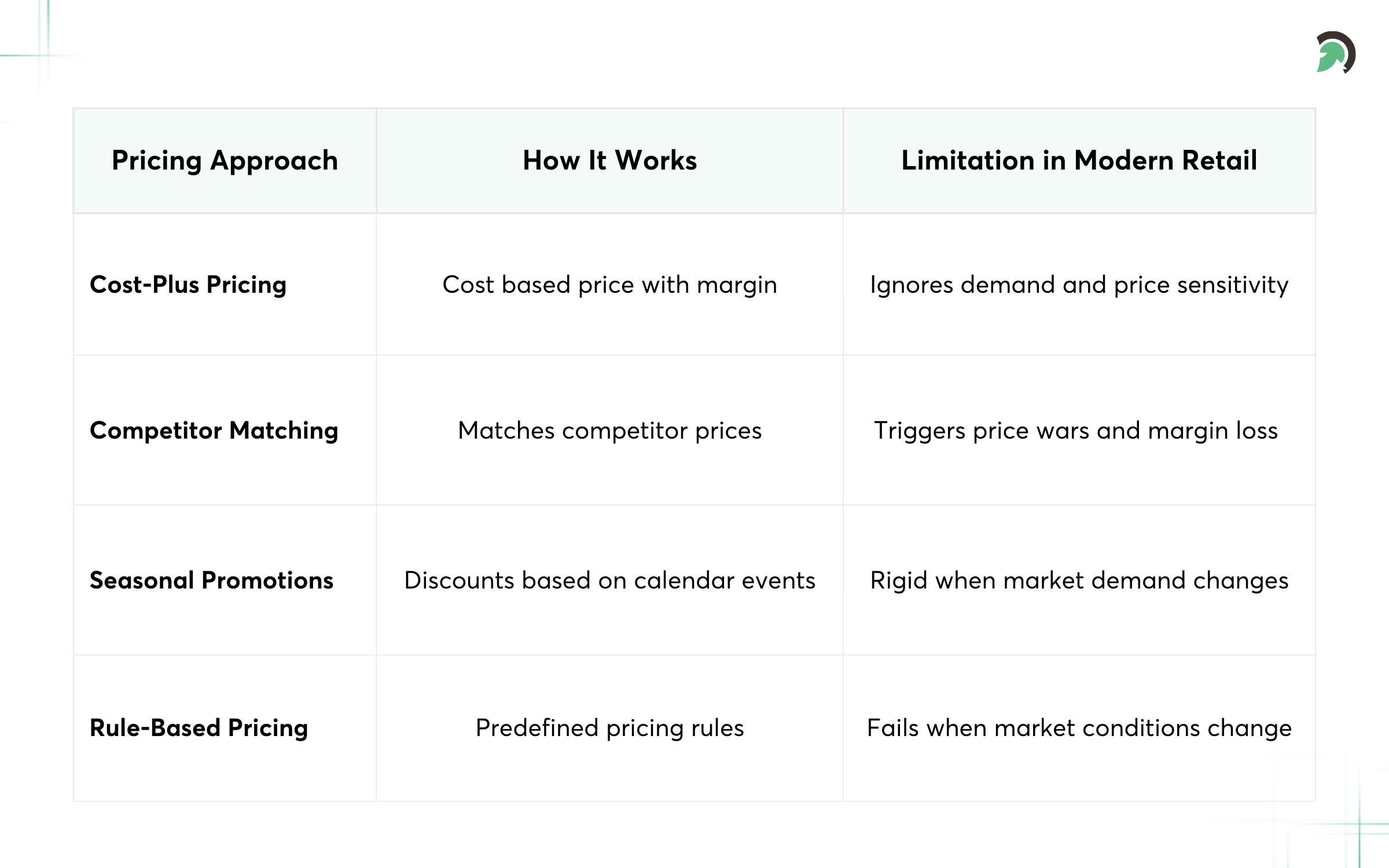
Most retailers still rely on cost-plus methods, competitor matching, and seasonal promotions. These are familiar, but they often underperform at today’s speed.
Cost-plus ignores how demand changes at different price points, and competitor matching can trap retailers in reactive cycles. Markdown calendars can also become rigid, especially when demand shifts unexpectedly or when inventory inventory constraints change. Rule-based pricing helps, but rules tend to become brittle when conditions change quickly.
The result is pricing that is often too slow, too broad, or too risky.
What AI-Driven Pricing Really Means In Retail
AI-driven pricing is not simply about automating price changes. It is about transforming pricing from a reactive, rule-based function into an adaptive, intelligence-led capability. At its core, it uses predictive analytics, statistical modeling, and optimization techniques to recommend or execute price decisions based on multiple variables simultaneously.
Traditional systems tend to rely on static logic such as cost-plus formulas, competitor matching rules, or fixed markdown schedules. AI-driven systems move beyond this by analyzing patterns across historical data, identifying correlations, and continuously learning from outcomes.
In practical retail environments, AI typically operates as a decision support layer rather than an uncontrolled automation engine. It evaluates inputs such as demand forecasts, price elasticity, competitive positioning, inventory health, and margin targets, then generates recommendations that align with defined business constraints. Pricing teams can review, adjust, and approve these recommendations, ensuring that strategic intent remains intact.
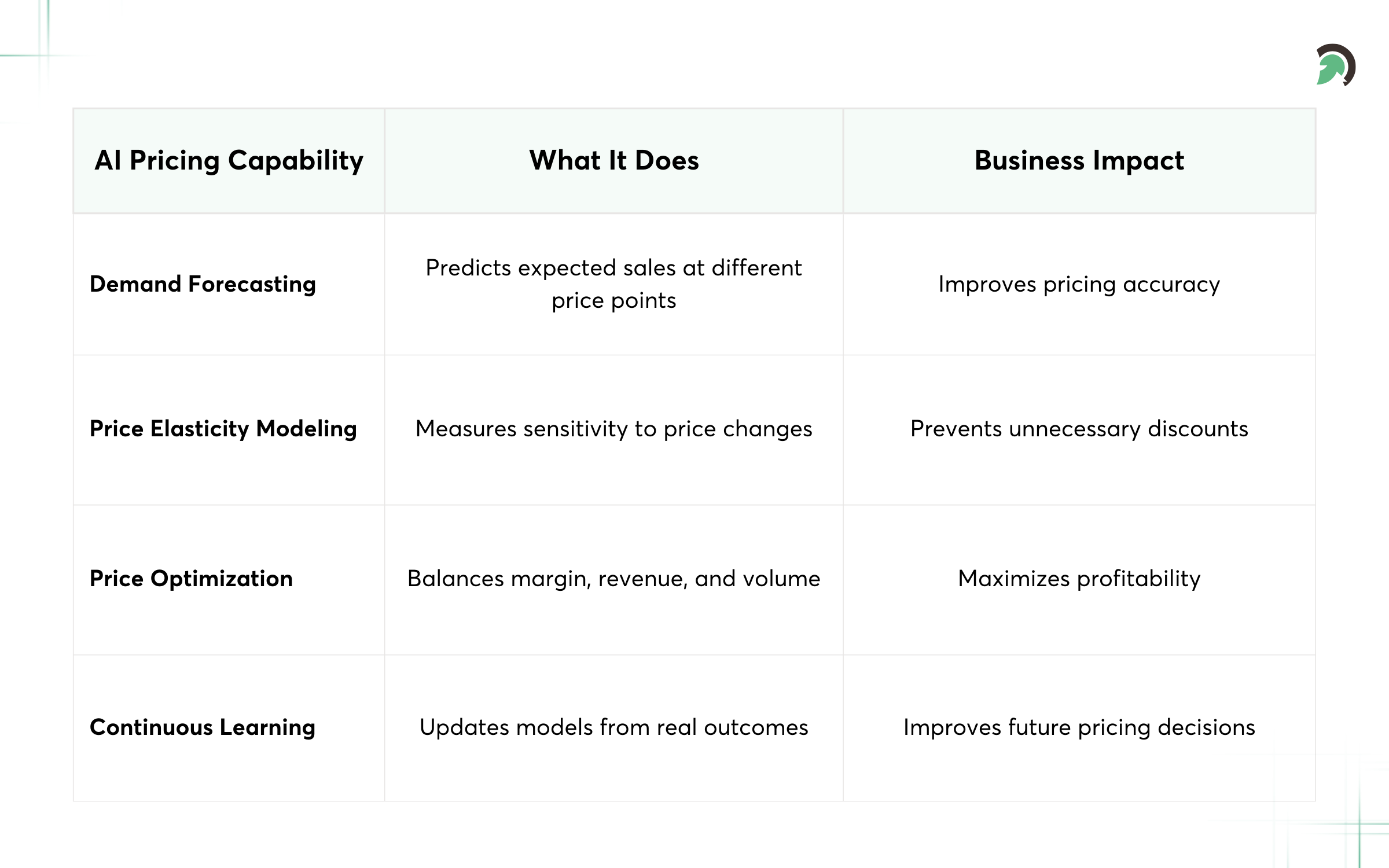
A mature AI pricing framework generally performs four core functions:
- Forecasting demand: Predicting expected sales at different price points
- Estimating elasticity: Understanding how sensitive customers are to price changes
- Optimizing outcomes: Balancing revenue, margin, and volume objectives
- Learning from feedback: Updating models based on real-world results
One of the most significant advantages of AI-driven pricing is its ability to optimize across competing objectives simultaneously. Retailers rarely pursue a single goal. They may want to increase revenue while protecting margin, accelerate sell-through while avoiding stockouts, or maintain premium brand perception while responding to competitive pressure. AI systems can evaluate these trade-offs mathematically, something manual processes struggle to achieve consistently.
Another important dimension is adaptability. Markets shift quickly due to seasonality, promotions, competitor actions, or unexpected external events. AI models are designed to recalibrate as new data becomes available. If a price increase reduces demand more than expected, the system incorporates that outcome into future recommendations. If a competitor sustains a long-term price drop, the model adjusts its understanding of market positioning.
It is also important to clarify what AI-driven pricing is not. AI-driven pricing should not create undisciplined price fluctuations or rely on blind automation. It should support strategic decision-making with control, context, and business guardrails. And it is not a replacement for strategic thinking. Instead, it is an analytical layer that enhances human decision-making by surfacing insights at a scale and speed that manual teams cannot replicate.
When implemented thoughtfully, AI allows retailers to consider demand signals, competitive dynamics, inventory realities, and business objectives in one cohesive decision framework rather than addressing each factor in isolation.
Building The Data Foundation For Smarter Pricing
Even the most advanced pricing algorithms cannot compensate for weak data. The effectiveness of any pricing system depends on the completeness, consistency, and timeliness of the information feeding it. Retailers that succeed with pricing optimization treat data infrastructure as a strategic asset, not a technical afterthought.
A robust pricing data foundation combines internal performance data with external market intelligence. Internal data reveals how products have performed historically and how customers have responded to past pricing decisions. External data provides the competitive and contextual lens necessary for informed positioning.
Core internal inputs typically include:
- Detailed sales history across channels and regions
- Historical price changes and promotion depth
- Inventory levels, replenishment cycles, and sell-through rates
- Product hierarchies, attributes, and lifecycle stages
- Cost of goods, supplier terms, and markdown allowances
- Customer engagement data from loyalty programs
External inputs often include:
- Competitor prices across comparable SKUs
- Competitor promotional activity and timing
- Seasonal demand patterns and local events
- Regional economic indicators that influence purchasing power
However, collecting data is only the first step. Standardization and validation are equally critical. For example, a competitor’s product listing must be accurately matched to the correct SKU in your system. A difference in pack size, color variant, or configuration can distort competitive comparisons if not normalized properly.
Many pricing initiatives struggle not because of flawed algorithms, but because of fragmented data environments.
Common challenges include:
- Inconsistent SKU definitions across systems
- Outdated or inaccurate cost data
- Missing competitor matches
- Delays in inventory updates
- Different departments using conflicting performance metrics
Without alignment, pricing models produce recommendations that may look mathematically sound but fail operationally.
To build trust in pricing recommendations, retailers must invest in:
- Clear product taxonomy and SKU mapping
- Regular data validation checks
- Centralized data governance ownership
- Real-time or near real-time updates where required
- Cross-functional agreement on definitions and KPIs
When the data foundation is strong, pricing optimization becomes reliable and defensible. Teams gain confidence in the insights generated because they understand the inputs behind them. This trust is essential for adoption, especially when pricing decisions influence revenue, profitability, and customer perception directly.
Ultimately, the foundation determines the ceiling of pricing performance. Strong data enables smarter decisions, faster reactions, and more accurate forecasting. Weak data, regardless of how advanced the model, leads to hesitation and underperformance.
Understanding Demand And Price Sensitivity
Price elasticity is not one number. It varies by product, category, customer type, channel, and season. AI helps teams estimate that sensitivity at scale, so price changes become more intentional.
Instead of blanket discounting, teams can identify where pricing truly matters and where it does not. Some products can tolerate small increases without hurting volume, while others require careful tuning because even small changes cause demand to drop. This is also where retailers can learn whether a bundle, a loyalty offer, or a limited promotion would perform better than a direct price cut.
Competitive Awareness Without Reactive Chaos
Retailers need to be aware of the market, but reacting to every competitor move is a quick path to margin erosion. The goal is to understand the competitive landscape and respond only when it is strategically necessary.
This is where retail price intelligence supports smarter decision-making. Instead of occasional checks, teams get continuous visibility into how key competitors position similar items across channels. More advanced setups use AI competitor price tracking to differentiate meaningful shifts from noise, so retailers do not end up chasing temporary changes or low-impact competitors.
Competitive pricing should support your positioning, not override it.
Dynamic Pricing Strategies In Practice
Dynamic pricing retail is most effective when it is intentional and governed. It is not about constant price changes. It is about adjusting prices when clear business conditions justify it.
In retail, dynamic pricing allows teams to respond to real signals instead of relying on fixed calendars. These signals typically relate to inventory, demand shifts, or product lifecycle changes.
Retailers most commonly apply dynamic pricing in three situations:
- Inventory pressure: Reducing overstock, managing aging inventory, or protecting margin when supply is limited
- Seasonal or event-driven demand: Aligning prices with holiday peaks, regional events, or temporary demand surges
- Lifecycle transitions: Adjusting pricing from launch to growth to clearance in a structured way
When used correctly, dynamic pricing reduces the need for steep, last-minute markdowns and improves sell-through. However, without guardrails, it can confuse customers or damage trust.
That is why successful programs define clear limits, such as minimum margin thresholds, price floors, and frequency controls. With the right governance, dynamic pricing becomes a disciplined tool to protect profitability while staying responsive to market conditions.
Personalization And Targeted Offers
Personalization does not always mean changing the base price for everyone. Many retailers get better outcomes by keeping shelf pricing stable while tailoring incentives through loyalty programs, segments, or targeted offers. This allows price-sensitive shoppers to be motivated without giving unnecessary discounts to everyone else.
The most important consideration here is trust. Pricing experiences must remain consistent, explainable, and fair, especially when different customers may receive different offers.
Promotions As A Strategic Lever, Not A Habit
Promotions are often treated as routine, but they should be treated as investments. AI helps retailers shift from running promotions out of habit to running them with clear intent and measurable outcomes.
Instead of focusing only on short-term uplift, teams can evaluate trade-offs like cannibalization, halo effects, and long-term customer impact. This is also where retailers can test whether a bundle or value-added offer could outperform a deeper discount, especially in categories where brand perception matters.
Quick Stat:
In 2025, up to 40% of luxury goods were sold at discounted prices, the highest rate in more than a decade (excluding the COVID period), and industry profit margins fell to their lowest levels since 2009, as per the Financial Times.
Managing Pricing Across Channels
Omnichannel pricing is difficult because customer expectations collide with the economics of different channels. In-store pricing may be influenced by local competition and store-specific inventory. eCommerce pricing is transparent and fast-moving. Marketplaces add fees and rules that reshape margin calculations.
Marketplaces add fees and rules that reshape margin calculations.
Successful retailers define clear policies around where parity is required and where flexibility is acceptable. This prevents internal channel conflict and reduces customer confusion.
Guardrails, Governance, And Human Oversight
AI improves pricing decisions, but it should never operate without constraints. Guardrails protect profitability, brand perception, and customer trust, while governance clarifies who owns decisions and how exceptions are handled.
Typical guardrails include:
- Minimum margin thresholds and price floors
- Limits on how frequently prices can change
- Approval workflows for high-risk categories or key value items
- Exception rules for stockouts, launch periods, or vendor-funded promos
Human oversight remains essential for strategy, unusual market events, and brand stewardship. AI should make teams faster and more consistent, not remove accountability.
Technology Architecture And Integration
Pricing optimization does not operate in isolation. Even the most advanced models will fail to deliver value if they are not tightly integrated with the systems that power daily retail operations. Execution speed, data accuracy, and system alignment determine whether pricing strategies remain theoretical or actually drive results. This is where AI development becomes critical, helping retailers integrate pricing engines with ERP, POS, ecommerce platforms, and inventory systems.
At a minimum, pricing engines must connect seamlessly with:
- ERP systems for cost data, supplier terms, and product structure
- POS systems for in-store price execution and transaction capture
- eCommerce platforms for digital price updates and testing
- Inventory management systems for stock levels and replenishment signals
For many retailers, ecommerce development services also play an important role in connecting pricing engines with storefronts, promotions, catalogs, and customer experience systems. These integrations ensure that pricing recommendations are based on accurate inputs and can be executed without friction.
Retailers typically choose between two execution models. Some operate on scheduled batch updates, refreshing prices daily or hourly depending on operational complexity. Others adopt real-time price optimization, especially in eCommerce environments where competitor moves and demand fluctuations happen rapidly. Real-time capabilities are particularly valuable in digital channels, where price updates can be implemented instantly without physical relabeling or store-level constraints.
However, integration quality often matters more than model sophistication. If cost data is outdated, inventory levels are inaccurate, or product mappings between systems are inconsistent, pricing outputs will be flawed regardless of how advanced the algorithm is. A well-integrated, reliable architecture frequently outperforms a complex model running on fragmented data.
Strong technology architecture also supports governance. It enables approval workflows, exception handling, audit trails, and performance tracking. This ensures that pricing decisions are not only optimized, but also transparent and controllable.
Ultimately, technology architecture is the bridge between insight and impact. Without clean integration and reliable execution, even the smartest pricing strategy cannot deliver measurable business value.
Measuring Success Beyond Revenue
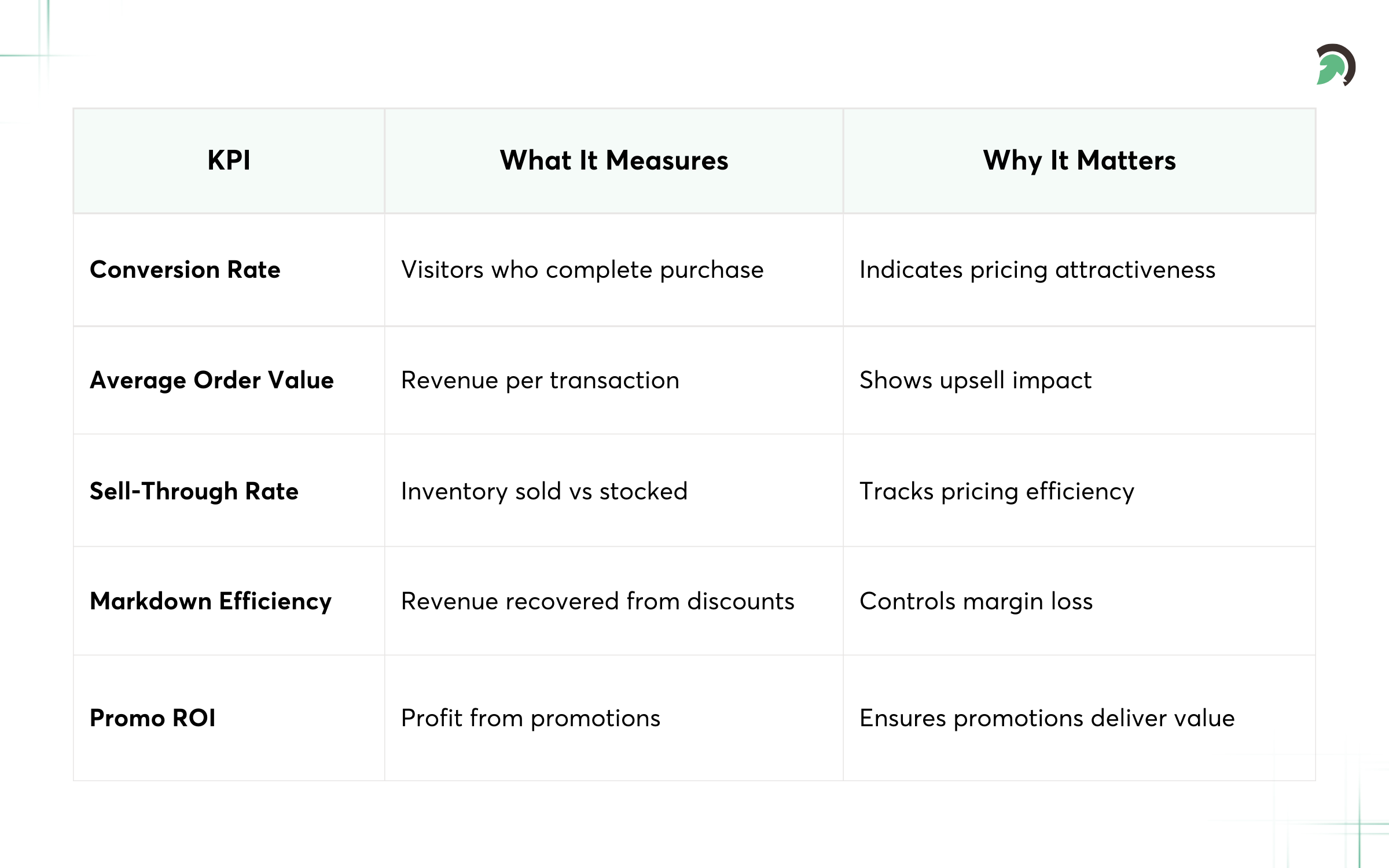
Pricing success is not just revenue lift. It also includes margin protection, inventory health, and customer outcomes. Strong programs use controlled experiments to validate changes safely and prove impact, rather than relying on assumptions.
Common measures include conversion rate, average order value, sell-through, stock turn, markdown efficiency, promo ROI, and repeat purchase behavior. The best teams also track customer trust signals, such as complaints, returns, and churn, when pricing changes become more dynamic.
Quick Stat:
Bain notes that companies confident in their ability to push through price increases in 2025 see a 3 percentage-point profit margin premium compared with less confident peers.
Use Cases Across Retail Categories
Category dynamics shape pricing strategy. Electronics pricing faces intense competition and fast depreciation. Fashion pricing balances trends, markdown risk, and brand image. Home and living often benefit from bundles and seasonal planning.
AI works best when it adapts to category behavior rather than enforcing one pricing rule everywhere.
Common Pitfalls To Avoid
Retailers often struggle with AI pricing for a small set of predictable reasons:
- Poor data quality: Inaccurate cost data, delayed inventory updates, or mismatched SKUs lead to recommendations that fail in real-world execution.
- Overreacting to competition: Chasing every competitor price change can trigger unnecessary price wars and margin erosion.
- Over-automation without guardrails: Lack of price floors, margin thresholds, frequency limits, or exception rules increases financial and brand risk.
- Weak change management: Treating pricing transformation as only a technology upgrade, rather than an operating model shift, slows adoption.

Retailers that achieve sustainable results typically focus on the following:
- Training and enablement: Helping pricing and category teams understand and trust AI recommendations.
- Strong governance: Clear ownership, approval workflows, and escalation paths.
- Controlled experimentation: Using tests and pilots to prove impact before scaling.
Teams that expect instant results from automation often lose internal confidence, while those that invest in people, process, and governance build long-term pricing maturity.
The Future Of Retail Pricing
The next phase of retail pricing will focus on explainability, scenario modeling, and tighter links between pricing, merchandising, and supply chain decisions. Better transparency will also matter as regulations evolve and customers become more sensitive to fairness.
Advanced machine learning pricing models will increasingly balance growth and profitability goals while adapting faster to market shifts. Retailers that build strong foundations now will be able to adopt these advances more confidently.
Final Thoughts
Pricing has moved from a back-office task to a competitive weapon. The retailers that win are not the ones that discount the most, but the ones that price with clarity, speed, and discipline.
AI pricing optimization is not about chasing the lowest price. It is about understanding value, anticipating demand, and executing smarter decisions at scale.
If you want to take this further, teams like EvinceDev can help translate these principles into a practical roadmap, from data readiness and integration to governed retail price optimization that fits your category strategy and brand positioning.