

Key Takeaways:
- Buyer Journey Shift: Shoppers describe needs in natural language, voice, or visual search. Brands win by structuring product content so AI can interpret and recommend it.
- Commerce Journey: AI tailors product pages, offers, and content using behavior signals, making relevance and conversion a baseline expectation.
- Shopping Journey: Buyers compare products, prices, and reviews instantly using AI tools, looping between options until confidence is high.
- Frictionless Buy: AI agents can shortlist, decide, and even purchase routine items, shifting influence away from traditional search and store navigation.
- Smarter Checkout: AI predicts drop-off moments and reduces friction with better payment options, clearer delivery timelines, and instant answers.
- New Buying Flow: Address validation and delivery predictions improve by factoring real-world constraints, reducing dissatisfaction after purchase.
- Modern Commerce: Low-risk buyers get a smooth experience while higher-risk orders trigger extra verification, protecting revenue without hurting conversions.
- Conversion Path: AI improves inventory, demand forecasting, and logistics, leading to better fulfillment and stronger customer satisfaction.
Artificial intelligence is no longer a supporting tool in eCommerce. AI in eCommerce is steadily becoming the connective layer that links discovery, decision making, fulfillment, and retention into a single, intelligent experience. Shoppers may not always notice where AI is at work, but they increasingly feel its impact through smoother journeys, faster decisions, and more relevant interactions.
What makes the current phase of AI adoption different is not speed alone. It is the shift in role. AI eCommerce is moving from isolated automation to contextual guidance. It helps buyers decide, not just browse. At the same time, it forces brands to rethink how they deliver trust, transparency, and value at scale.
Much of this shift is being driven by generative AI eCommerce capabilities that can interpret intent, generate contextual responses, and adapt experiences in real time.
This blog explores how AI is redefining each stage of the eCommerce buyer journey today, and what this transformation means for brands building for the next phase of digital commerce.
Quick Stat:
Adobe reports AI-driven traffic to U.S. retail sites rose 4,700%, based on analysis of traffic from generative AI-powered chat services and browsers.
What Is Changing and Why It Matters?
AI as a Shopping Layer Across the Journey
In practice, Gen AI ecommerce enables systems to carry context across search, product pages, checkout, and support, rather than treating each step as a separate workflow.
Historically, AI in eCommerce existed in silos. Search algorithms focused on relevance. Recommendation engines optimized click-through rates. Support bots reduced ticket volumes. Each system improved a narrow metric but rarely spoke to the others.
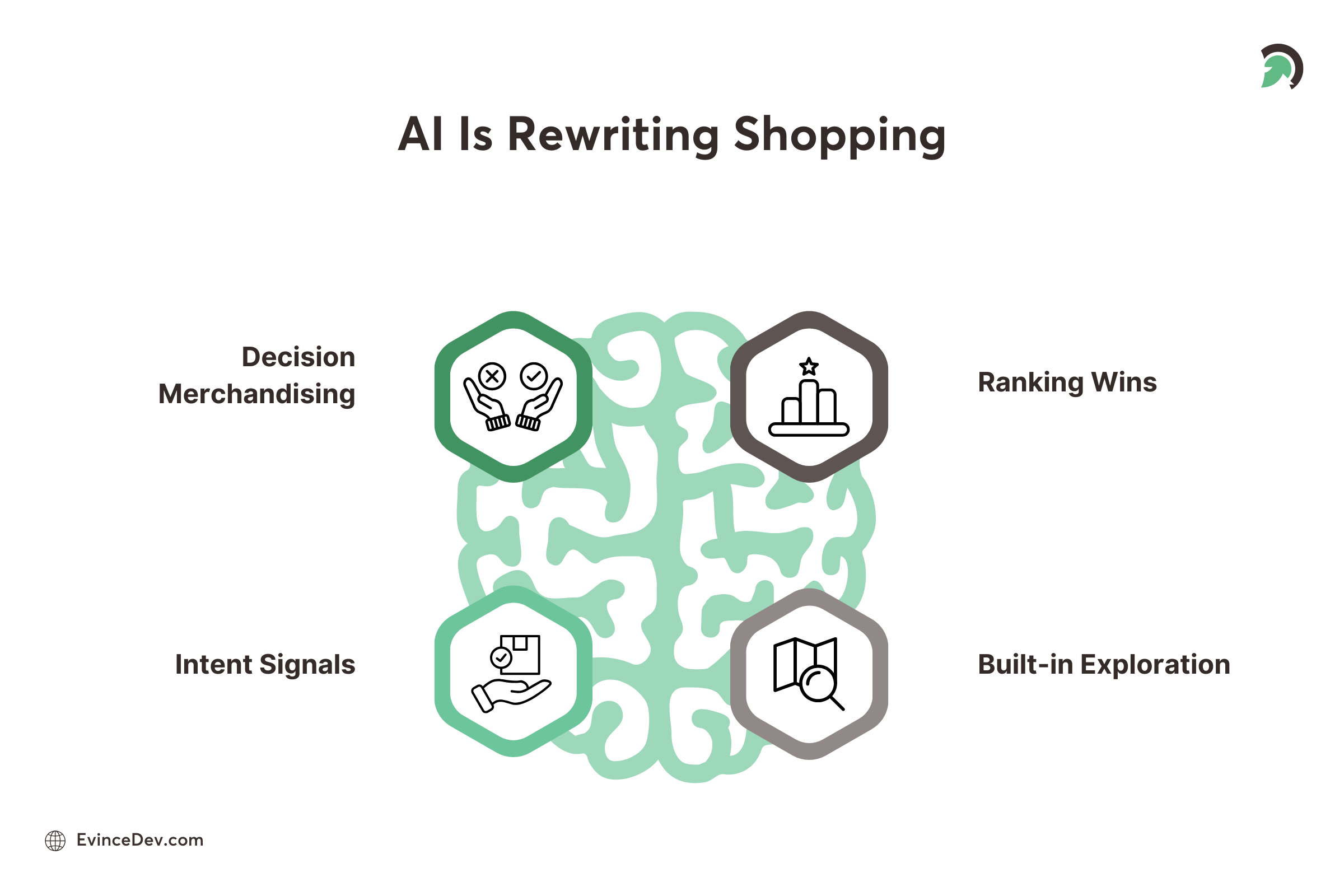
Today, AI increasingly acts as a unifying shopping layer, shaping how modern eCommerce development connects data, intent, and experience across the journey. This shift is at the core of how AI eCommerce experiences are being designed across the buyer journey. It connects intent, behavior, product data, operations, and service into a continuous experience. The shopper is no longer passed back and forth between systems. Instead, context travels with them.
This matters because buying is not a sequence of pages. It is a sequence of questions, hesitations, and decisions. AI works best when it is designed around these moments rather than around channel-specific optimizations.
How This Differs From Earlier AI Adoption
Earlier waves of AI focused on efficiency. Faster responses, lower costs, and higher throughput. While valuable, these gains were largely invisible to customers.
The current shift is toward prediction and context awareness. AI interprets signals across sessions, channels, and time. It anticipates friction, surfaces guidance proactively, and adapts experiences based on intent rather than assumptions.
Another important change is cultural. As many industry leaders point out, AI success now depends as much on organizational mindset as on technology. Teams must learn to trust AI insights while maintaining human judgment, especially in areas that affect customer trust.
Discovery Becomes Conversational and Intent-Based
From Keyword Search to Describing Needs
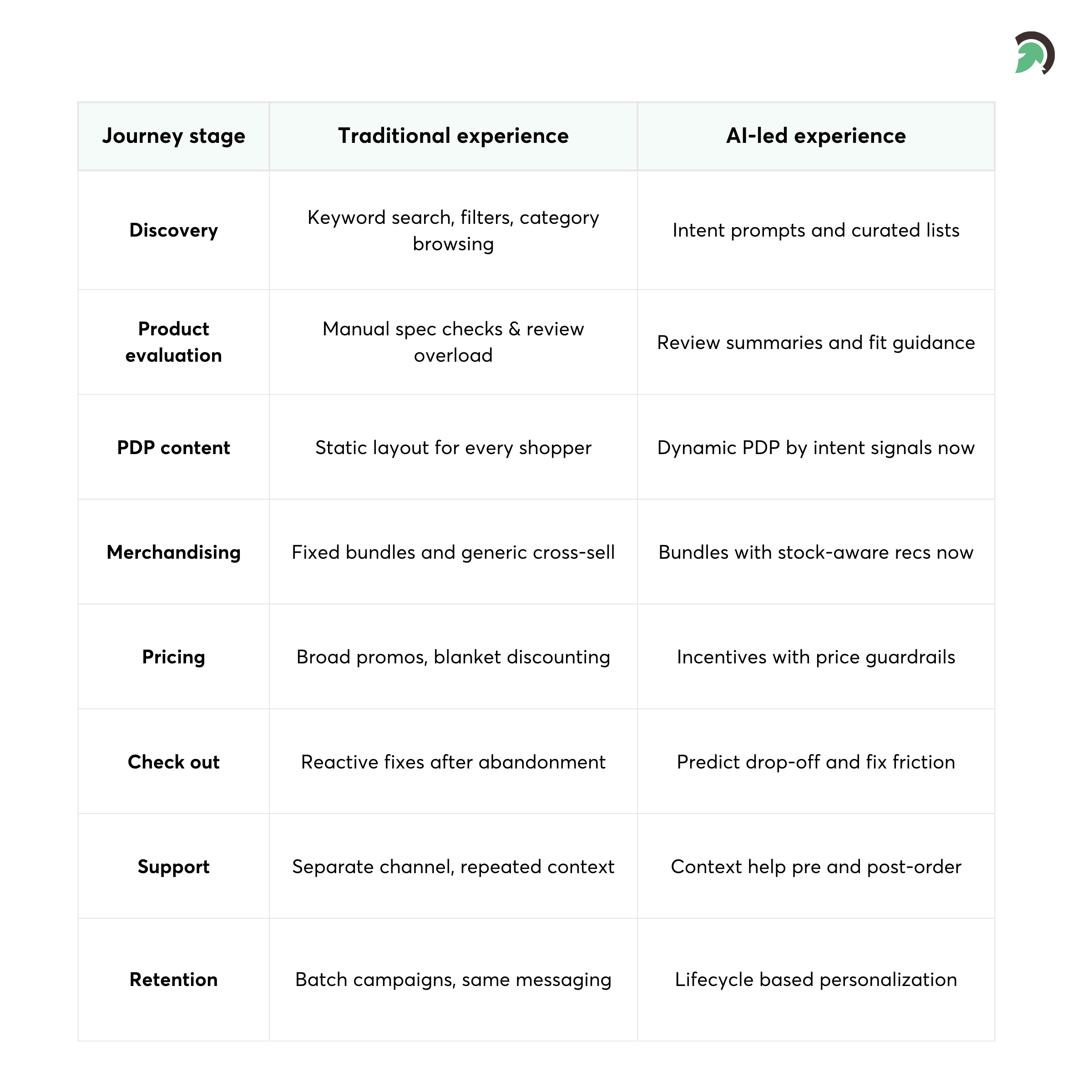
Traditional discovery requires shoppers to translate intent into keywords. This often leads to frustration, irrelevant results, and excessive filtering.
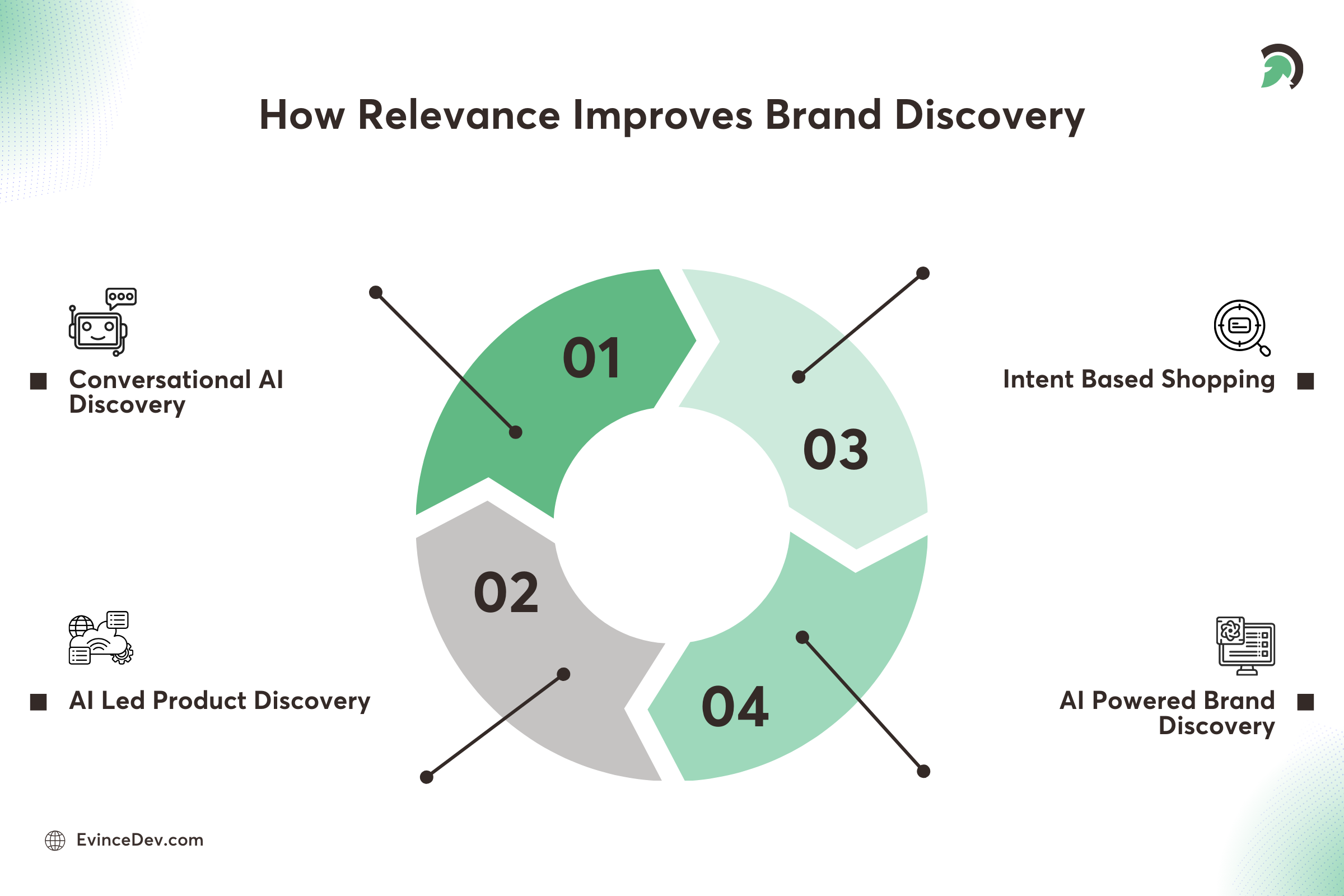
In AI eCommerce, discovery shifts toward conversation. This is also driving AI mode shopping experiences where customers explore options through guided dialogue instead of relying on filters and category pages. Shoppers describe their needs in natural language, including constraints, preferences, and use cases. Instead of searching for products, they explain situations.
The system interprets this intent and responds with relevant options, often presented as a curated shortlist rather than an overwhelming catalog. That shift is a defining pattern of generative AI ecommerce 2026, where the experience is shaped around intent, context, and decision support.
AI Curated Shortlists and Brand Discovery
Curated discovery changes how brands are found. Visibility is no longer driven only by paid placement or brand recognition. Products surface because they fit the need. Over time, generative AI product discovery will reward brands that clearly communicate use cases, constraints, and differentiation in structured product data.
This creates opportunities for brands with strong product clarity and positioning, even if they are not widely known. Shoppers increasingly encounter new brands because AI identifies relevance more effectively than manual browsing.
The emotional experience of discovery also changes. Instead of feeling overwhelmed, shoppers feel guided. This mirrors how people seek advice in real life, by describing needs rather than requesting specific products.
Being Recommended by AI Assistants
Search optimization evolves into recommendation readiness. To be consistently surfaced, brands must ensure product data is structured, accurate, and meaningful.
AI needs to understand what a product is for, who it is best suited for, and how it differs from alternatives. Brands that help AI explain their value clearly gain disproportionate visibility in conversational discovery.
Quick Stat:
Adobe found that from Nov 1 to Dec 31, 2024, traffic to U.S. retail sites from generative AI sources rose 1,300% YoY, with Cyber Monday up 1,950% YoY.
Product Pages Become Dynamic and Personalized
-
Personalized Product Detail Experiences
Static product pages assume every visitor needs the same information in the same order. AI challenges this assumption, and ecommerce development services are now expected to build PDP experiences that adapt to intent in real time.
Product pages increasingly adapt based on intent, behavior, and confidence level. Some shoppers see benefits highlighted first. Others see reviews, comparisons, or technical details. FAQs and visuals reorder dynamically. The objective is not to show everything, but to show what matters most at the moment of decision.
-
AI-Driven Size, Fit, and Compatibility Guidance
In categories like fashion, electronics, furniture, and beauty, uncertainty is one of the biggest conversion blockers.
AI reduces this uncertainty through personalized guidance. Size recommendations consider past purchases and return behavior. Compatibility checks ensure accessories or add-ons work with existing products. Usage guidance clarifies expectations before purchase. This builds confidence and reduces returns without forcing shoppers to guess.
-
Content Generation Versus Content Accuracy
AI makes it easier to generate content at scale, but accuracy becomes critical. Shoppers rely on AI-powered summaries and explanations. Any inconsistency or exaggeration damages trust quickly.
The strongest brands use AI to personalize content while enforcing strict validation and governance. Relevance and credibility must grow together.
Building dynamic PDPs, guided discovery, and smarter checkout requires strong foundations in ecommerce development. If you are planning AI ready upgrades, explore our ecommerce development services to align experience, performance, and data
Evaluation Is Accelerated by AI Comparisons
-
AI Summaries of Reviews
Instead of reading dozens of reviews, shoppers receive clear summaries of common praise, frequent complaints, and important caveats.
These summaries are contextual. A concern that matters to one shopper may be irrelevant to another. AI highlights what is most likely to influence the individual’s decision.
This saves time and reduces decision fatigue. -
Side-by-Side Comparisons and Best Fit Guidance
AI comparisons translate specifications into outcomes. Rather than listing numbers, they explain how differences affect real-world use.
Shoppers are guided toward the option that best fits their priorities, not necessarily the most expensive or most popular one.
-
Reducing Choice Overload
Too many options often result in no decision. AI addresses this by narrowing choices, explaining why certain options were selected, and reassuring shoppers when a decision is reasonable.
Explainability plays a key role here. When shoppers understand why options were excluded and why others were highlighted, confidence increases and search fatigue decreases.
Smarter Merchandising and Bundles
-
Intent Driven Bundles
Bundles are no longer static combinations created once and reused indefinitely. AI builds bundles dynamically based on intent, seasonality, behavior patterns, and context.
A first-time buyer sees different bundles than a loyal customer. A gift shopper sees different combinations than someone buying for personal use. This increases perceived value while keeping recommendations relevant.
-
Helpful Cross-Sell and Upsell
AI learns when suggestions are helpful and when they feel intrusive. Upsells are framed as solutions to anticipated needs rather than generic revenue prompts. When done well, cross-selling feels like guidance, not pressure.
-
Inventory Aware Recommendations
AI learns when suggestions are helpful and when they feel intrusive. Upsells are framed as solutions to anticipated needs rather than generic revenue prompts. When done well, cross-selling feels like guidance, not pressure.
AI factors in stock levels, delivery timelines, and fulfillment constraints. It avoids recommending products that cannot meet expectations. This tighter alignment between merchandising and operations reflects a broader move toward unified commerce, where decisions are coordinated across systems rather than optimized in isolation.
Pricing and Offers in the Age of AI
-
Personalized Incentives Without Over-Discounting
AI allows brands to personalize incentives based on behavior, sensitivity, and relationship stage.
Not every shopper needs a discount. Some need reassurance, urgency, or clarity around value. Personalized incentives reduce margin erosion and promo fatigue.
-
Pricing Guardrails and Trust
As pricing becomes more adaptive, brands must define guardrails to protect fairness and brand perception. Shoppers are more accepting of personalized pricing when it feels logical and transparent.
Clear communication and consistency are as important as algorithmic sophistication.
Checkout and Payments Optimized End to End
-
Predicting Drop Off and Resolving Friction
AI identifies hesitation signals during checkout and intervenes in real time. This may involve clarifying delivery timelines, surfacing alternative payment options, or answering last-minute questions.
Instead of analyzing abandonment after it happens, AI works to prevent it. -
Delivery Promise Accuracy
AI improves address validation and delivery prediction by factoring in real-world constraints. Shoppers see realistic expectations rather than optimistic estimates.
Accurate promises build trust and reduce post-purchase dissatisfaction.
-
Smarter Fraud Prevention
Risk-based authentication reduces friction for legitimate customers while maintaining security. Most shoppers experience a seamless checkout, while higher-risk transactions trigger additional verification.
AI-Powered Customer Support as a Conversion Driver
-
Pre-Purchase Support That Removes Blockers
AI answers questions before purchase with full context awareness. It understands what the shopper is considering and why they are hesitant. Support becomes part of the buying experience rather than a separate function.
-
Post Purchase Continuity
Order changes, shipping updates, and returns are handled conversationally. Context is preserved across interactions, reducing repetition and frustration.
-
Elevating Human Roles
As AI handles routine inquiries, human agents focus on empathy, judgment, and complex problem-solving. This cultural shift elevates the role of support teams rather than replacing them.
Post Purchase Experiences That Drive Retention
-
Setup and Usage Guidance
AI helps customers get value quickly by delivering personalized setup instructions and usage tips at the right moment. This reduces friction and increases satisfaction.
-
Proactive Issue Resolution
By monitoring signals across orders and usage, AI identifies potential problems and reaches out before issues escalate. Proactive service strengthens loyalty and reduces churn.
-
Lifecycle-Based Personalization
Communication adapts to the customer’s stage, from onboarding to loyalty to reactivation. The relationship feels intentional rather than transactional.
Returns and Reverse Logistics Reinvented
-
Predicting Returns Before They Happen
AI predicts the likelihood of a return based on product attributes, customer behavior, and historical patterns. High-risk scenarios trigger additional guidance before purchase.
-
Guided Returns and Exchanges
Returns are handled through conversational flows that prioritize exchanges or alternatives when appropriate. Instant refunds or credits reduce frustration.
-
Balancing Cost and Experience
The focus shifts from restricting returns to preventing unnecessary ones through better guidance and clearer expectations.
Trust, Authenticity, and Governance
-
Managing AI Errors and Misinformation
As AI becomes more visible, errors become more costly. Incorrect claims or hallucinated content can quickly damage credibility.
Brands must implement safeguards, monitoring, and human oversight.

-
Review Integrity and Authenticity
Detecting fake reviews and highlighting verified feedback becomes essential. Trust shifts from content volume to quality and credibility.
-
Transparency in AI Usage
Customers increasingly want to know when AI is involved and how decisions are made. Transparency builds confidence rather than resistance.
Quick Stat:
Salesforce’s State of the AI Connected Customer found that only 42% of customers trust businesses to use AI ethically, down from 58% in 2023.
Data, Privacy, and Compliance
- First Party Data Foundations: Personalization relies on consent-driven first-party data strategies. Brands invest in collecting meaningful data with clear value exchange.
- Privacy and Regulation: Compliance is embedded into personalization logic rather than treated as an afterthought. Consent and regional regulations shape what is possible and acceptable.
- Safe Personalization Boundaries: Brands define limits to avoid intrusive or uncomfortable experiences. Respect becomes a differentiator.
Metrics That Matter in an AI-Led Journey
-
Beyond Conversion Rate
Along with conversion rate, time to decision, assisted conversions (purchases influenced by AI search, recommendations, or support), and return rate (decision quality), to measure long-term impact.
-
Measuring Trust and Recommendation Quality
Monitor the acceptance rate of monitor recommendations (clicked, added to cart, purchased), the override rate (users choosing alternatives), and simple experience signals like confidence feedback, repeat purchase behavior, and churn indicators to understand whether AI is helping or creating friction.
Conclusion
AI is reshaping eCommerce far beyond automation. It is changing how customers discover products, evaluate options, build trust, and stay loyal, and the winners will be the brands that connect every touchpoint into one coherent experience that reduces friction and increases confidence. Execution matters as much as vision. Lasting results depend on clean data, thoughtful architecture, and responsible governance across discovery, product experiences, pricing, checkout, support, and post-purchase engagement.
This is where experienced technology partners can help. Brands often work with partners like EvinceDev to deliver production-ready AI eCommerce initiatives through AI development services and AI app development solutions that scale across conversational discovery, intelligent merchandising, and support automation, without losing sight of performance and ROI.
Brands that invest thoughtfully now will not only keep pace but create buying journeys that feel more intuitive, trustworthy, and human.