
Key Takeaways:
- Remote Patient Monitoring: AI analyzes data from wearables and home devices to track vitals, detect subtle changes, and support timely interventions between visits.
- Early Risk Prediction: Identifies deterioration patterns early and estimates risk of events like hospitalization, flare ups, or complications so care teams can prioritize action.
- Personalized Care: Learns each patient’s baseline and flags meaningful deviations, improving accuracy versus one size thresholds.
- Anomaly Detection: Detects unusual patterns even when readings appear within normal ranges, enabling earlier warnings.
- Predictive Models and Risk Scores: Uses machine learning to estimate likelihood of adverse events and rank patients by urgency.
- EHR Integration and Interoperability: Uses standards like HL7 and FHIR so insights fit into clinical workflows and existing systems.
- Data Quality Issues: Inconsistent device use, missing readings, and sensor noise can reduce accuracy and reliability.
- Clinical Adoption: Care teams need trust, training, and workflow alignment or RPM becomes another dashboard to manage.
Most healthcare happens in the gaps. Most healthcare happens in the gaps that appear between appointments, lab reports, and the moment a patient starts feeling slightly off before deciding to seek help.
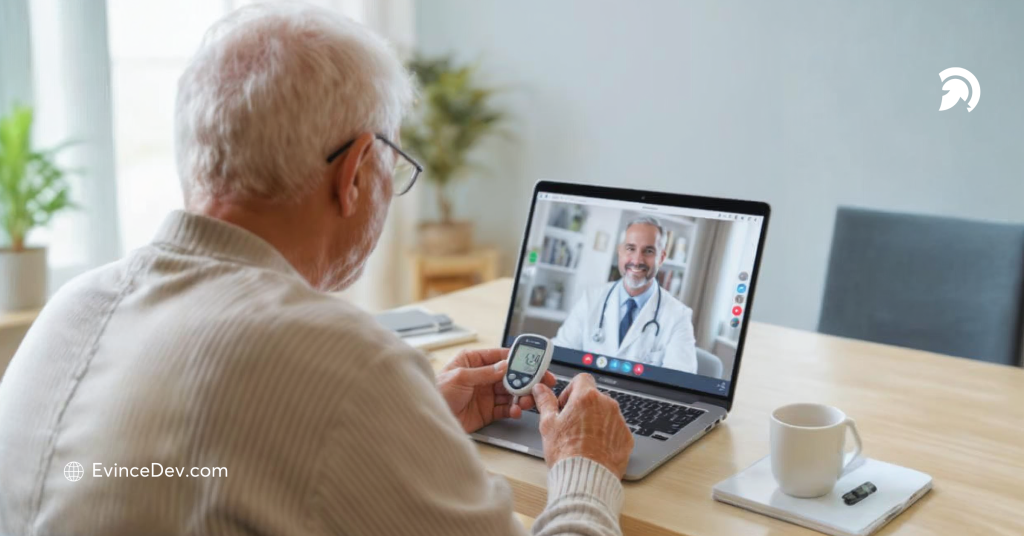
AI powered Remote Patient Monitoring helps close that gap. Smart sensors and connected devices can track vital signs, symptoms, and daily behaviors in real time, right where life happens. Yet collecting data is only half the battle. Without intelligence, RPM can overwhelm clinicians with dashboards and alerts and still miss the early signals that matter.
That is where AI changes the equation. It turns raw, continuous data into insights that guide timely intervention, personalize care, and support care teams at scale. But delivering AI powered RPM at scale takes more than algorithms. It requires robust healthcare software development that connects devices, data pipelines, AI models, and clinical workflows into a secure, reliable system.
This blog explores how AI in remote patient monitoring works from sensors to insights, the key technologies behind it, practical use cases, implementation considerations, and where AI-driven monitoring is headed next.
Quick Stat:
MarketsandMarkets estimates the global Remote Patient Monitoring market at $27.72B in 2024 and projects it to reach $56.94B by 2030, growing at a 12.7% CAGR (2024–2030), reflecting the rapid pace of healthcare investment in remote, connected care models.
In practice, RPM platforms are often delivered as behavioral healthcare software modules that support longitudinal monitoring, outreach, and care coordination.
What Is Remote Patient Monitoring?
Remote Patient Monitoring is a healthcare approach that uses digital technologies to collect patient health data outside traditional clinical settings and transmit it securely to healthcare providers for assessment and decision-making.
RPM systems typically track physiological and behavioral data such as heart rate, blood pressure, glucose levels, oxygen saturation, activity, sleep patterns, and medication adherence. These measurements are collected using wearable devices, home medical equipment, mobile applications, and, in some cases, ambient or implantable sensors.
The primary goals of RPM include early detection of health deterioration, improved management of chronic conditions, reduced hospital admissions, and greater patient engagement in their own care. RPM is widely used in managing conditions such as diabetes, heart failure, hypertension, respiratory diseases, post-surgical recovery, and elderly care.
However, as RPM adoption has grown, so has the volume and complexity of data generated. This has exposed the limitations of traditional monitoring approaches that rely heavily on static thresholds and manual review. Modern behavioral healthcare software reduces noise by prioritizing what matters most, helping teams respond faster with fewer unnecessary alerts.
Why RPM Needs Intelligence?
Collecting data remotely is only the first step. Without intelligence, remote patient monitoring quickly becomes overwhelming rather than helpful.
A single patient can generate thousands of data points per day. Multiply that across hundreds or thousands of patients, and clinicians face massive data streams that are difficult to interpret in real time. Traditional RPM systems often rely on predefined thresholds, such as heart rate above a fixed threshold or glucose levels within a fixed range. While simple to implement, these rules frequently produce false alarms and miss subtle but clinically significant trends.
This leads to several critical challenges:
- Alert fatigue among clinicians due to excessive, low-value notifications
- Limited ability to personalize care based on individual patient baselines
- Delayed intervention because early warning signs are buried in noise
- High operational burden for care teams reviewing dashboards manually
Intelligence is needed to filter, prioritize, and interpret data continuously. AI enables RPM systems to move beyond passive monitoring toward proactive, predictive, and personalized care.
The Role of AI in Healthcare RPM: From Tracking to Prediction
Artificial intelligence fundamentally changes what remote patient monitoring can achieve.
In traditional RPM, data is tracked and visualized. With AI powered RPM, that same data is analyzed, learned from, and converted into insights that support clinical decisions. Put simply, AI enables care teams to shift from reactive tracking to proactive decision making at scale.
AI plays several key roles in modern RPM systems:
-
Personalization
AI models learn a patient’s normal baseline over time. Instead of comparing everyone to population-level thresholds, the system detects deviations relative to the individual. This dramatically improves sensitivity and reduces false alarms.
-
Pattern recognition
Machine learning algorithms analyze longitudinal time series data to identify trends and correlations that are difficult for humans to spot. For example, subtle changes in heart rate variability, combined with reduced activity, may signal an early heart failure exacerbation.
-
Anomaly detection
AI can detect abnormal patterns that do not conform to expected behavior, even when values remain within normal ranges. This allows earlier detection of deterioration before a crisis occurs.
-
Prediction and risk scoring
Predictive analytics in remote patient monitoring estimate the likelihood of adverse events such as hospitalization, disease flare-ups, or complications. These risk scores help clinicians prioritize patients who need urgent attention.
-
Clinical summarization
AI can condense large volumes of data into concise summaries, trends, and explanations, thereby reducing clinicians’ cognitive load.
Through these capabilities, AI transforms RPM from simple tracking into predictive, proactive care management.
How AI-Powered RPM Works?
An AI-powered remote patient monitoring system follows a structured pipeline that converts sensor data into actionable insights.
Data Capture
The process begins with data collection through various sources:
- Wearable devices measuring vitals and activity
- Home medical devices such as blood pressure monitors and glucometers
- Mobile apps capturing patient-reported outcomes and symptoms
- Ambient or implantable sensors in advanced care scenarios
Data Ingestion and Normalization
Collected data is transmitted securely to cloud or edge platforms. At this stage, data is cleaned, normalized, timestamped, and associated with the correct patient profile. Missing values, noise, and device inconsistencies are addressed.
AI and Machine Learning Analysis
Machine learning models analyze the processed data. This includes baseline modeling, anomaly detection, trend analysis, and prediction. Models may incorporate historical health records, demographics, and contextual data to improve accuracy.
Insight Generation
Instead of raw charts, the system generates insights, including risk scores, prioritized alerts, trend summaries, and recommended actions. Insights are designed to be interpretable and clinically relevant.
Clinical and Care Action
Insights are delivered through dashboards, EHR integrations, or care management tools. Clinicians, nurses, or care coordinators can intervene through outreach, medication adjustments, or escalation to in-person care. This end-to-end flow is what enables RPM systems to truly deliver on the promise of continuous, intelligent care. For many organizations, custom healthcare software is essential to unify devices, EHR integration, and care team workflows without adding operational friction.
Key Technologies Enabling AI RPM
Several technologies work together to enable AI-driven RPM.
-
Sensors and Devices
Accurate, reliable sensors form the foundation of RPM. Advances in wearables, medical-grade devices, and low-power IoT hardware have improved data quality and patient comfort.
-
Connectivity and Data Infrastructure
Secure data transmission relies on mobile networks, Wi Fi, Bluetooth, and emerging standards like 5G. Cloud platforms provide scalable storage and computing resources, while edge computing supports real-time analysis when latency matters.
-
Artificial Intelligence and Machine Learning
AI frameworks and libraries enable model development, training, and deployment. Time series analysis, deep learning, and probabilistic models are commonly used in RPM applications.
-
Interoperability and Integration
Integration with electronic health records and clinical systems ensures that RPM insights fit into existing workflows. Standards like HL7 and FHIR support data exchange across systems.
-
Security and Compliance
Encryption, access controls, audit logging, and compliance with healthcare regulations are essential to protecting patient data and maintaining trust.
Together, these technologies create the backbone of intelligent remote monitoring platforms.
Core Benefits for Patients, Providers, and Payers
AI-powered RPM delivers value across the healthcare ecosystem.
- Benefits for Patients: Patients receive continuous care without frequent hospital visits. Early detection reduces complications, while personalized insights improve adherence and engagement. RPM empowers patients to take a more active role in managing their health.
- Benefits for Providers: Clinicians gain better visibility into patient health between visits. AI reduces alert fatigue, prioritizes care, and supports timely intervention. This improves outcomes while reducing workload and burnout.
- Benefits for Payers and Health Systems: Proactive monitoring reduces hospitalizations, emergency visits, and overall costs. Data-driven insights support value-based care models and population health management.
These benefits make AI-driven RPM a strategic investment rather than a technology experiment.
Market Insight:
Proactive monitoring reduces hospitalizations, emergency visits, and overall costs. In one large-scale example, a Michigan Medicine remote patient monitoring program reported a 59% reduction in hospital admissions in the six months after patients enrolled, with average admissions falling from 1.38 to 0.57 when compared across the six months before versus after RPM participation.
What Are the Use Cases of RPM?
AI-powered RPM is applied across a wide range of clinical scenarios.
- Chronic Disease Management: Conditions such as diabetes, hypertension, heart failure, and COPD benefit from continuous monitoring and early intervention.
- Post Acute and Post Surgical Care: RPM supports recovery after discharge by tracking vitals, mobility, and symptoms, reducing readmissions.
- Elderly and Assisted Living Care: Fall detection, activity monitoring, and behavioral analysis improve safety and independence for aging populations.
- Maternal and Neonatal Monitoring: Continuous tracking during pregnancy and postpartum periods helps detect complications early.
- Mental Health and Behavioral Monitoring: Patterns in sleep, activity, and engagement can support early identification of mental health risks.
These use cases demonstrate the versatility of AI-driven RPM across care settings.
Implementing behavioral healthcare software for RPM requires aligning data governance, clinical adoption, and interoperability from day one.
Implementation Challenges and Considerations
Despite its potential, implementing AI-powered RPM comes with challenges.
- Data Quality and Reliability: Inconsistent device usage, sensor errors, and missing data can affect model performance.
- Integration Complexity: Connecting RPM platforms to existing clinical systems requires careful planning and support for interoperability.
- Privacy and Compliance: Healthcare data is highly sensitive. Strong security practices and regulatory compliance are non-negotiable.
- Bias and Fairness: AI models must be monitored for bias to ensure equitable care across populations.
- Clinical Adoption: Successful RPM requires trust, training, and alignment with clinical workflows. Addressing these challenges is critical for sustainable deployment.
How to Build It in Practice?
Building an AI-powered RPM system requires more than model training.
- Python and AI stack: Python is widely used due to its rich ecosystem of data science and machine learning libraries. Tools support data processing, model development, and evaluation.
- Machine Learning Workflow: A complete workflow includes data ingestion, feature engineering, model training, validation, deployment, and continuous monitoring.
- Deployment and Monitoring: Models must be monitored for performance drift, reliability, and safety. Human oversight remains essential in clinical contexts.
Many organizations rely on ai healthcare app development services to manage the full lifecycle, from data ingestion and model development to compliant deployment and long term monitoring.
The Future of AI Remote Patient Monitoring?
Remote patient monitoring is moving from “watching numbers” to predicting risk and preventing complications. In the next few years, AI will make RPM more personalized, more proactive, and easier for care teams to act on.
Where RPM is headed
- Predictive care: spotting early warning signs days before symptoms become serious
- Preventive interventions: nudging timely actions to avoid hospital visits and escalations
- Personalized monitoring: learning each patient’s normal baseline instead of relying only on one-size-fits-all thresholds
Trends shaping the next wave
- Ambient monitoring: passive signals from the environment and devices, with less manual effort from patients
- Multimodal insights: combining vitals, activity, sleep, symptoms, and medical history for a fuller picture
- Explainable AI: clearer reasoning behind alerts so clinicians can trust and validate them
- Workflow first integration: insights delivered inside EHR and clinical tools, not isolated dashboards
What this means for care teams
AI will increasingly support, not replace, clinicians by:
- prioritizing who needs attention first
- reducing alert fatigue
- summarizing trends into actionable next steps
Why it matters now
As healthcare shifts toward value-based care, intelligent RPM will become central to:
- population health management
- fewer readmissions and emergencies
- better outcomes with more efficient clinical effort
Conclusion
Remote Patient Monitoring has evolved from simple data collection into a sophisticated, intelligence-driven approach to care. Sensors and connected devices generate a continuous stream of information, but it is AI that converts that data into insights clinicians can trust and act on. As AI in remote patient monitoring matures, the real advantage will come from systems that deliver fewer, smarter alerts and clearer next steps for care teams.
By enabling early detection, personalization, and proactive intervention, AI-powered RPM is redefining how care is delivered beyond hospital walls. Organizations that invest in intelligent monitoring today are positioning themselves for a more resilient, efficient, and patient-centered healthcare future.
For teams looking to move from concept to production and looking for a partner for healthcare application development, EvinceDev supports healthcare innovators with end-to-end product engineering, from building secure IoT-based smart healthcare solutions to developing, deploying, and monitoring AI models that integrate smoothly into clinical workflows.