
Key Takeaways:
- Plan for Scale: Choose a platform that can handle peak traffic, integrations, and automation as you grow.
- Infra Matters: Architecture impacts flexibility, costs, performance, and how fast you can evolve operations.
- Control vs Ease: Open platforms give control; hosted platforms reduce ops effort but limit deep customization.
- Avoid Lock: In Understand platform limits early to reduce switching costs and keep future options open.
- Own the Data: Prioritize data access and portability to support analytics, AI, and future migrations safely.
- Integration Ready: Plan for ERP, CRM, WMS, and logistics integrations before complexity forces rework later.
- Ecosystem Strength: Bigger ecosystems mean more plugins, developers, and partners to reduce delivery risk.
- Strategy First: Match platform choice to your business model, risk tolerance, and long term scale plan.
In the early stages of an eCommerce business, platform selection often feels straightforward. The storefront launches, products display correctly, payments process smoothly, and customers begin placing orders. At that moment, most platforms appear equally capable.
The real test of an eCommerce platform does not occur during launch. It occurs during scale.
It happens when traffic increases fivefold during peak seasons. When fulfillment workflows must integrate with logistics providers across regions. When automation becomes necessary to manage thousands of daily transactions. When marketing teams require data pipelines to optimize customer acquisition. When international expansion introduces regulatory, currency, and operational complexity.
At that point, the eCommerce platform stops being a website. It becomes infrastructure.
Having worked in technology and consulting since 2002, and observing eCommerce systems evolve from early custom storefronts to today’s globally interconnected commerce ecosystems, one pattern has remained consistent. Platform decisions rarely fail early. Their limitations emerge gradually, as businesses grow beyond the architectural assumptions built into their initial platform.
Today, WooCommerce, Shopify, Magento (Adobe Commerce), and BigCommerce represent four of the most structurally significant eCommerce platforms globally. Each platform supports successful businesses. However, each platform optimizes for a different operational model, risk profile, and scalability strategy.
Understanding these differences early allows founders and CTOs to align infrastructure with long-term operational goals rather than short-term convenience.
Market Insight:
According to the U.S. Census Bureau, Quarterly Retail E-Commerce Sales (Q3 2025), US retail ecommerce sales reached $310.3B in Q3 2025 (seasonally adjusted), and ecommerce now makes up 16.4% of total retail sales, which is why choosing the right enterprise platform is no longer a technical decision alone. It is a growth and resilience decision.
Global Market Adoption and Ecosystem Maturity
Platform adoption provides insight into ecosystem maturity and reliability. Platforms with large adoption benefit from larger developer ecosystems, more integrations, and stronger long-term viability.
Quick Stat:
Ecosystem maturity matters because ecommerce has become more platform-centric. UNCTAD’s compilation shows platform transactions grew 55% during the pandemic, from about $2.6T in 2019 to $4T in 2021. Larger ecosystems tend to attract more integrations, implementation talent, and long-term vendor investment.
According to global web usage data, WordPress powers approximately 42.6 percent of all websites, and WooCommerce benefits directly from this ecosystem maturity. Shopify powers millions of eCommerce stores globally and has become one of the dominant SaaS ecommerce infrastructure providers. Magento and BigCommerce maintain strong presence among mid-market and enterprise organizations due to their scalability and integration capabilities.
The following table summarizes structural ecosystem maturity:

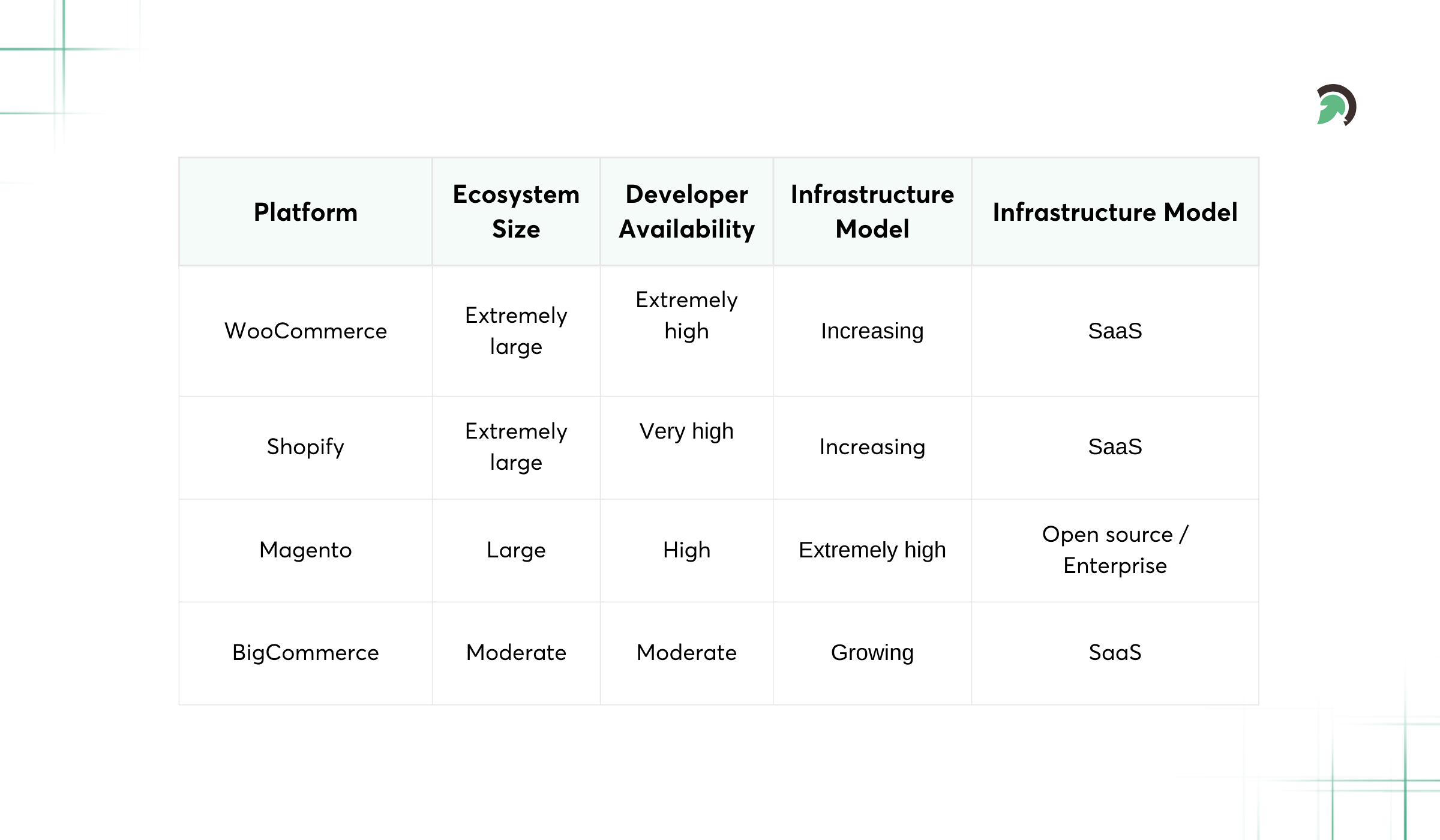
Ecosystem maturity influences long-term sustainability, innovation speed, and integration flexibility.
Platform Architecture Determines Long-Term Operational Flexibility
eCommerce platforms fall into two architectural categories:
- Open infrastructure platforms: WooCommerce and Magento provide full infrastructure ownership and control.
- Hosted infrastructure platforms: Shopify and BigCommerce provide managed infrastructure with reduced operational responsibility.
This architectural distinction directly affects automation capability, scalability independence, and operational risk.
Market Insight:
During the 2024 holiday season (Nov 1 to Dec 31, 2024), online spend reached $241.4B (up 8.7% YoY), and 54.5% of transactions happened on smartphones, according to Adobe Analytics. That is why platform architecture, especially mobile performance and checkout flexibility under peak load, increasingly determines operational outcomes at scale.
WooCommerce: Infrastructure Ownership and Maximum Customization
WooCommerce is an open-source eCommerce platform built on WordPress. It allows businesses to fully control infrastructure, application logic, and integration architecture.
This ownership model provides maximum flexibility but requires infrastructure responsibility.
Advantages of WooCommerce
1. Full infrastructure ownership and independence
Businesses maintain complete control over data, hosting, and platform architecture. This eliminates vendor lock-in risk and ensures long-term operational independence.
Infrastructure ownership becomes particularly valuable when implementing custom automation workflows, AI integrations, or enterprise system connections.
2. Unlimited customization capability
WooCommerce provides direct access to application code and database architecture. This enables implementation of complex workflows such as:
- Custom checkout logic
- ERP and warehouse integrations
- Subscription and recurring billing models
- Marketplace and multi-vendor architecture
This level of flexibility is essential for businesses with complex operational requirements.
3. Long-term cost efficiency
WooCommerce does not charge platform subscription fees. Operational costs scale with infrastructure usage rather than platform licensing, providing predictable long-term economics.
This makes WooCommerce particularly attractive for businesses planning long-term scale.
4. Superior SEO control
Because WooCommerce runs on WordPress, businesses gain full control over technical SEO, content architecture, and page optimization.
This improves organic search visibility and reduces long-term customer acquisition costs.
5. Large global developer ecosystem
WordPress and WooCommerce benefit from one of the largest developer ecosystems globally, reducing dependency risk and improving long-term support availability.
6. Migration flexibility
Because infrastructure remains fully controlled, migration between hosting providers or architectural environments remains feasible without platform restrictions.
Limitations of WooCommerce

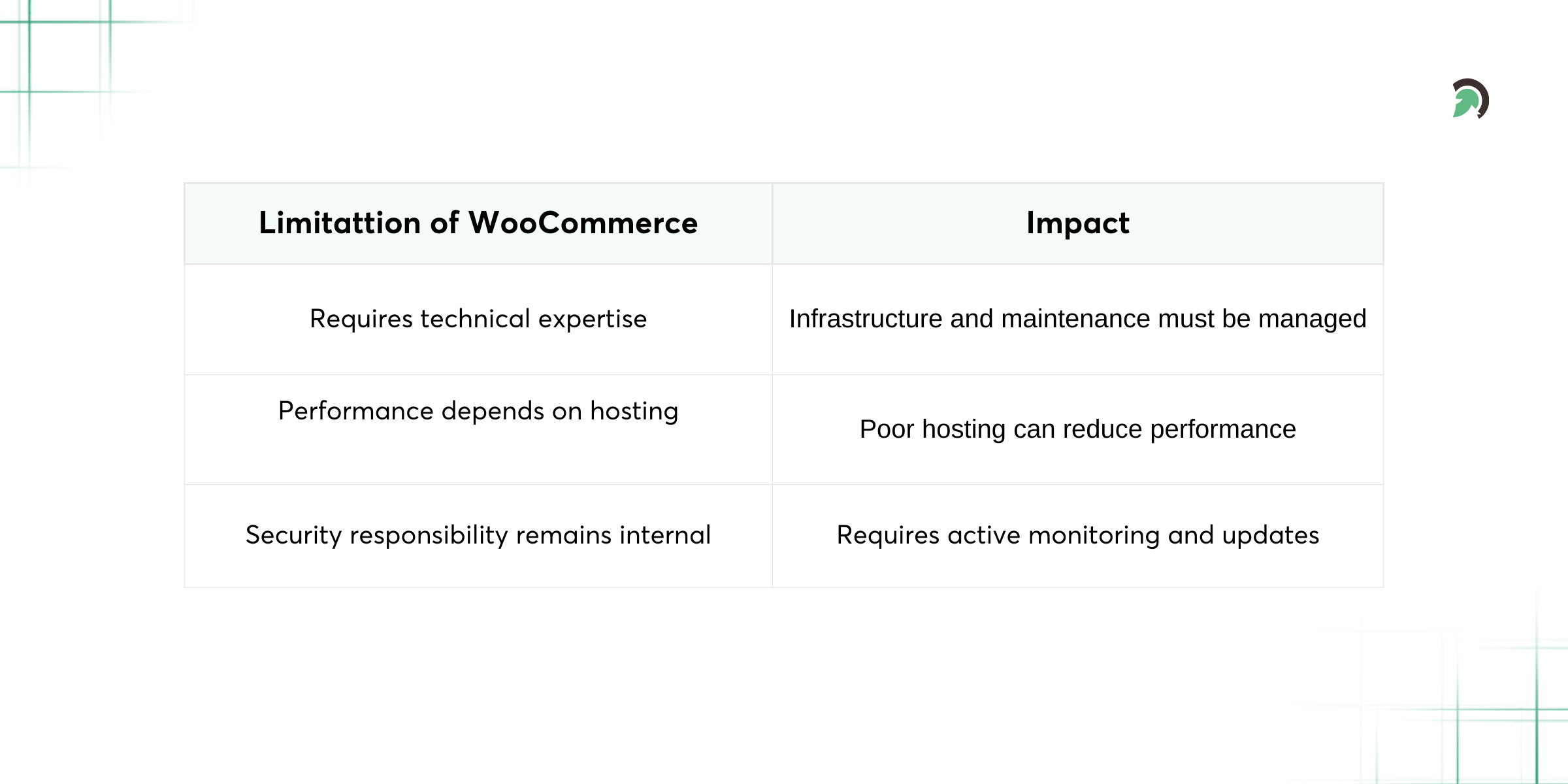
WooCommerce provides maximum flexibility but requires operational discipline.
Shopify: Infrastructure Abstraction and Operational Simplicity
Shopify is a fully hosted eCommerce platform designed to abstract infrastructure complexity and simplify eCommerce deployment.
Shopify manages hosting, performance optimization, and security automatically.
This significantly reduces operational overhead.
Advantages of Shopify
1. Fastest deployment capability
Shopify enables businesses to launch eCommerce stores rapidly without infrastructure configuration.
This accelerates time to market.
2. Fully managed infrastructure
Shopify manages:
- Hosting
- Security
- Performance scaling
- Software updates
This reduces infrastructure responsibility.
3. Proven reliability and scalability
Shopify supports millions of active stores globally and processes high transaction volumes.
This demonstrates infrastructure reliability under scale.
4. Extensive integration ecosystem
Shopify supports thousands of integrations across payments, logistics, marketing, and analytics.
This simplifies operational integration.
5. Reduced technical maintenance requirements
Shopify eliminates infrastructure management responsibilities, allowing teams to focus on business growth.
6. Continuous platform innovation
Shopify continuously improves platform performance, automation capability, and developer tools.
Limitations of Shopify
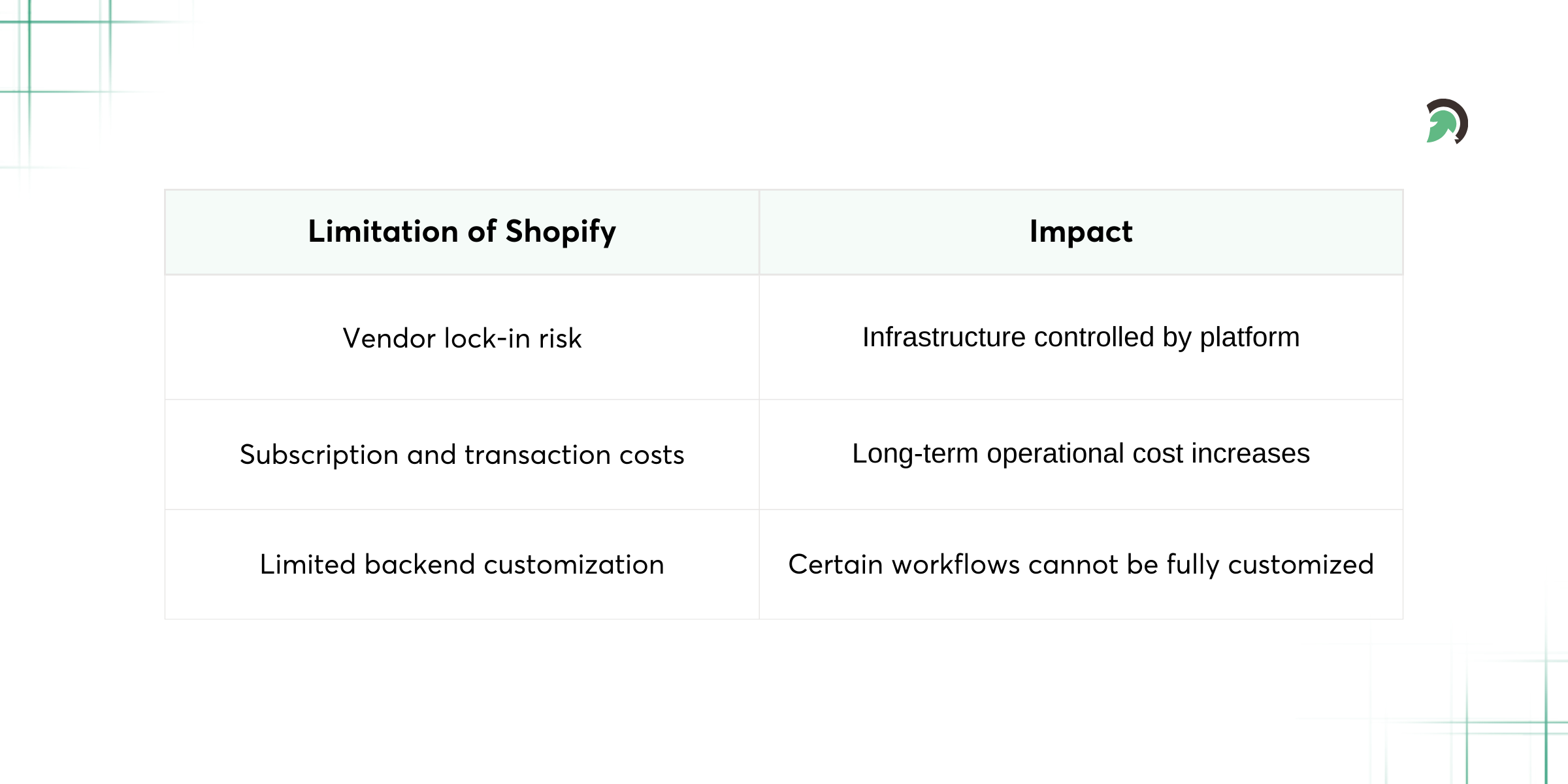
Shopify optimizes operational simplicity but limits infrastructure independence.
Magento: Enterprise-Grade Scalability and Architectural Control
Magento, now Adobe Commerce, provides enterprise-grade eCommerce infrastructure designed for complex commerce operations.
Magento is widely used by global brands requiring scalable and customizable commerce systems.
Advantages of Magento
- Enterprise scalability: Magento supports large product catalogs, high transaction volumes, and multi-region commerce. This makes it suitable for enterprise operations.
- Full customization capability: Magento allows full control over application architecture, enabling complex operational workflows.
- Strong enterprise integration capability: Magento integrates easily with ERP, CRM, logistics, and enterprise automation systems.
- Multi-store and multi-region support: Magento supports global commerce operations from a single infrastructure environment.
- Advanced built-in enterprise features: Magento includes advanced pricing, customer segmentation, and catalog management features.
- Long-term infrastructure independence: Magento provides infrastructure ownership, reducing vendor dependency.
Limitations of Magento
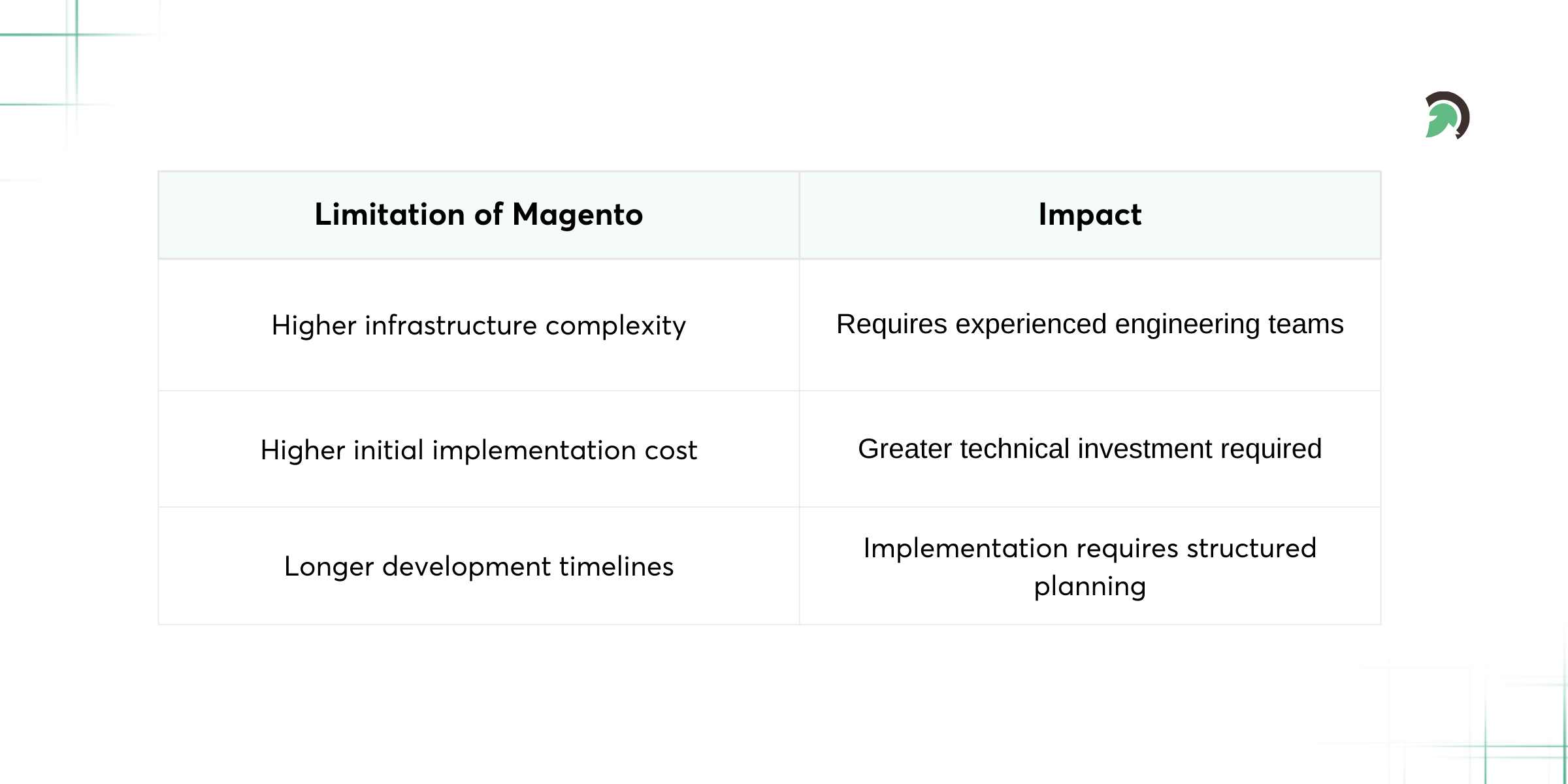
Magento provides maximum enterprise flexibility but requires infrastructure investment.
BigCommerce: Hosted Infrastructure with Enterprise Capability
BigCommerce is a hosted eCommerce platform designed to balance infrastructure abstraction with enterprise scalability.
It provides SaaS convenience while supporting advanced commerce architectures.
Advantages of BigCommerce
- Fully managed infrastructure: BigCommerce manages hosting, security, and platform updates.
- Strong built-in eCommerce features: BigCommerce includes many native eCommerce capabilities, reducing reliance on third-party plugins.
- Enterprise scalability capability: BigCommerce supports growing eCommerce businesses transitioning to enterprise scale.
- Headless commerce support: BigCommerce supports modern headless architecture, enabling flexible frontend development.
- Reduced infrastructure responsibility:Platform-managed infrastructure simplifies operational management.
- Reliable performance: Hosted infrastructure ensures stable performance under normal operational loads.
Limitations of BigCommerce
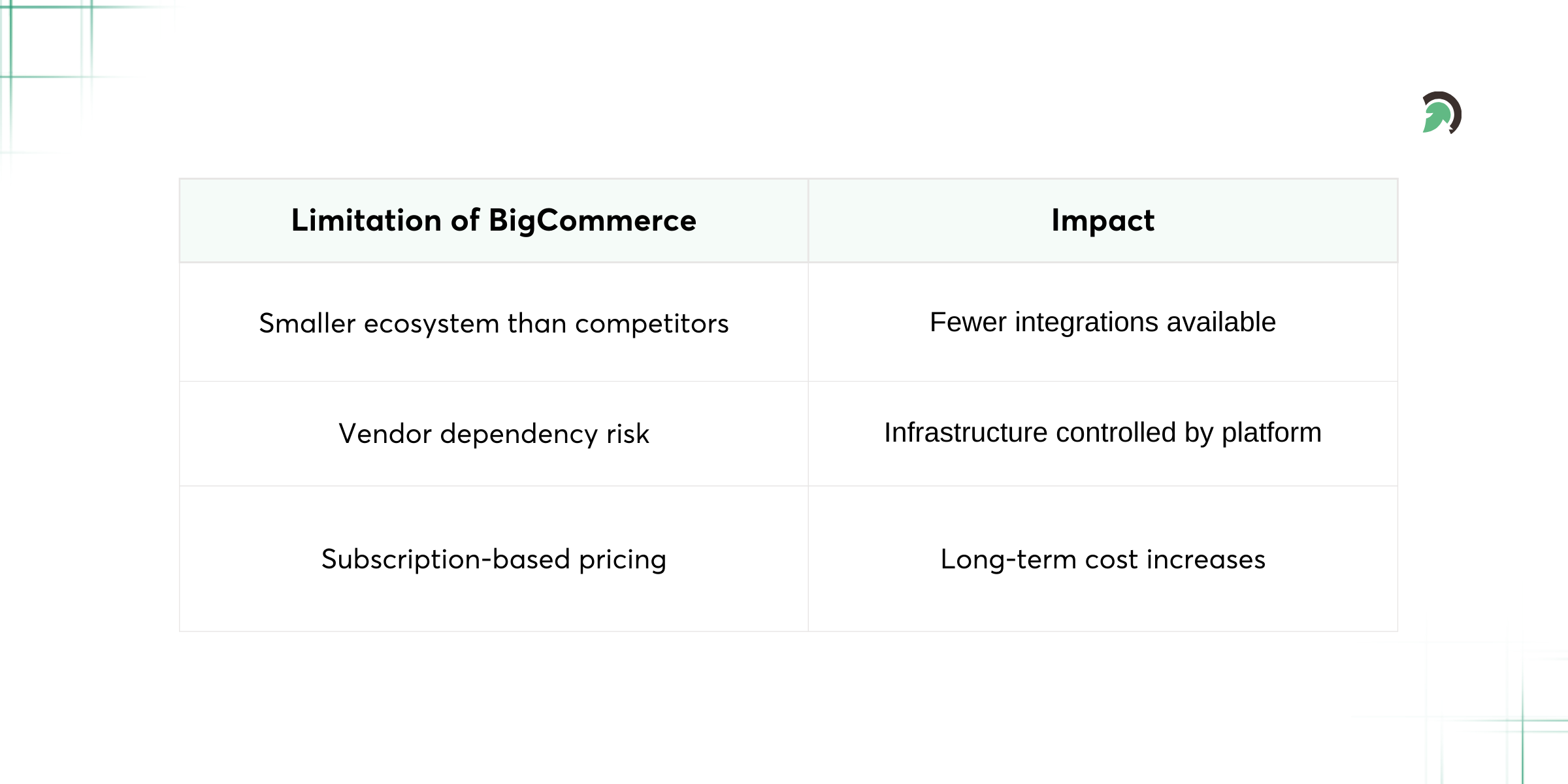
BigCommerce provides balanced flexibility and operational simplicity.
Migration Complexity Comparison
Migration difficulty increases as operational complexity grows.
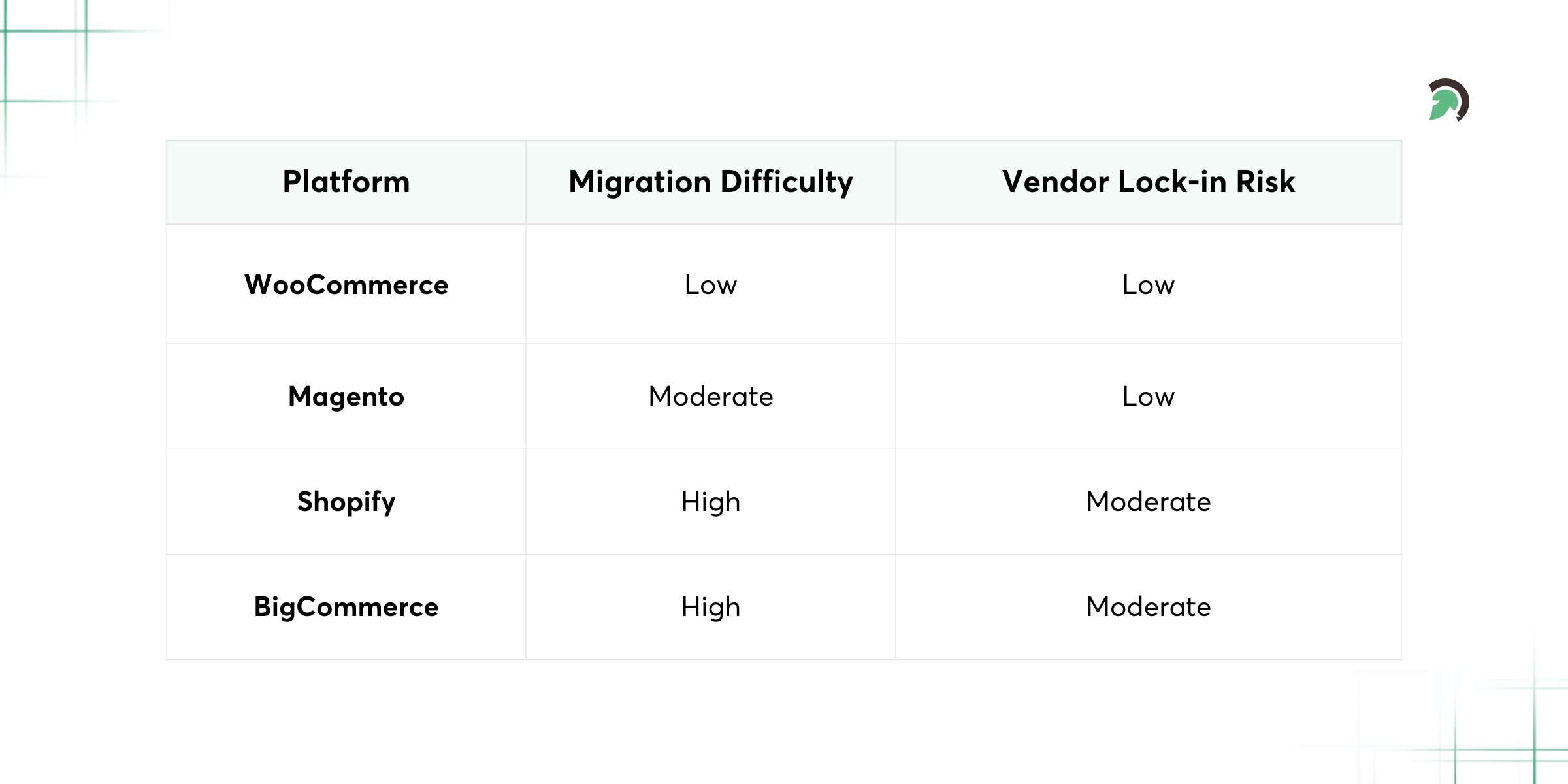
Vendor lock-in risk affects long-term infrastructure flexibility.
Enterprise CTO Platform Decision Framework
Enterprise technology leaders typically evaluate platforms based on five structural criteria:
- Infrastructure control: Ability to control infrastructure behavior independently.
- Automation flexibility: Ability to implement advanced automation workflows.
- Integration capability: Ability to integrate with operational systems.
- Scalability independence: Ability to scale infrastructure without platform constraints.
- Migration freedom: Ability to migrate infrastructure without structural limitations.
These criteria prioritize long-term operational stability.
Strategic Verdict: Infrastructure Decisions Shape eCommerce Scalability
Each platform serves a different operational model.
WooCommerce provides maximum infrastructure ownership and customization flexibility.
Shopify provides operational simplicity and infrastructure abstraction.
Magento provides enterprise scalability and architectural control.
BigCommerce provides hosted infrastructure with moderate architectural flexibility.
There is no universally superior platform.
The optimal platform depends on alignment between infrastructure architecture and operational strategy.
eCommerce platform selection is not merely a software decision. It is an infrastructure decision that shapes operational flexibility, scalability, and risk exposure for years to come.
Businesses that align platform architecture with long-term operational goals typically scale with fewer structural constraints and greater operational efficiency.