


Key Takeaways:
- AI Support Scale: AI handles repetitive tickets, helping Shopify stores scale support without growing headcount.
- Returns Automation: AI streamlines returns and refunds with policy checks, faster approvals, and fewer back-and-forths.
- Helpdesk Co-Pilot: AI boosts agents with intent tagging, smart routing, and reply drafts aligned to brand tone.
- Omnichannel Unity: Unify chat, email, and social into one workflow so customers get consistent, faster answers.
- Human Escalation: Keep a clear handoff to agents for complex cases, disputes, and VIP customer situations.
- Data Guardrails: Use identity checks, approved sources, and logs to keep responses accurate and customer-safe.
- Measure the ROI: Track deflection, CSAT, resolution time, and cost per ticket to prove AI support impact.
As stores scale, a few recurring issues tend to show up:
- Ticket volume rises faster than the support team can grow
- Peaks like holidays and sales create sudden backlogs
- Customers reach out across multiple channels, increasing complexity
- Agent workload becomes repetitive and draining
This is where AI customer support for Shopify changes the equation. Instead of manually responding to every query, Shopify merchants can automate many parts of their support workflows while still delivering a high-quality customer experience.
What Does AI Customer Support for Shopify Actually Mean?
AI customer support for Shopify refers to using AI to automate, assist, and optimize customer interactions throughout the support journey. It is not just about adding a chatbot to a store. It is about creating a connected system that understands customers, accesses real-time Shopify data, and resolves issues end-to-end.
Most solutions combine a few key elements:
- Chatbot support for common questions and basic workflows
- Helpdesk intelligence for routing, prioritization, and response assistance
- Automated order tracking tied to Shopify and shipping carriers
- Returns and refunds workflows based on store policies
In simple terms, it is AI support automation for Shopify stores that helps merchants handle more conversations, faster, with fewer manual steps.
What Are the Most Common Customer Support Pain Points for Shopify Merchants?
Before understanding how AI helps, it is important to look at the real problems Shopify merchants face every day.
One of the biggest pain points is WISMO queries, which stand for “Where is my order?”. Customers want quick status updates, but each query still takes time if tracking is not automated.
Returns and refunds are another major challenge. Customers are often unsure about eligibility, timelines, and steps. Support agents end up repeating policy explanations and manually processing requests.
Product-related questions also consume significant time. Customers ask about sizing, materials, compatibility, availability, and usage. These are important pre-sales questions, but they can overwhelm a team during high traffic periods.
Finally, managing support across multiple channels creates chaos. Customers reach out via email, live chat, Instagram, WhatsApp, and contact forms. Without a unified system, response times suffer, and messages can slip through the cracks.
Here is how AI customer support changes these challenges in practice.
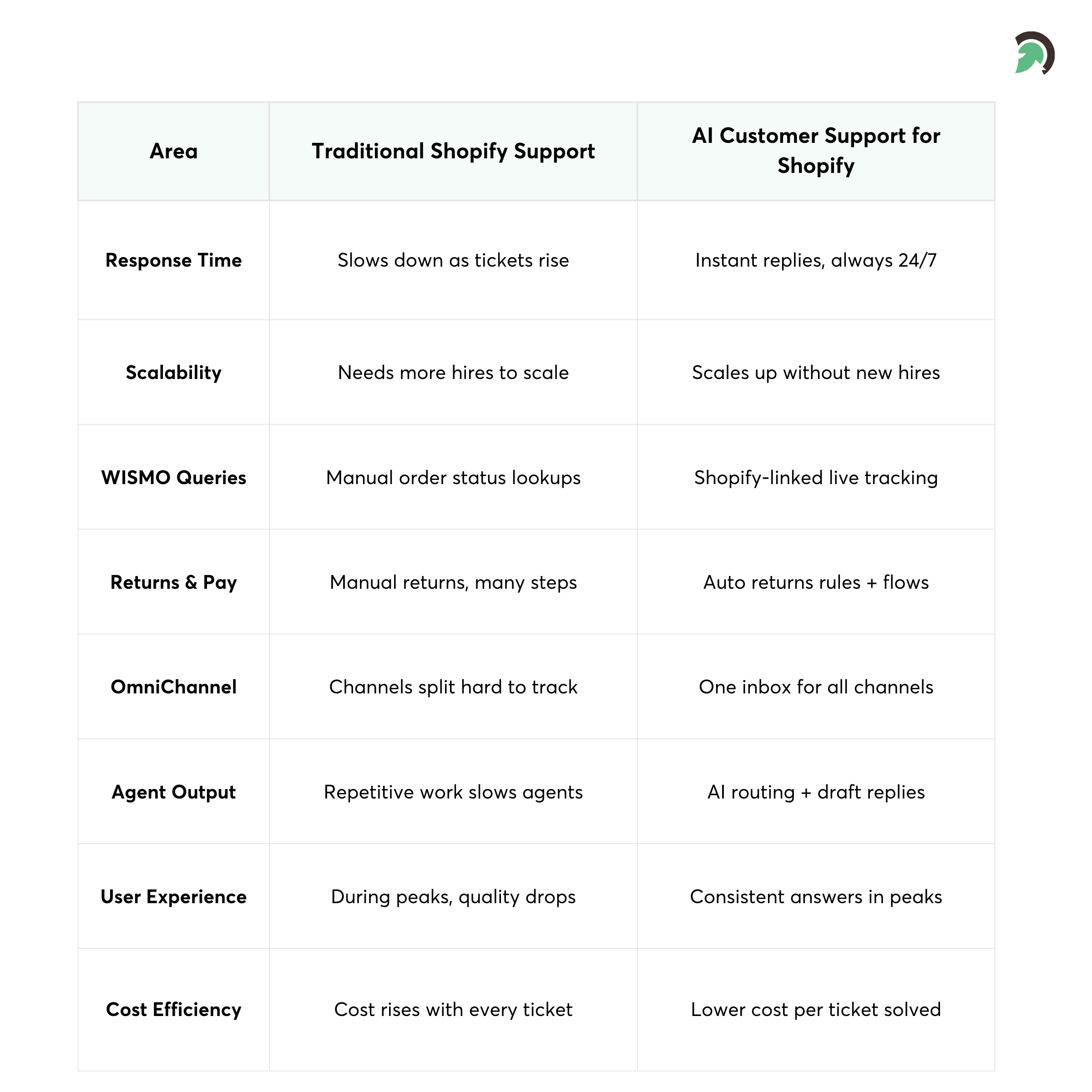
How Do AI Chatbots Improve Customer Support for Shopify Stores?
An AI chatbot acts as the first point of contact for customers visiting a Shopify store. Unlike basic rule-based bots, modern AI chatbots understand natural language and context. This allows them to respond conversationally and accurately.
For Shopify stores, an AI chatbot can instantly answer frequently asked questions about shipping, payments, products, and policies. It can guide customers to the right product by asking clarifying questions and offering recommendations. It can also handle post-purchase queries like order tracking and delivery updates.
Many merchants start with a Shopify customer support chatbot because it reduces repetitive tickets immediately while improving response time and availability.
In most stores, chatbot impact is easiest to see in these areas:
- FAQ deflection for shipping, payments, and policies
- Pre-sales guidance (product discovery and comparisons)
- Basic post-purchase support (order lookup and tracking)
When a query is too complex, the chatbot can escalate it to a human agent with full conversation context. This ensures a smooth handoff instead of frustrating the customer.
Quick Stat:
Gartner predicts that by 2027, chatbots will be the primary customer service channel for roughly 25% of organizations, showing how quickly conversational support is becoming a standard expectation rather than a nice-to-have.
What Should a Shopify AI Chatbot Be Capable of Handling?
A well-designed chatbot should cover both pre-sales and post-sales use cases, and it should do so reliably.
On the pre-sales side, it should answer product questions, suggest alternatives, explain pricing and promotions, and help customers make purchase decisions. On the post-sales side, it should fetch order details using email or order number, provide real-time tracking updates, explain delivery timelines, and handle basic modification requests where possible.
It should also understand store policies, including shipping, returns, exchanges, and refunds. This ensures consistent and accurate responses. Multilingual support is another key capability, especially for stores selling internationally.
When implemented well, a Shopify AI chatbot becomes a true support layer rather than just a widget that answers FAQs.
How Does an AI-Powered Helpdesk Differ From Traditional Support Systems?
Traditional helpdesks rely heavily on manual processes. Tickets are created, assigned, and answered by agents one by one. While this works at a small scale, it becomes inefficient as volume grows.
An AI-powered helpdesk uses automation and intelligence to streamline these workflows. Incoming tickets are automatically categorized based on intent, such as order status, returns, or product queries. Priority levels are assigned based on urgency and customer value.
This is where Shopify helpdesk automation makes an immediate difference because it reduces time spent sorting tickets, routing conversations, and hunting for the right context.
AI can also suggest response drafts to agents using past conversations and knowledge base articles. In many cases, simple tickets can be resolved automatically without human intervention.
How Does AI Help Support Agents Work Faster and Better?
AI does not replace support agents. Instead, it acts as a co-pilot that removes repetitive tasks and reduces cognitive load.
It helps agents by pulling the right context quickly and reducing manual work:
- Surfaces order details, customer history, and past conversations
- Suggests replies aligned with store policies and brand tone
- Highlights intent and urgency so agents can prioritize better
- Reduces time spent searching across tools and tabs
Over time, this leads to happier agents, lower turnover, and better customer experiences.
Why Is Order Status Automation the Highest ROI Use Case for Shopify?
Order status automation delivers immediate and measurable impact for Shopify stores. This is because order-related queries make up the largest share of support volume.
By connecting AI directly to Shopify order data and shipping carriers, customers can get real-time updates without contacting support. They can check whether an order is confirmed, shipped, out for delivery, or delivered.
Implementing Shopify order status automation significantly reduces WISMO tickets, lowers support costs, and improves customer trust. It also helps merchants communicate proactively during delays rather than waiting for customers to complain.
Quick Stat:
A Microsoft report found that more than two-thirds of customers want organizations to use proactive notifications, making automated order updates and delay alerts a strong customer experience upgrade.
How Does AI-Powered Order Tracking Work in Practice?
When a customer asks about their order, the AI system verifies their identity using details like email or order number. It then fetches live data from Shopify and connected shipping providers.
From the customer’s perspective, the flow feels simple:
- They ask where their order is
- They confirm identity with email or order number
- They instantly receive status, plus a tracking link and delivery estimate
- If something looks wrong, the conversation gets escalated to an agent
This entire process can occur in seconds without human intervention.
How Can AI Automate Returns and Refunds for Shopify Stores?
Returns and refunds are often the most time-consuming support processes. AI can dramatically simplify and standardize these workflows.
With returns automation, customers initiate a return through a chatbot or self-service portal. AI checks return eligibility against store policy, including the return window, item condition, and product category.
Using Shopify returns automation improves turnaround times and creates a smoother, self-serve experience without long email threads. If eligible, the system provides instructions, generates return labels where needed, and tracks the shipment. Once conditions are met, refunds or exchanges can be triggered automatically, while exceptions get flagged for review.
Quick Stat:
According to the National Retail Federation (NRF) and Happy Returns, retailers estimate that 16.9% of annual sales in 2024 will be returned, with total returns projected to reach $890 billion. That scale is exactly why returns automation is one of the quickest areas to see impact.
What Role Do Store Policies Play in AI-Driven Returns Automation?
Policies are the backbone of returns automation. AI systems rely on clearly defined rules to make accurate decisions.
To make automation reliable, these policy elements should be clearly mapped:
- Return window (for example, 7, 14, or 30 days)
- Product exclusions (final sale, customized items, hygiene categories)
- Condition rules (unused, tags intact, packaging requirements)
- Refund methods (original payment, store credit, exchanges)
- Fees or deductions (shipping, restocking, where applicable)

Once policies are properly configured, AI ensures consistent enforcement across channels. Customers receive the same answers regardless of when or where they ask.
Which Integrations Are Essential for AI Customer Support on Shopify?
Effective AI customer support depends on seamless integrations. At a minimum, you need Shopify connected for orders, customers, products, and fulfillment data. Shipping integrations are crucial for accurate tracking updates. Payment integrations are important if you want refunds to move faster with fewer manual steps.
Many stores also integrate their help desk or CRM to unify conversations across email, chat, and social channels. If exchanges are a priority, inventory and OMS integrations are valuable for avoiding out-of-stock replacements.
What should Shopify merchants automate vs keep human?
Not every support interaction should be automated. The goal is to automate repetitive workflows and keep humans available for high-context issues.
Good candidates for automation include FAQs, order status, returns initiation, and policy clarifications. Human agents are still essential for edge cases, disputes, emotional situations, VIP customers, and any scenario requiring judgment or flexibility.
How Can Shopify Stores Ensure Data Security and Response Accuracy With AI?
Trust is critical in customer support. AI systems must handle customer data safely and respond accurately.
Security and accuracy depend on strong guardrails: using approved data sources, verifying identity before sharing order details, maintaining audit logs, and updating policy content regularly. Merchants should also monitor conversations to spot gaps, refine flows, and ensure the AI stays aligned with business rules.
Which Metrics Should Shopify Merchants Track to Measure AI Support Success?
To evaluate impact, merchants should measure both efficiency and customer experience.
Useful metrics include:
- Ticket deflection rate (how many queries are solved without agents)
- First response time and average resolution time
- Cost per ticket over time
- CSAT and sentiment trends
- Return processing time and repeat contact rate
For pre-sales chat, conversion rate and average order value help quantify revenue influence.
What Does a Practical Implementation Roadmap Look Like for Shopify AI Support?
Successful implementation starts with understanding your support data. Identify the most common ticket types, then automate the highest-volume workflows first.
A practical rollout often looks like:
- Start with FAQ coverage and policy alignment
- Connect Shopify order data and shipping tracking
- Launch order status flow, then returns flow
- Add helpdesk intelligence for routing and suggested replies
- Review conversations regularly and optimize
This approach delivers quick wins while keeping risk low.
What Common Mistakes Should Shopify Merchants Avoid With AI Customer Support?
AI works best when it is designed with clear escalation paths and continuous improvement.
Common mistakes include over-automation with no way to reach a human, unclear return policies, poor knowledge base maintenance, and failure to monitor chatbot conversations. Another frequent issue is treating AI as “set and forget” rather than as something that requires tuning based on real customer behavior.
Why Is AI Customer Support Becoming Essential for Shopify’s Growth?
As ecommerce competition intensifies, customer experience becomes a key differentiator. Fast, accurate, and always-on support is no longer optional.
AI-powered customer support enables Shopify merchants to scale without proportional increases in costs. It improves response times, reduces friction, and builds trust. When combined with automation for order status and returns, it also reduces the biggest sources of support volume.
Conclusion
AI customer support is quickly becoming a practical advantage for Shopify brands that want to scale without letting support costs and ticket volume spiral out of control. The strongest approach is to start with workflows that generate the most repetitive work, then expand automation step by step while maintaining a clear path to human support for complex cases.
A simple way to move forward is:
- Begin with high-volume queries like order tracking and return requests
- Add a chatbot layer for FAQs and common post-purchase questions
- Connect Shopify order data and shipping updates so customers get instant, accurate statuses
- Introduce helpdesk automation for ticket routing, prioritization, and agent assist
- Monitor conversations regularly and refine policies, flows, and responses over time
The goal is not to automate everything. It is to automate the predictable work, reduce response times, and give your support team more room to focus on high-context issues that genuinely need a human touch.
If you want to implement this end-to-end, it often helps to work with a team that understands Shopify build work, integrations, and support workflows. Teams like EvinceDev can support Shopify development, automation setup, and integration alignment so your chatbot, helpdesk, order status, and returns flows work seamlessly as a single, connected experience.