


Key Takeaways:
- AI Consulting Turns Ideas Into Execution: It helps businesses translate AI goals into practical, scalable solutions.
- Strategy Is Critical for AI Success: Strong planning, data readiness, and clear business goals drive better outcomes.
- AI Adoption Comes With Challenges: Common barriers include poor data quality, integration complexity, and limited in-house expertise.
- Consulting Helps Reduce Risk: Expert support improves implementation quality and shortens the path to value.
- AI Creates Measurable Business Impact: When implemented well, it can improve efficiency, decision-making, customer experience, and growth.
Artificial intelligence is rapidly moving from experimentation to everyday business reality. Organizations across industries are exploring how intelligent systems can streamline operations, uncover insights from data, and create better digital experiences for customers. Yet adopting AI successfully requires more than technology alone. Businesses need a clear strategy, the right infrastructure, and a structured path from concept to implementation. AI consulting services help bridge that gap by guiding organizations through planning, development, and deployment, ensuring artificial intelligence delivers measurable, sustainable business value.
In this blog, we will explore what AI consulting services include, how implementation works, and how businesses can use AI to drive long-term transformation and growth.
Quick Stat:
According to McKinsey’s global AI survey, about 65% of organizations already use generative AI in at least one business function, underscoring how quickly artificial intelligence is becoming part of everyday operations.
What Are AI Consulting Services?
AI consulting services are specialized advisory and implementation services that help organizations plan, build, deploy, and optimize artificial intelligence solutions. These services are designed to bridge the gap between business goals and technical execution. Rather than simply introducing AI tools, consultants work to ensure that every solution supports real operational and strategic needs.
At a high level, consulting engagements usually begin with discovery. Consultants assess existing business processes, identify friction points, evaluate available data, and determine whether artificial intelligence is truly the right solution. This early stage is important because not every problem requires machine learning, automation, or generative AI. Good consulting focuses on practical value rather than unnecessary complexity.
As the engagement progresses, consultants help organizations create roadmaps, prioritize use cases, design solution architecture, and support implementation. In many cases, they also assist with governance, training, optimization, and scaling. This makes consulting especially valuable for companies that lack in-house artificial intelligence expertise or need external support to accelerate outcomes.
For organizations navigating digital transformation, AI consulting services for businesses provide both direction and execution. They turn broad AI ambition into structured action.
Why Businesses Are Investing in AI Consulting
The growing interest in artificial intelligence comes from one simple reality: businesses are under pressure to operate faster, smarter, and more efficiently. Customers expect personalized experiences. Teams need quicker access to insights. Leaders want more accurate forecasting, stronger automation, and better use of data across the enterprise.
Still, most organizations face major barriers when trying to adopt AI internally. They may not have mature data systems. Their teams may lack machine learning expertise. Existing software may be too fragmented to support intelligent automation. In many cases, leadership understands the opportunity but lacks a clear implementation strategy.
That is why companies increasingly turn to consultants. A capable consulting partner helps reduce uncertainty, improve planning, and accelerate delivery. Instead of trial and error, organizations get a proven framework for building and deploying solutions that create measurable business value.
Common reasons businesses invest in consulting include:
- Identifying high-impact AI use cases based on real operational priorities
- Building a roadmap for scalable and responsible AI adoption
- Improving data readiness for intelligent systems and automation
- Accelerating AI software development for production-ready platforms
- Reducing implementation risk through expert architecture and governance
- Supporting cross-functional alignment between business, data, and engineering teams
A strong consulting engagement helps organizations move forward with greater clarity and confidence.
Quick stat:
A Gartner survey found that 58% of finance functions were already using AI in 2024, highlighting how quickly artificial intelligence is being adopted across enterprise operations.
What an AI Consulting Company Typically Offers
A professional AI consulting company usually supports businesses across the full artificial intelligence lifecycle. That means consulting is not limited to strategy workshops or high-level recommendations. It often includes technical planning, engineering execution, deployment guidance, and post-launch optimization.
-
AI Strategy and Opportunity Discovery
This stage focuses on understanding where artificial intelligence can create the most value. Consultants assess workflows, customer journeys, internal operations, and data systems to identify meaningful use cases. The goal is to prioritize practical opportunities rather than chasing technology trends.
A strong strategy engagement answers several important questions. Which business problems are best suited for AI? What results should the business expect? What internal capabilities are needed? Which projects should come first? This helps create a roadmap grounded in business value.
-
Data and Infrastructure Assessment
Artificial intelligence depends on reliable data. If data is incomplete, fragmented, outdated, or inaccessible, even strong models will struggle. Consultants review the business data environment to determine whether existing infrastructure can support intelligent systems effectively.
This stage often includes evaluating data pipelines, integrations, storage architecture, quality standards, and governance processes. It may also identify what needs to improve before implementation begins. For many organizations, data readiness becomes the foundation for long-term AI success.
-
Solution Design and Architecture
Once priorities are clear, consultants help design the technical architecture required for implementation. This includes model frameworks, data processing layers, APIs, integrations, user interfaces, monitoring systems, and security controls.
This is especially important in enterprise AI consulting services, where systems must scale across departments, tools, and large operational environments. Without strong architecture, even promising solutions can become expensive to maintain or difficult to expand.
-
AI Development and Engineering Support
Many consulting firms also provide direct development support. This may include machine learning engineering, intelligent workflow automation, generative AI system design, and AI app development for customer-facing or internal platforms.
Examples include predictive analytics dashboards, AI copilots, recommendation systems, document processing tools, intelligent search systems, and conversational assistants. In these cases, consulting moves beyond planning and becomes an active part of building the solution.
-
Deployment and Optimization
Implementation does not end when a model is tested. Real business value appears only when the solution works consistently inside actual workflows. This is where AI implementation consulting becomes critical. Consultants help organizations integrate AI systems into business operations, train internal teams, and establish monitoring practices.
They also support model refinement, performance tracking, governance controls, and scaling plans. This ensures the business can maintain and improve systems over time rather than treating deployment as a one-time event.

Common AI Consulting Use Cases Across Industries
AI consulting services are most effective when they focus on real business problems within specific industries. Instead of applying artificial intelligence broadly, consultants help organizations identify use cases where AI can improve efficiency, decision-making, and customer experience.
Some common industry use cases include:
- Healthcare: patient data analysis, diagnostics support, appointment and workflow automation, and resource planning
- Retail and ecommerce: recommendation engines, demand forecasting, pricing optimization, and customer behavior analysis
- Finance: fraud detection, risk assessment, compliance monitoring, and support automation
- Manufacturing: predictive maintenance, quality inspection, and production optimization
- Logistics and supply chain: route optimization, inventory forecasting, warehouse automation, and shipment tracking
By focusing on industry-specific opportunities, businesses can prioritize AI investments that are more practical, measurable, and aligned with their operational goals.
How AI Implementation Usually Works
A structured implementation process helps businesses reduce risk and improve success rates. While every project differs, most AI consulting engagements follow a similar framework.
-
Discovery and Business Alignment
Consultants begin by understanding strategic goals, operational pain points, and data availability. They speak with stakeholders, review current workflows, and identify areas where artificial intelligence can support measurable improvement.
-
Feasibility and Data Validation
Next comes validation. Consultants assess whether the business has enough reliable data to support the intended use case. They also examine technical constraints, compliance considerations, and integration requirements.
-
Roadmap and Solution Design
Once feasibility is confirmed, the team defines the implementation roadmap. This includes priorities, milestones, architecture plans, staffing requirements, and expected outcomes.
-
Development and Testing
During this phase, technical teams begin building the solution. Depending on the use case, this may involve model training, workflow automation, API integrations, interface design, and platform engineering. Testing ensures that the solution performs accurately and works within the organization’s real operating environment.
-
Deployment and Integration
The finished system is deployed into live workflows. Consultants support integration with business tools, operational dashboards, customer platforms, or enterprise systems. This step often includes change management and internal team enablement.
-
Monitoring and Continuous Improvement
After launch, consultants help businesses measure performance, identify gaps, and optimize results. AI systems need regular monitoring to maintain quality, accuracy, and alignment with changing business needs.
This phased approach makes AI consulting services more strategic and more reliable than isolated technical experiments.

Challenges Businesses Face During AI Adoption
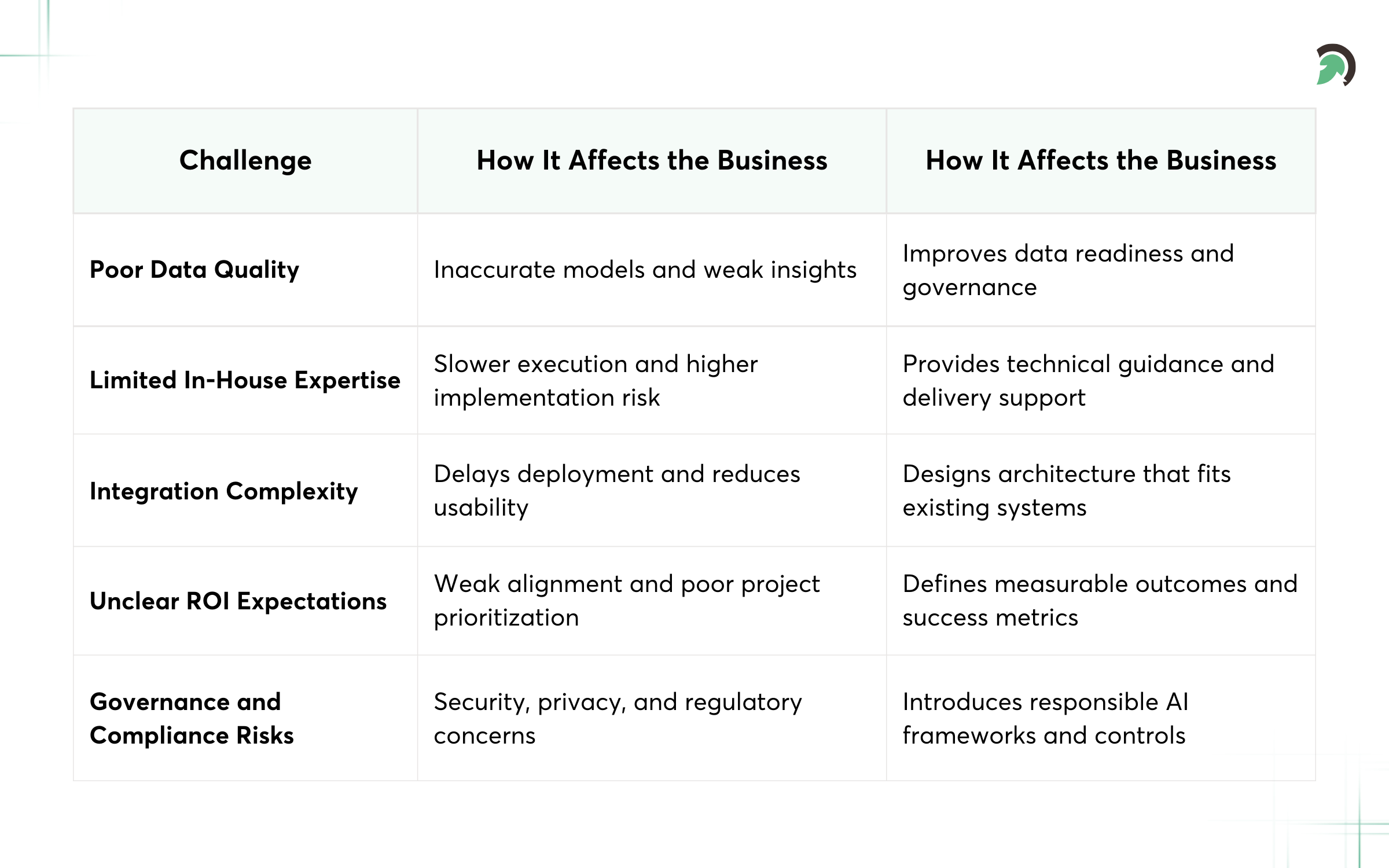
Although AI offers strong business potential, many organizations face challenges when moving from interest to implementation. These barriers can delay progress, increase costs, or limit the success of AI initiatives.
Common challenges include:
- Poor data quality: Incomplete, outdated, or siloed data makes it difficult to build reliable AI systems
- Limited in-house expertise: Many businesses lack the technical skills needed for machine learning, integrations, and AI engineering
- Integration complexity: AI solutions often need to connect with existing platforms, workflows, and enterprise systems
- Unclear ROI expectations: Projects can lose direction when business goals and success metrics are not clearly defined
- Governance and compliance concerns: Businesses must also consider privacy, security, and responsible AI practices
- Change management issues: Teams may resist new systems if implementation is not supported with training and clear communication
This is where AI consulting services add value by helping businesses reduce uncertainty, solve technical gaps, and create a more structured path to adoption.
Quick Stat:
According to a McKinsey survey, only 1% of companies report reaching full AI maturity, highlighting the gap between AI investment and successful implementation.
How AI Consulting Drives Business Transformation
The true value of AI is not limited to one automation project or one internal tool. When implemented well, artificial intelligence changes how a business operates at a deeper level. It improves decision-making, enhances customer experiences, supports innovation, and creates more scalable operating models.
-
Operational Efficiency
One of the most immediate benefits of AI is efficiency. Businesses can automate repetitive tasks, reduce processing times, and improve workflow speed across departments. This helps teams focus on higher-value responsibilities while reducing manual overhead.
-
Better Decision-Making
AI-powered analytics can help leaders make faster and more informed decisions. Predictive systems identify patterns, surface insights, and improve planning across operations, finance, marketing, supply chains, and customer service.
-
Improved Customer Experience
AI can strengthen personalization, speed up support, and create more intuitive digital experiences. Businesses use artificial intelligence to power recommendation engines, support assistants, intelligent routing, and proactive customer engagement.
-
Scalable Innovation
Consulting also helps businesses identify new revenue opportunities. Some organizations use AI to enhance existing products. Others launch entirely new platforms, services, or digital experiences built on intelligent systems.
This is why AI consulting services for businesses are becoming a strategic investment rather than a purely technical one. The impact can extend across operations, products, customer relationships, and long-term market positioning.
How Businesses Measure ROI from AI Consulting
For many decision makers, one of the most important questions is how to measure the return on investment from AI consulting services. The value of AI is usually seen not just in technical performance but in business outcomes that improve efficiency, productivity, and growth.
Common ROI indicators include:
- Reduced operational costs: through automation, process improvement, and lower manual effort
- Faster workflows: by streamlining repetitive tasks and improving response times across teams
- Higher productivity: allowing employees to focus more on strategic work instead of routine activities
- Better decision-making: using predictive insights, forecasting, and data-driven analysis
- Improved customer experience: through personalization, intelligent support, and faster service delivery
- New revenue opportunities: by launching AI-enabled products, features, or digital services
By tracking these outcomes, businesses can better understand how AI consulting contributes to measurable performance improvements and long-term competitive advantage.
What to Look for in the Right Consulting Partner
Choosing the right consulting partner is one of the most important decisions in the AI journey. Businesses should look beyond generic claims and evaluate whether the firm can actually support both strategic planning and technical execution.

A strong partner should offer:
- Experience with complex AI software development and real implementation environments
- A clear methodology for strategy, delivery, and scaling
- Knowledge of data infrastructure, integrations, and governance
- Ability to support enterprise AI consulting services across multiple functions
- Practical understanding of business outcomes, not just technical outputs
- A collaborative working style that helps internal teams build long-term capability
The best consulting relationships are not built around selling tools. They are built around solving business problems with the right combination of strategy, engineering, and execution discipline.
Future of AI Consulting
Artificial intelligence is evolving quickly, and consulting models are evolving with it. Businesses are now exploring generative AI, intelligent copilots, industry-specific automation, and real-time analytics in ways that were previously less accessible.
As adoption increases, consulting will become even more important. Organizations will need support not only with implementation but also with governance, ethics, compliance, and change management. New opportunities will continue to emerge, but so will new risks. Businesses that move thoughtfully will be better positioned to capture value while protecting trust, security, and long-term performance.
That is why consulting should not be seen as a short-term support function. It is becoming a core part of successful digital transformation.
Quick Stat:
According to Future Market Insights, the AI consulting services market will grow from $11.07 billion in 2025 to $90.99 billion by 2035, at a 26.2% compound annual growth rate.
Conclusion
Artificial intelligence is no longer just an emerging technology topic. It is now a business capability that directly influences growth, operational efficiency, customer experience, and innovation. Companies that want to unlock its full value need more than interest in AI. They need a clear strategy, strong technical foundations, and a practical roadmap for implementation.
This is where AI consulting services make a measurable difference. They help businesses identify the right opportunities, build scalable systems, and embed intelligence into everyday workflows. From strategic planning to AI app development and AI implementation consulting, the right partner can accelerate adoption while reducing risk.
For businesses aiming to grow with confidence, EvinceDev can help transform AI ambition into real business outcomes. With experience across strategy, development, and execution, EvinceDev supports organizations in building practical AI solutions that deliver long term value, stronger performance, and sustainable competitive advantage.