
Key Takeaways:
- AI’s New Direction: AI is moving from content generation to action-driven systems, making this shift important for modern businesses.
- What Generative AI Does: Generative AI creates text, images, and code by learning from large datasets and recognizing patterns.
- What Agentic AI Does: Agentic AI can plan, make decisions, and take action to complete tasks and achieve specific goals.
- Main Difference Explained: The difference between agentic AI and generative AI is action-oriented execution versus content generation.
- How Workflows Improve: Generative AI speeds up content tasks, while agentic AI improves automation and multi-step workflow execution.
- Different Use Cases: Generative AI supports creative output, while agentic AI is better suited for process automation and task handling.
- Real Business Benefits: Agentic AI helps reduce manual effort, improve speed, and support more scalable business operations.
- Where AI Is Heading: The future of AI lies in combining generative and agentic capabilities to build smarter digital systems.
Artificial intelligence is no longer limited to automating repetitive tasks or generating simple outputs. It is rapidly evolving into systems capable of thinking, planning, and executing complex workflows with minimal human intervention. At the center of this transformation is the growing conversation around Agentic AI vs Generative AI, two powerful yet fundamentally different approaches to AI.
Understanding Agentic AI vs Generative AI is essential for businesses navigating digital transformation. While generative AI has already reshaped industries by enabling rapid content creation and intelligent assistance, agentic AI represents the next step forward. It introduces autonomy, allowing systems to make decisions and act toward achieving defined goals.
The distinction between these two approaches is not just technical. It directly impacts how organizations design workflows, improve efficiency, and scale operations.
In this blog, we will explore Agentic AI vs Generative AI in depth, including definitions, working mechanisms, key differences, use cases, benefits, and future implications. This will help you determine which approach aligns best with your business needs.
Quick Stat:
According to McKinsey, 88% of organizations use AI in at least one business function, showing how quickly AI has become part of mainstream business operations.
To fully understand Agentic AI vs Generative AI, it is important to first define the roles of generative systems and agentic AI.
What Is Generative AI?
Generative AI refers to artificial intelligence models designed to create new and original content by learning patterns from large datasets. These models, including large language models and diffusion-based systems, are trained on massive volumes of data to understand structure, context, and relationships.
When a user provides a prompt, generative AI predicts the most relevant output based on its training. This could be a written response, a piece of code, an image, or even a video. The strength of generative AI lies in its ability to replicate human-like creativity and produce outputs at scale.
Use cases for generative AI
There are several high-impact use cases for generative AI across industries:
- Marketing teams use it to generate blogs, social media content, and ad copy
- Developers rely on it for code suggestions, debugging, and documentation
- Designers use it for image creation and concept visualization
- Enterprises deploy it for chatbots and knowledge assistants
GenAI workflow benefits
The adoption of generative AI brings significant GenAI workflow benefits:
- Accelerates content production cycles
- Reduces dependency on manual effort
- Enhances creativity and experimentation
- Enables scalability across multiple teams and functions
However, generative AI operates within a limited scope. It responds to prompts but does not independently plan or execute tasks. This limitation becomes clearer when comparing Agentic AI vs Generative AI.
Quick Stat:
Gartner estimates that global generative AI spending will reach $644 billion in 2025, driven by rising enterprise demand and adoption.
What Is Agentic AI?
Agentic AI refers to intelligent systems that can independently plan, make decisions, and execute tasks to achieve specific goals. Unlike generative AI, which focuses on producing outputs, agentic AI is designed to deliver outcomes through continuous action and reasoning.
Agentic AI systems combine multiple technologies, including large language models, memory frameworks, planning modules, and integrations with external tools or APIs. This allows them to operate in a loop where they can assess a situation, decide on a course of action, execute it, and refine their approach based on feedback.
Use cases for agentic AI
Organizations are increasingly exploring use cases for agentic AI in areas such as:
- Automating customer support workflows from query to resolution
- Managing complex business processes across departments
- Supporting clinical decision-making in healthcare
- Optimizing financial operations and compliance workflows
- Acting as intelligent assistants that handle multi-step tasks
Agentic AI workflow benefits
The shift toward agentic systems introduces several Agentic AI workflow benefits:
- Enables end-to-end automation of complex processes
- Reduces the need for constant human intervention
- Improves efficiency and operational speed
- Adapts dynamically to changing conditions
- Continuously learns and improves through feedback loops
When analyzing Agentic AI vs Generative AI, agentic AI clearly extends beyond creation into execution and decision-making.
How Has AI Evolved from Generative AI to Agentic AI?
The progression from generative AI to agentic AI reflects a broader shift in how artificial intelligence is applied.
Early AI systems were rule-based and limited in flexibility. Machine learning introduced adaptability, while generative AI brought creativity and content generation capabilities. However, as business needs became more complex, there was a growing demand for systems that could not only generate insights but also act on them.
This is where agentic AI emerges. It builds on the capabilities of generative models and adds layers of reasoning, planning, and execution. This evolution highlights the transition from passive assistance to active problem-solving.
In the context of Agentic AI vs Generative AI, this shift represents a move from isolated outputs to integrated workflows that deliver measurable outcomes.
Quick Stat:
According to McKinsey, 23% of organizations are actively scaling agentic AI systems, while 39% are still experimenting with AI agents, showing that agentic AI is gaining momentum but is still in a developing stage.
Agentic AI vs Generative AI: Key Differences
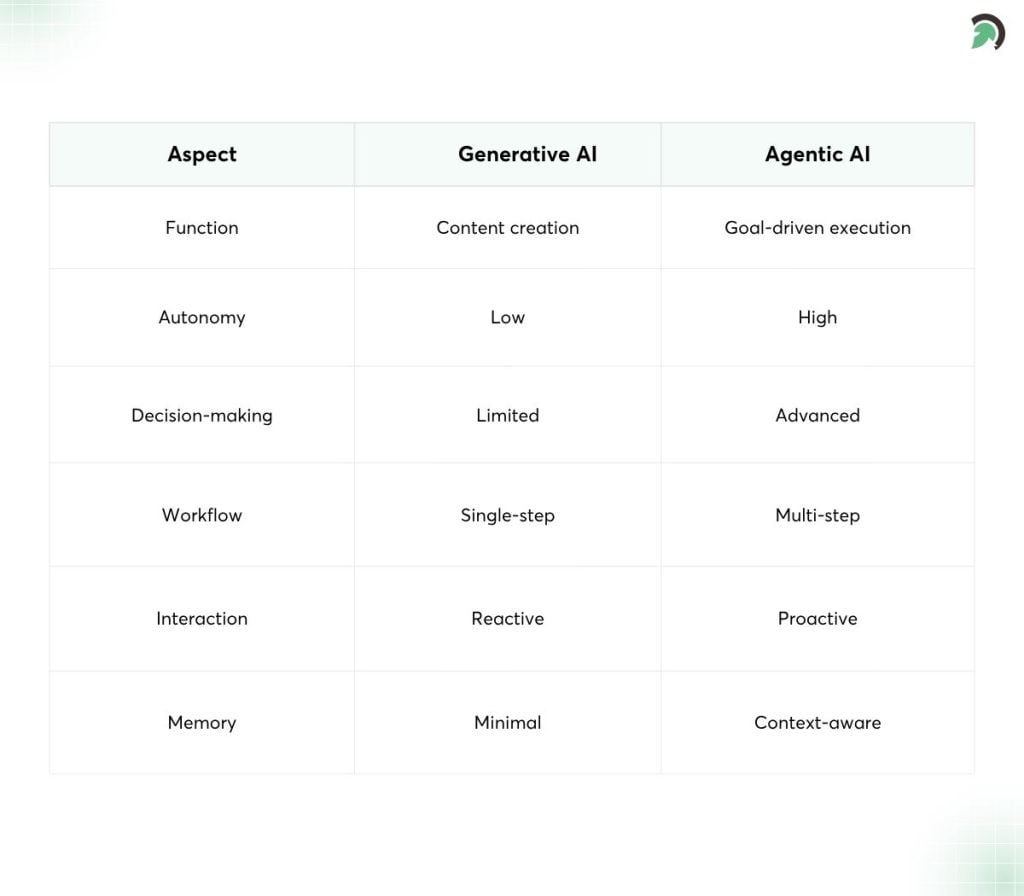
Understanding the difference between agentic AI and generative AI is essential for making the right strategic decisions.
Core Comparison
Detailed Explanation
- Output vs Outcome
Generative AI focuses on producing outputs such as text, images, or code. Agentic AI, on the other hand, is designed to achieve outcomes by completing tasks from start to finish. - Prompt-driven vs Goal-driven
Generative AI relies on user prompts for each action. Agentic AI operates based on predefined goals and determines the steps required to achieve them. - Static vs Adaptive Execution
Generative systems provide responses but do not adapt over time. Agentic systems continuously evaluate results and adjust their actions accordingly. - Human Dependency vs Autonomy
Generative AI requires ongoing human input, while agentic AI reduces dependency by automating workflows.
These distinctions are at the core of the Agentic AI vs Generative AI comparison and define how each technology is applied in real-world scenarios.
How Agentic AI Works
To better understand Agentic AI vs. Generative AI, it is important to examine how agentic systems are structured and how they function in real-world workflows. Unlike generative AI, which mainly responds to prompts with content, agentic AI is designed to interpret goals, make decisions, and take action through a connected system of components.
Agentic AI typically operates through the following interconnected layers:
- Perception Layer:
This layer captures and interprets inputs such as user requests, system signals, workflow triggers, or environmental data. It helps the agent understand the context in which it needs to operate. - Reasoning Engine:
The reasoning engine processes the input using AI models to analyze information, understand intent, and decide what needs to happen next. This is where the system evaluates options and supports intelligent decision-making. - Planning Module:
Once the objective is understood, the planning module breaks it down into smaller, actionable steps. Instead of handling only one instruction, agentic AI can map out a sequence of tasks required to achieve the goal. - Memory System:
The memory layer stores relevant context, previous interactions, workflow history, and learned patterns. This helps the system maintain continuity, improve responses, and make more informed decisions over time. - Action Layer:
This layer is responsible for execution. It connects the AI system to tools, APIs, databases, software platforms, or internal systems so it can complete tasks and advance workflows.
These components work together in a continuous loop:
- Define the objective:
The system identifies the goal based on user input or a workflow trigger. - Plan the next steps:
It determines the sequence of actions needed to achieve that goal. - Execute actions:
The AI interacts with connected systems or tools to carry out the required tasks. - Evaluate results:
It reviews outcomes, checks whether the action was successful, and identifies any gaps. - Refine the approach:
Based on feedback or updated conditions, it adjusts the next steps and continues the process.
This iterative workflow is what makes agentic AI more dynamic and action-driven. It can manage complex, multi-step tasks with greater autonomy, which is one of the biggest distinctions in Agentic AI vs Generative AI.
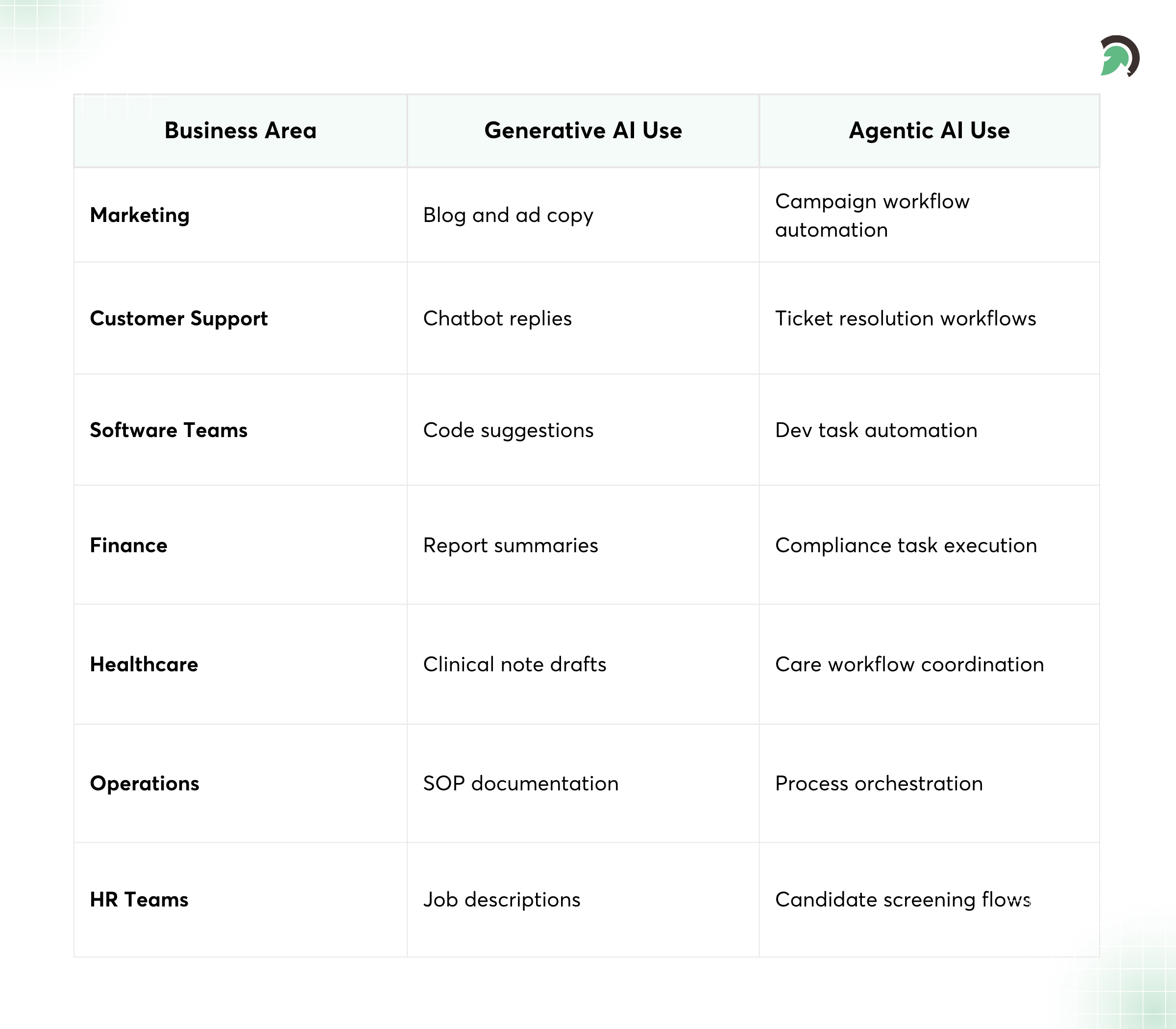
What Are the Use Cases of Generative AI vs Agentic AI?
Use cases for generative AI
Organizations are leveraging use cases for generative AI to enhance creativity and efficiency:
- Automated content generation for marketing and communication
- Code assistance for developers
- Design and multimedia creation
- Knowledge management and documentation
Use cases for agentic AI
In contrast, use cases for agentic AI focus on automation and execution:
- End-to-end workflow automation
- Intelligent customer service systems
- Supply chain and operations management
- Financial analysis and automated decision-making
Where They Overlap
Many modern applications combine both approaches. For example, AI copilots can generate insights and execute tasks, creating a seamless user experience. This overlap reinforces the importance of understanding Agentic AI vs Generative AI as complementary technologies.
Benefits of Agentic AI Over Generative AI
Agentic AI brings a more action-oriented approach to artificial intelligence, enabling systems to move beyond content generation and actively execute tasks. This shift introduces several practical advantages for businesses looking to automate and optimize their operations:
- End-to-End Workflow Automation:
Agentic AI can handle complete workflows, not just individual prompts or isolated tasks. - Greater Operational Efficiency:
It helps streamline processes and reduce delays by acting on goals with less manual input. - Faster Execution of Complex Tasks:
Agentic AI can manage multi-step tasks more effectively by planning and progressing actions on its own. - Reduced Manual Intervention:
Unlike generative AI, it requires less constant prompting and oversight during routine workflows. - Improved Decision Support:
It can assess context and determine the next best action based on the objective. - Continuous Improvement:
Feedback loops help agentic AI refine actions over time and improve overall accuracy. - Better Adaptability:
It can respond more effectively to changing inputs or conditions within dynamic workflows. - Stronger Enterprise Scalability:
Agentic AI is better suited for large-scale operations that involve multiple systems and processes. - Outcome-Driven Execution:
While generative AI focuses on creating outputs, agentic AI is designed to move tasks toward measurable outcomes.
What Are the Key Challenges and Risks?
Despite their advantages, both technologies present challenges.
Generative AI Challenges
- Risk of inaccurate or misleading outputs
- Limited contextual understanding
- Dependence on high-quality prompts
Agentic AI Challenges
- Complexity in design and deployment
- Risk of unintended actions
- Security and compliance concerns
- Need for strong governance frameworks
Evaluating these risks is essential when deciding between Agentic AI vs Generative AI.
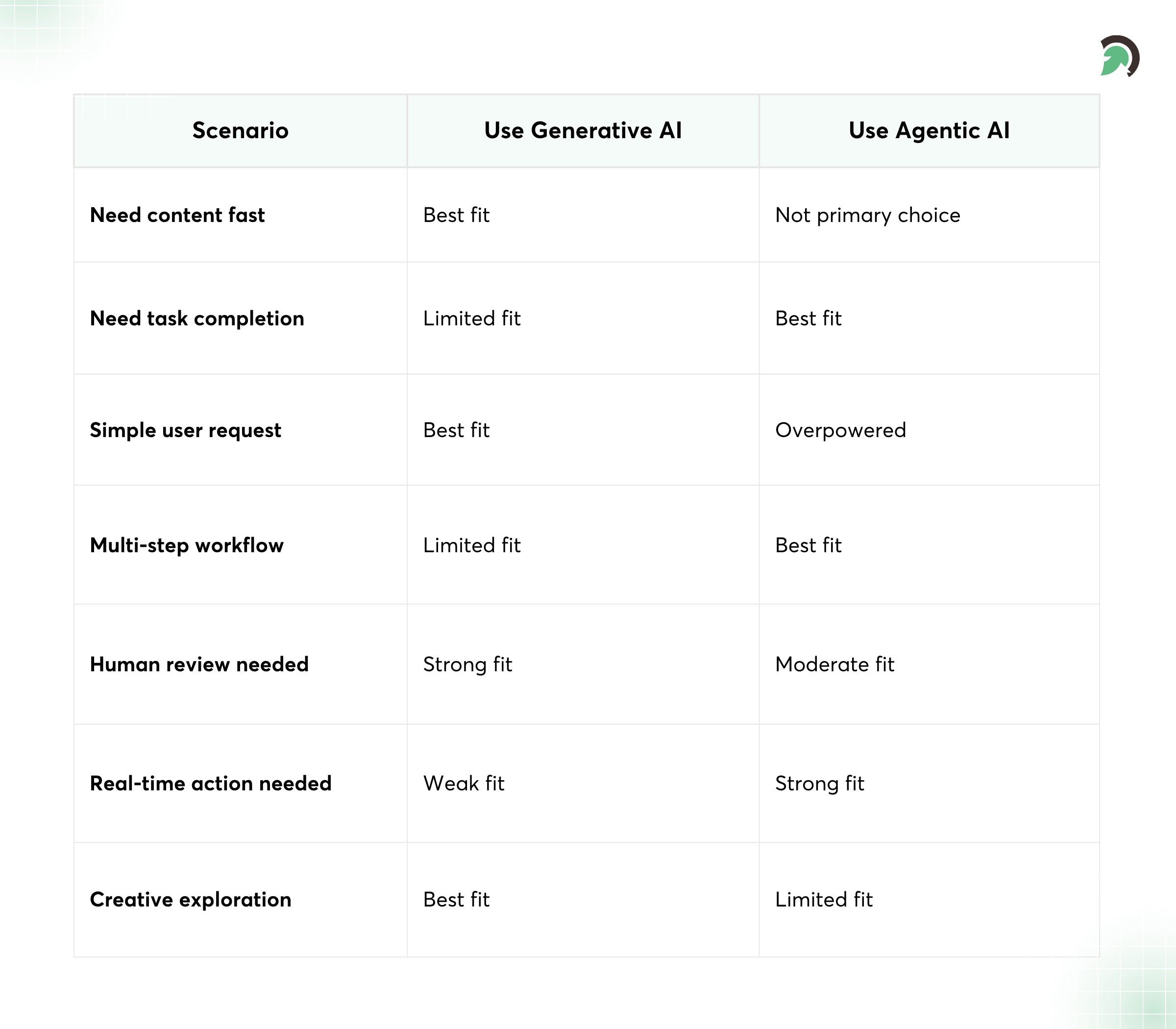
When to Use Generative AI vs Agentic AI
Choosing the right approach depends on the nature of the task.
Use Generative AI When
- The focus is on content creation
- Tasks are simple and well-defined
- Human oversight is required
Use Agentic AI When
- Tasks involve multiple steps and dependencies
- Automation and efficiency are priorities
- Decision-making is critical
This framework helps organizations make informed decisions in the Agentic AI vs Generative AI landscape.
The Future: Convergence of Agentic and Generative AI
The future of AI lies in combining the strengths of both approaches.
Hybrid systems are emerging that integrate generative capabilities with agentic execution. These systems can generate insights, make decisions, and take action in real time.
Businesses investing in AI consulting services are already exploring this convergence. For instance:
- In fintech software development, AI can generate financial insights and automate transactions
- Through generative AI consulting services, companies can optimize content workflows
- With AI solutions development, organizations can build scalable, intelligent ecosystems
This convergence makes the discussion of Agentic AI vs Generative AI more relevant than ever.
Conclusion
The Comparison of Agentic AI vs Generative AI marks a turning point in the use of artificial intelligence for various modern companies. Though generative AI technology has revolutionized the way people create and produce content, agentic AI moves further and allows for more autonomy and automation of decisions and processes.
It is critical for companies to understand the difference between agentic AI and generative AI, as this can help them choose capabilities that meet their needs. Instead of perceiving both models as rival technologies, companies should think about them as different approaches for achieving success.
As more and more organizations look for opportunities for AI applications, it becomes vital to consider the possibilities of combining these technologies.
This is where EvinceDev can add value. Our AI consulting services and generative AI consulting services help organizations identify where each technology fits best and how to maximize value from both. We also support businesses with custom AI solutions development built around agentic and generative AI, along with digital transformation services tailored to different industries.