


Key Takeaways:
- AI Planning Shift: AI-driven financial planning replaces static budgets with real-time, adaptive financial strategies and insights.
- Smarter Decisions: AI improves financial decision-making with predictive analytics, helping businesses respond faster to change.
- Real-Time Insights: Continuous data analysis enables real-time financial monitoring, forecasting, and dynamic adjustments.
- Better Forecasting: AI enhances forecasting accuracy using data-driven models, reducing uncertainty in financial planning.
- Personalized Plans: AI-driven financial planning delivers tailored strategies based on individual goals, behavior, and risk levels.
- Cost & Efficiency: Automation reduces manual effort and operational costs, improving efficiency across financial workflows.
- Risk Management: AI identifies risks and anomalies early, helping businesses strengthen financial control and compliance.
- Future of Finance: AI is shaping financial planning through intelligent systems, automation, and scalable decision-making.
Financial planning has traditionally been a structured but rigid process. Individuals and businesses relied on periodic reviews, manual calculations, and assumptions that often became outdated within weeks. In a world where markets shift rapidly and financial decisions grow more complex, this approach is no longer sufficient.
Today, AI-driven financial planning is redefining how financial strategies are created, managed, and optimized. Instead of static spreadsheets and delayed insights, AI introduces real-time intelligence, predictive analysis, and continuous adaptation. This shift is not just about automation. It is about enabling better, faster, and more informed financial decisions.
As organizations and individuals navigate increasing financial complexity, the integration of financial planning technology powered by artificial intelligence is becoming essential. From investment strategies to operational budgeting, AI is transforming financial planning into a dynamic, data-driven system.
Quick Stat:
Around 75% of financial firms are already using AI, with an additional 10% planning to adopt it in the coming years, highlighting how rapidly AI is becoming a major part of financial operations, according to a report from the Bank of England.
What Is AI-Driven Financial Planning?
At its core, AI-driven financial planning involves using artificial intelligence to analyze financial data, predict future outcomes, and automate decision-making. Unlike traditional planning methods that rely on historical data and human interpretation, AI systems continuously learn and adapt based on real-time inputs.
The role of AI in financial planning is to create a more responsive and intelligent system. It combines multiple technologies such as ML, predictive analytics, and automation to deliver insights that are both accurate and actionable.
Key components include:
- Data aggregation from multiple financial sources
- Predictive modeling for forecasting
- Automated recommendations
- Continuous monitoring and optimization
With AI for financial planning, decisions are no longer based on static assumptions. Instead, they evolve dynamically as new data becomes available.
Quick Stat:
According to McKinsey, AI can improve financial forecasting accuracy by up to 20–30%, enabling more reliable and data-driven financial decisions.
How AI Transforms Financial Planning
The biggest shift introduced by AI-driven financial planning lies in how financial strategies are developed and executed.
Traditional Financial Planning
- Periodic reviews, often monthly or annually
- Heavy reliance on manual analysis
- Reactive decision-making
- Limited personalization
AI-Driven Financial Planning
- Continuous, real-time monitoring
- Predictive and scenario-based insights
- Automated adjustments
- Highly personalized recommendations
For example, instead of setting a fixed monthly budget, an AI-powered system can adjust spending recommendations in response to real-time income fluctuations, unexpected expenses, or market changes.
This transformation shows us how artificial intelligence changes financial planning from something reactive to something proactive, where people and companies are able to predict their financial results and be prepared for them.
Key Technologies Behind AI-Driven Financial Planning
The effectiveness of AI-driven financial planning depends on a combination of advanced technologies working together within modern financial planning technology ecosystems.
Machine Learning
ML algorithms analyze large volumes of financial data to identify patterns and trends. These insights help improve forecasting accuracy and enable better decision-making.
Predictive Analytics
Predictive models estimate future financial outcomes based on historical and real-time data. This allows businesses to anticipate revenue changes, market shifts, and potential risks.
Natural Language Processing (NLP)
NLP enables AI systems to process unstructured financial data such as reports, news, and customer feedback. This helps in understanding sentiment and external factors that may impact financial decisions.
Data Integration Systems
Today’s financial technology incorporates information from several sources like banking systems, investment platforms, and business software. Such an approach becomes crucial to implementing AI in financial planning.
Combined together, they constitute the basis of smart financial technologies that can be further developed and improved upon.
Real-World Use Cases of AI-Driven Financial Planning
The impact of AI-driven financial planning is best understood through practical applications across different financial domains.
1. Personal Financial Planning
AI-powered tools help individuals manage budgets, track expenses, and optimize savings. For example, a system can analyze spending habits and recommend adjustments to achieve financial goals faster.
2. Investment Management
AI enables dynamic portfolio optimization by analyzing market trends, risk factors, and individual preferences. Investors receive personalized recommendations that adapt to changing market conditions.
3. Business Financial Planning
Organizations use financial planning technology to forecast revenue, manage cash flow, and optimize operational costs. AI systems can simulate different business scenarios and recommend the most effective strategies.
4. Risk and Fraud Detection
AI systems identify unusual patterns in financial transactions, helping detect fraud and mitigate risks before they escalate.
5. Tax Optimization
AI tools analyze financial data to identify tax-saving opportunities, ensuring compliance while maximizing efficiency.
These use cases demonstrate how AI in financial planning delivers value across both individual and enterprise contexts.
Benefits of AI-Driven Financial Planning
The growing adoption of AI-driven financial planning is driven by its ability to deliver measurable advantages.
Real-Time Insights
AI systems provide continuous updates, enabling faster and more informed decisions.
Hyper-Personalization
Financial strategies are tailored to individual needs, preferences, and goals.
Cost Efficiency
Automation reduces the need for manual processes, lowering operational costs.
Improved Accuracy
AI minimizes human errors by relying on data-driven analysis.
Faster Decision-Making
Access to real-time data and predictive insights accelerates the decision-making process.
By integrating AI for financial planning, organizations and individuals can achieve better financial outcomes with greater efficiency.
Quick Stat:
According to Gartner, about 59% of finance leaders have already implemented AI in their finance functions, showing how quickly AI is becoming part of modern financial decision-making.
Challenges and Limitations
Despite its advantages, AI-driven financial planning is not without challenges.
Data Privacy Concerns
Handling sensitive financial data requires robust security measures and regulatory compliance.
Over-Reliance on Automation
Excessive dependence on AI can lead to reduced human oversight and potential risks.
Algorithmic Bias
AI systems may produce biased results if trained on incomplete or skewed data.
Lack of Transparency
Some AI models operate as black boxes, making it difficult to understand how decisions are made.
Integration Challenges
Implementing advanced financial planning technology within existing systems can be complex.
Addressing these challenges is necessary to realize the potential of AI in financial planning.
AI vs Traditional Financial Planning
A direct comparison highlights the advantages of AI-driven financial planning over traditional methods.
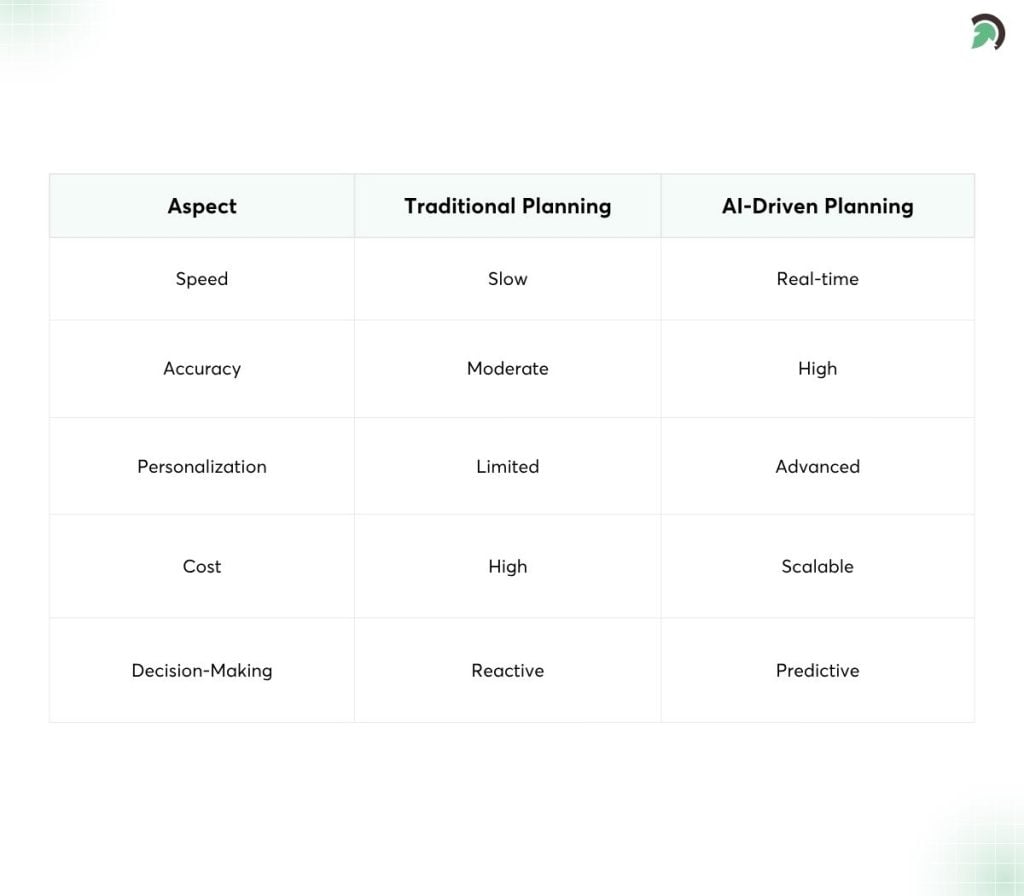
This comparison reinforces why AI in financial planning is becoming the preferred approach for modern financial management.
How to Adopt AI-Driven Financial Planning
The implementation of AI-driven financial planning must follow a systematic process. It aims not to revolutionize current financial systems in one fell swoop, but to enhance their performance through technology, information, and sound judgment.
Start with Data Readiness
Begin by ensuring financial data is accurate, well-organized, and easy to access. AI performs best when it works with clean, reliable, and connected data sources.
Choose the Right Tools
Select solutions that match your financial goals, business needs, and existing systems. The right platform should support your planning process while making analysis and forecasting more efficient.
Integrate Gradually
Introduce AI in phases instead of applying it across all functions at once. Starting with specific use cases helps reduce disruption and allows teams to adapt more effectively.
Combine AI with Human Expertise
AI should support financial decision-making, not replace it. Human judgment remains essential for interpreting insights, setting priorities, and making strategic choices.
Organizations looking to build tailored solutions often turn to FinTech Software Development to create custom platforms that meet their operational and financial needs. In many cases, AI consulting services also help businesses choose the right adoption strategy and technology stack. For a broader industry context, AI in Fintech offers useful insight into how AI is shaping the future of financial services.
The Future of AI in Financial Planning
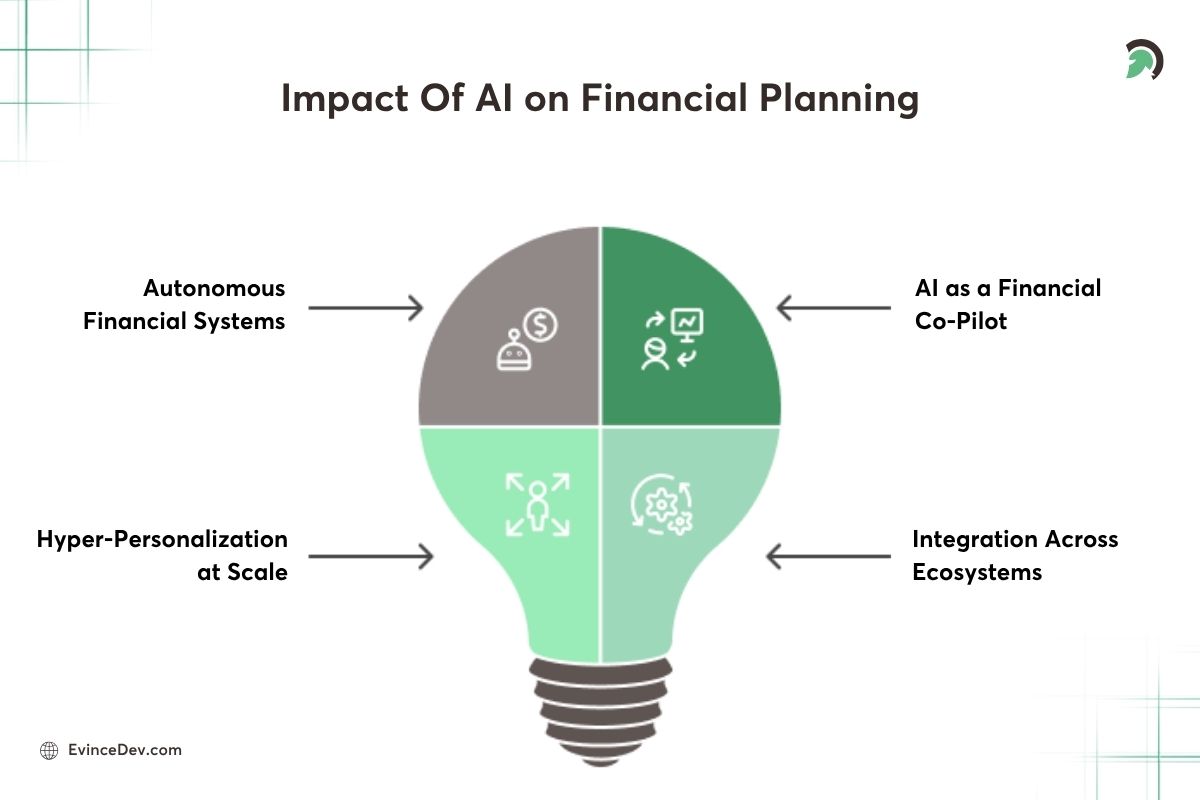
The future of AI-driven financial planning is centered around increased autonomy and intelligence.
Autonomous Financial Systems
AI systems will manage financial processes with minimal human intervention.
AI as a Financial Co-Pilot
AI will assist users in making complex financial decisions by providing real-time recommendations.
Hyper-Personalization at Scale
Financial strategies will become increasingly tailored to individual and business needs.
Integration Across Ecosystems
AI will connect financial planning with broader business systems, creating a unified decision-making environment.
As AI for financial planning continues to evolve, it will play a crucial role in shaping the future of financial management.
Quick Stat:
According to PwC, 86% of financial services firms expect AI to become mainstream in their operations, showing how quickly AI is moving from experimentation to widespread adoption across the industry.
Conclusion
The use of AI for financial planning has brought about a revolution in this area. Through the use of technology and timely information, AI makes it possible for individuals to engage in financial planning that is much more precise than before.
Though there are still some obstacles associated with AI technology when used for financial planning purposes, the benefits associated with such technology make it impossible to ignore the need for its adoption.
As companies seek to embrace the revolution in financial planning using AI technology, those that take the lead will be in a better position to survive and thrive in the financial industry.
Financial planning has ceased being the business of making future predictions, and it has become the process of constantly adjusting to changes in the environment.