


Key Takeaways:
- Smarter Care Access: Conversational AI in healthcare improves access to information, support, and services through faster digital interactions.
- Stronger Patient Engagement: It helps patients receive quicker answers, easier scheduling, and more personalized communication across care journeys.
- Efficient Care Workflows: Healthcare teams can reduce repetitive tasks and improve operational efficiency with AI-powered conversations.
- High-Impact Use Cases: Common applications include appointment booking, triage, follow-ups, intake support, and billing assistance.
- Responsible AI Use: Effective adoption depends on privacy, compliance, accuracy, and the right balance of automation and human oversight.
- Future-Ready Healthcare: Conversational AI for healthcare is shaping more scalable, proactive, and patient-centered care experiences.
Healthcare systems across the world are under increasing pressure. Rising patient expectations, administrative overload, workforce shortages, and the need for faster, more accessible care are pushing providers to rethink how they operate. Patients today expect the same level of convenience they experience in other industries, including instant responses, digital-first communication, and personalized interactions. This is where conversational AI in healthcare is making a significant impact. By enabling intelligent, human-like interactions through chatbots, voice assistants, and AI-driven messaging systems, healthcare organizations can streamline communication, reduce operational burden, and improve patient experiences.
From scheduling appointments to supporting clinical workflows, conversational AI in healthcare is rapidly evolving into a foundational technology that supports both patients and providers. As digital transformation accelerates, its role is becoming increasingly critical in delivering scalable, efficient, and patient-centric care.
In this blog, we will explore what conversational AI in healthcare is, how it works, its key use cases, implementation considerations, and the future trends shaping its role in modern healthcare.
Quick Stat:
The rapid growth of conversational AI in healthcare is reflected in market projections, with the global market valued at around $13.5 billion in 2024 and expected to reach nearly $48.8 billion by 2030 at a CAGR of over 23%, according to Yahoo Finance.
What Is Conversational AI in Healthcare?
At its core, conversational AI in healthcare refers to the use of artificial intelligence systems that can understand, process, and respond to human language in a natural and meaningful way within healthcare environments.
These systems are designed to simulate conversations through text or voice interfaces, enabling patients, caregivers, and healthcare professionals to interact with digital systems as they would with a human assistant.
Unlike traditional rule-based chatbots, modern conversational AI technology in healthcare uses advanced machine learning and natural language processing to understand context, intent, and user behavior. This allows for more accurate, dynamic, and personalized interactions.
Whether it’s answering patient queries, guiding users through care pathways, or assisting clinicians with information retrieval, healthcare conversational AI is transforming how communication happens across the healthcare ecosystem.
How Conversational AI Works in Healthcare
To understand the value of conversational AI healthcare systems, it’s important to look at how they function behind the scenes.
These systems rely on several key components:
- Natural Language Processing (NLP):
This enables the system to understand human language, including variations in phrasing, tone, and intent. - Machine Learning Models:
AI models learn from historical data and interactions, improving accuracy and response quality over time. - Intent Recognition and Context Handling:
The system identifies what the user wants and maintains context across conversations, ensuring continuity and relevance. - Speech Recognition and Voice Processing:
In voice-enabled systems, speech-to-text and text-to-speech technologies allow seamless interaction. - Integration with Healthcare Systems:
Modern solutions connect with EHRs, CRMs, scheduling systems, and billing platforms, enabling real-time data access and action.
Through these capabilities, conversational AI technology in healthcare can deliver intelligent, context-aware responses that go far beyond simple scripted interactions.
Chatbots vs Conversational AI vs AI Agents
It’s important to distinguish between different types of conversational systems used in healthcare:
- Rule-Based Chatbots:
These follow predefined scripts and decision trees. They are limited in flexibility and cannot handle complex or unexpected queries. - Conversational AI Systems:
These use NLP and machine learning to understand intent and context. They can manage dynamic conversations and provide more personalized responses. - AI Agents:
These are more advanced systems capable of executing tasks autonomously, such as scheduling appointments, triggering workflows, or coordinating across multiple systems.
Understanding these differences helps organizations choose the right level of sophistication when implementing conversational AI for healthcare solutions.
Why Healthcare Organizations Are Adopting Conversational AI?
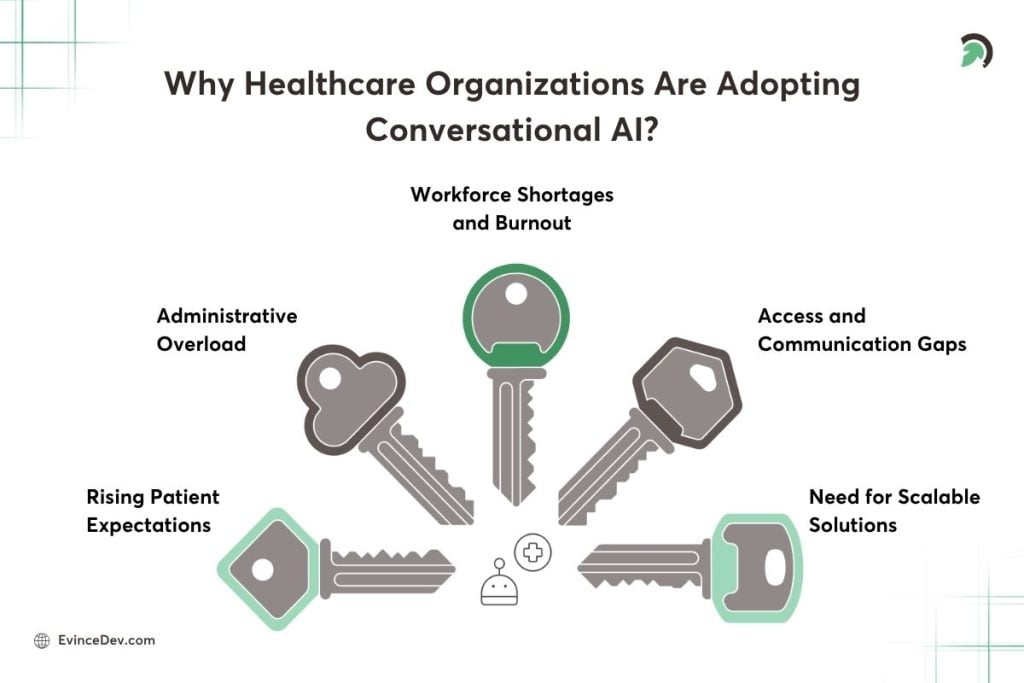
The adoption of conversational AI in healthcare is being driven by several critical factors.
- Rising Patient Expectations:
Patients expect quick, convenient, and digital-first communication options. - Administrative Overload:
Healthcare staff spend a significant amount of time handling repetitive tasks such as scheduling, follow-ups, and answering routine questions. - Workforce Shortages and Burnout:
Automation helps reduce workload and allows staff to focus on higher-value tasks. - Access and Communication Gaps:
Patients often face delays in getting information or care, especially outside of regular hours. - Need for Scalable Solutions:
Healthcare providers need systems that can handle increasing demand without proportional increases in staffing.
By addressing these challenges, conversational AI healthcare solutions are enabling organizations to operate more efficiently while improving patient engagement.
Quick Stat:
Nearly 90% of healthcare executives say digital and AI transformation is a high or top priority for their organizations, highlighting its strategic importance in improving patient experience and operational efficiency, according to McKinsey.
Top Use Cases of Conversational AI in Healthcare
Patient Access and Engagement
One of the most impactful applications of conversational AI in healthcare is in improving patient access and engagement.
- Appointment Scheduling and Reminders:
Patients can book, reschedule, or cancel appointments instantly without waiting on hold. - Patient Intake and Pre-Visit Data Collection:
AI systems collect patient information before visits, reducing paperwork and saving time. - Symptom Checking and Triage:
Patients can describe symptoms and receive guidance on next steps, helping prioritize care. - Medication Reminders and Adherence Support:
Automated reminders help patients follow prescribed treatment plans. - Post-Visit Follow-Ups:
AI systems check in with patients after visits, ensuring continuity of care. - Multilingual and 24/7 Support:
Patients can interact in their preferred language at any time, improving accessibility.
These capabilities make healthcare conversational AI a powerful tool for enhancing patient experiences. These use cases are especially valuable in areas such as Behavioral Healthcare Software Development, where timely communication, follow-ups, and accessible patient support play a critical role in care continuity.
Clinical Workflow Support
Beyond patient-facing use cases, conversational AI for healthcare also supports clinicians and care teams.
- Information Retrieval:
Clinicians can quickly access patient data, clinical guidelines, or research insights through conversational interfaces. - Clinical Decision Support:
AI can assist in analyzing data and suggesting relevant information, improving decision-making. - Care Coordination:
Automated systems can help manage follow-ups, referrals, and communication between care teams. - Patient Education:
AI tools provide consistent and accurate information to patients, reducing the burden on clinicians.
By integrating into clinical workflows, conversational AI healthcare improves efficiency and reduces cognitive load on healthcare professionals.
Administrative and Operational Workflows
Administrative tasks are another area where conversational AI in healthcare delivers significant value.
- Billing and Insurance Queries:
Patients can get instant answers to billing questions and coverage details. - Call Center Automation:
AI handles high volumes of inquiries, reducing wait times and operational costs. - Patient Routing:
Systems guide patients to the right department or specialist based on their needs. - Internal Helpdesk Support:
Staff can use conversational interfaces for IT, HR, or operational queries.
These applications highlight how conversational AI technology in healthcare can streamline operations and improve overall efficiency.
Benefits of Conversational AI in Healthcare
For Patients
- Faster Responses and Better Access:
Patients receive immediate assistance without delays. - Improved Convenience:
Tasks like scheduling and follow-ups become simple and accessible. - Personalized Communication:
AI systems tailor interactions based on patient history and preferences. - Enhanced Engagement:
Regular communication improves adherence and outcomes.
For Providers and Healthcare Systems
- Reduced Administrative Burden:
Automation minimizes repetitive tasks and manual work. - Improved Staff Efficiency:
Healthcare teams can focus on high-value activities. - Cost Savings:
Operational efficiencies lead to reduced costs over time. - Scalability:
Organizations can handle higher volumes without increasing staff.
By delivering these benefits, conversational AI in healthcare is becoming a key driver of digital transformation.
Quick Stat:
Healthcare organizations are increasingly seeing operational benefits from AI, with many reporting improvements in efficiency and workflow optimization, according to the HIMSS and Medscape AI Adoption in Healthcare Report 2024.
What Conversational AI Should Not Replace
While conversational AI in healthcare offers significant value, it should not replace human expertise in situations that require medical judgment, empathy, or direct clinical oversight.
It should not be used as a substitute for:
- Clinical judgment and diagnosis
- Complex medical decision-making
- Empathetic human interaction in sensitive care situations
- Critical care or urgent scenarios that require direct supervision
Instead, conversational AI for healthcare should function as a support system, helping healthcare professionals work more efficiently while keeping human care at the center.
Risks, Challenges, and Compliance Considerations
Despite its potential, implementing conversational AI in healthcare comes with challenges.
- Data Privacy and Security:
Healthcare data is highly sensitive, requiring strict compliance with regulations like HIPAA. - Accuracy and Reliability:
AI systems must provide accurate information to avoid risks. - Bias and Fairness:
Training data must be carefully managed to prevent bias. - Integration Complexity:
Connecting with existing systems like EHRs can be challenging. - Regulatory Oversight:
Healthcare AI must meet evolving regulatory standards. - Digital Literacy Barriers:
Not all patients are comfortable using digital tools.
Addressing these concerns is critical for the successful adoption of healthcare conversational AI solutions.
How to Implement Conversational AI in Healthcare Successfully
A structured approach is essential for implementing conversational AI in healthcare effectively.
Define Clear Use Cases:
Start with specific problems such as appointment scheduling or patient support.
Engage Key Stakeholders:
Involve clinical, IT, compliance, and operational teams early.
Start with a Pilot:
Test the solution in a controlled environment before scaling.
Ensure System Integration:
Connect with EHRs, CRMs, and other platforms for seamless workflows.
Train Staff and Users:
Provide guidance to ensure adoption and effective usage.
Monitor and Optimize:
Continuously track performance, accuracy, and user feedback.
This approach ensures that conversational AI technology in healthcare delivers measurable value.
How to Evaluate a Conversational AI Solution
Choosing the right solution is critical when investing in conversational AI healthcare.
Consider the following factors:
- Healthcare-specific capabilities
- Data security and compliance readiness
- Integration with existing systems
- Human handoff and escalation mechanisms
- Multilingual support
- Customization and scalability
- Analytics and reporting features
Reviewing relevant healthcare case studies can also help organizations assess how conversational AI solutions perform in real clinical, operational, and patient engagement settings. This can support more informed decision-making and long-term success for conversational AI for healthcare initiatives.
Future Trends in Conversational AI for Healthcare
The future of conversational AI in healthcare is promising and rapidly evolving.
- Hyper-Personalization:
AI will deliver highly tailored interactions based on patient data. - Proactive Care Management:
Systems will anticipate patient needs and provide timely interventions. - Integration with Wearables and IoT:
Real-time data from devices will enhance AI-driven insights. - Advanced AI Agents:
More autonomous systems will handle complex workflows. - Expanded Clinical Applications:
AI will play a greater role in decision support and care delivery.
As these trends evolve, conversational AI technology in healthcare will continue to reshape the industry.
Conclusion
Conversational AI in healthcare is transforming how patients and providers interact, enabling faster communication, improved efficiency, and better care experiences. By automating routine tasks and supporting clinical workflows, it allows healthcare professionals to focus on what matters most: delivering quality care.
However, successful adoption requires careful planning, strong governance, and a clear understanding of its limitations. When implemented thoughtfully, conversational AI healthcare solutions can drive meaningful improvements in access, efficiency, and patient satisfaction.
As healthcare continues to evolve, conversational AI in healthcare will play an increasingly central role in shaping a more connected, responsive, and patient-centric ecosystem. As a Custom Software Development Company with expertise in building secure, scalable, and intelligent digital health solutions, EvinceDev helps healthcare organizations develop conversational AI systems tailored to their operational needs, patient engagement goals, and long-term growth.