

Imagine a customer is ready to buy, but instead of searching on Google, they ask ChatGPT: “Where should I buy this from?” That is already happening every day, and it is reshaping how Shopify brands get discovered. This shift is exactly why Shopify Agentic Storefronts are becoming important: storefronts designed to be easily understood, trusted, and recommended by AI tools during real buying conversations.
For years, ecommerce discovery followed a predictable path. Someone had a need, searched on Google, clicked a few results, compared options, and bought. But that pattern is changing fast. More shoppers are skipping search engines and going straight to AI tools like ChatGPT, Microsoft Copilot, and Perplexity to get instant recommendations that feel curated and context aware.
They ask questions like: What is the best Shopify store for sustainable clothing? Which brand sells good skincare for sensitive skin? Where can I buy minimalist furniture online in India? The answers often include brand names, product suggestions, and direct links. To the shopper, it feels conversational, faster than opening multiple tabs, and easier than doing research alone.
In fact, in a Bloomreach survey of 1,000+ U.S. consumers, 61% said they have used general-purpose AI tools like ChatGPT, Gemini, or similar assistants to help them shop online.
Here is the challenge for Shopify store owners: if your store is not easy for AI to understand and trust, it may not show up at all, even if your Google SEO looks solid. That can mean fewer discovery moments, fewer clicks, and eventually fewer sales, while competitors who adapt early start getting recommended inside these AI conversations.
This is where Shopify Agentic Storefronts and thoughtful Shopify development come together. In this blog, we break down what agentic storefronts are, why AI chats are becoming a critical discovery channel, and how Shopify brands can structure their stores to get discovered, trusted, and recommended by AI tools.
What Is an Agentic Storefront in Simple Terms?
An agentic storefront is not a new Shopify theme or app. It is a way of structuring and presenting your store so AI tools can understand, trust, and recommend it.
In simple words, an agentic storefront is:
A Shopify store that AI assistants can confidently talk about when users ask buying questions. In practice, a Shopify agentic storefronts setup means your product pages, policies, and support content are structured so AI can quickly understand what you sell and why it is credible.
A regular Shopify store is built mainly for humans. Shopify agentic storefronts are built for humans and AI agents.
This does not mean writing robotic content or stuffing keywords. It means being extremely clear about:
- What you sell
- Who it is for
- What problem does it solve?
- Why your store is trustworthy
AI tools work like smart research assistants. They scan content, compare sources, evaluate clarity, and summarize the best answers for users. If your store content is vague, overly marketing-heavy, or missing key information, AI will skip it.
Agentic storefronts focus on clarity over cleverness.
Why AI Chats Are the New Discovery Channel?
AI chats are becoming powerful discovery channels for three main reasons.
-
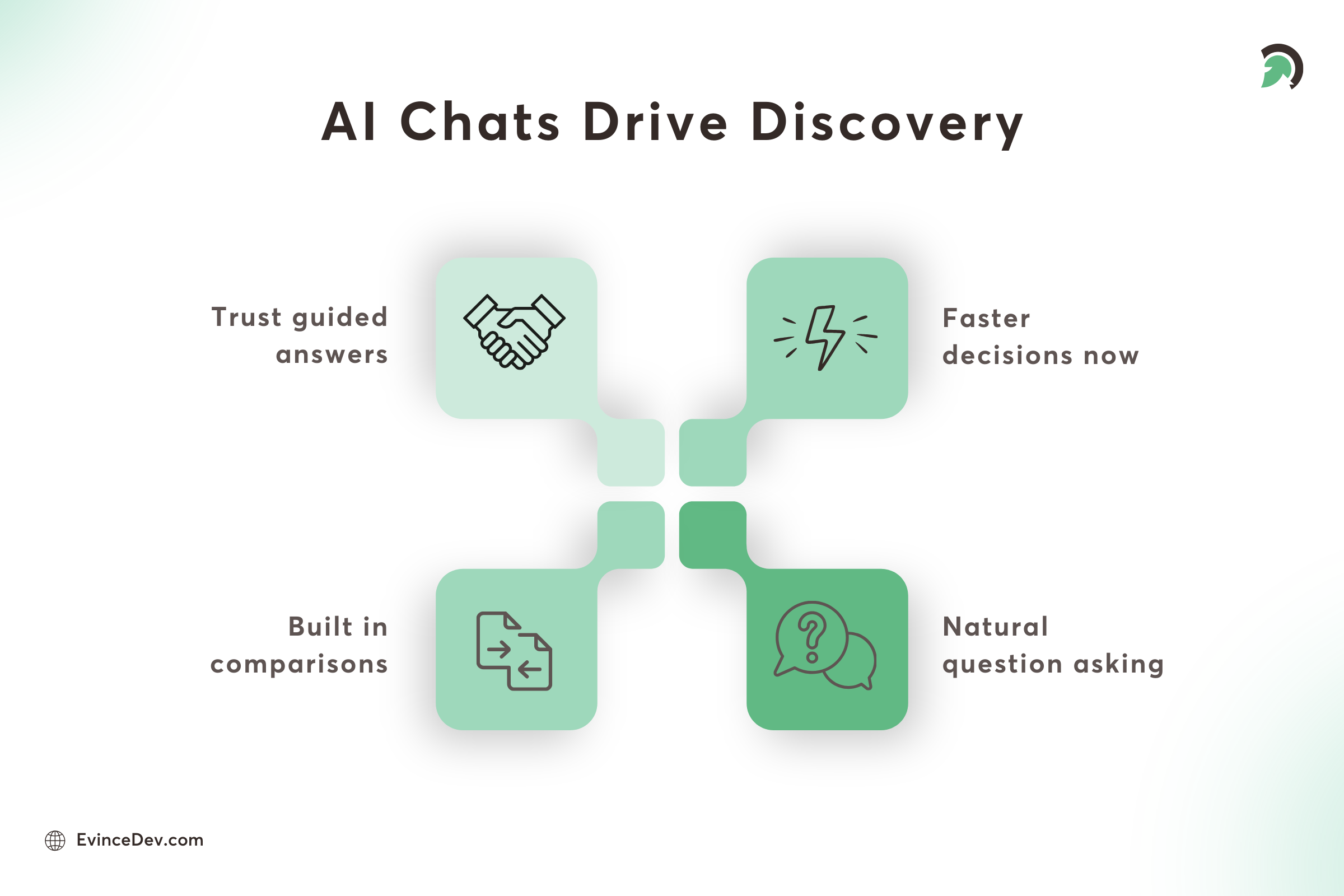
People Trust Conversational Answers
When an AI explains why a product is good, who it is suitable for, and where to buy it, users feel guided rather than sold to. This builds trust quickly.
Instead of browsing ten tabs, users get a single, structured response.
-
People Trust Conversational Answers
When an AI explains why a product is good, who it is suitable for, and where to buy it, users feel guided rather than sold to. This builds trust quickly.
Instead of browsing ten tabs, users get a single, structured response.
AI Search Is Redefining Online Buying Journeys
-
AI Compresses Decision-Making
AI tools do the comparison work for users. They summarize features, pros and cons, pricing ranges, and brand reputation. This shortens the buyer journey.
If your Shopify store is part of that summary, you are already halfway to a sale.
-
Younger Buyers Prefer Asking Over Searching
Many users, especially younger ones, are more comfortable asking questions than typing search keywords. AI chats feel natural, fast, and personalized.
This behavior is not replacing Google overnight, but it is reducing dependency on traditional search.
For Shopify brands, this means discovery is no longer just about ranking number one. It is about being the best answer.
Quick Stat:
Adobe reported that AI-driven traffic to U.S. retail sites jumped 4,700%, as shoppers used generative AI tools to research products, find deals, and get gift ideas.
This is why AI search optimization for ecommerce is becoming essential: discovery is shifting from keyword searches to AI-generated answers that summarize and recommend.
How AI Tools Decide Which Shopify Stores to Mention?
AI tools do not randomly recommend stores. While their exact systems differ, they generally look for the same signals.
1. Clear Understanding of What the Store Sells
AI needs to understand quickly:
- What category does your store belong to
- What types of products do you offer
- What makes your products different
Stores with vague descriptions like “premium quality products for modern lifestyles” are hard to understand. AI prefers plain explanations like “We sell handcrafted leather wallets made in India for everyday use.”
2. Strong Trust and Credibility Signals
AI tools are cautious about recommending unreliable stores. They look for signals such as:
- Clear About Us pages
- Transparent return and shipping policies
- Reviews and testimonials
- Mentions on other websites
Trust is not built through claims. It is built on evidence.
3. Helpful Content That Answers Buyer Questions
Stores that answer common questions clearly have an advantage. For example:
- Who is this product best for
- How is it different from alternatives
- What problems does it solve
- What are its limitations
AI values content that educates rather than only promotes.
4. Consistent Information Across the Web
If your brand information is consistent across your website, social profiles, directories, and mentions, AI finds it easier to trust and recommend you.
Inconsistency creates doubt.
What Are the Key Elements of an AI-Friendly Shopify Store?
Creating an agentic storefront does not require a complete rebuild. Most improvements are content and structure-focused. The goal of a Shopify AI commerce setup is simple: make your store easy to interpret, easy to trust, and easy to recommend inside AI conversations.
1. Clear Product Descriptions in Plain Language
Your product descriptions should explain the product as if you are talking to someone who has never seen it before.
Good descriptions answer:
- What it is
- What it does
- Who it is for
- Why is it useful
Avoid excessive hype and buzzwords. AI struggles with exaggerated marketing language.
2. Strong About Us Page
Your About Us page should clearly explain:
- Who you are
- Why the brand exists
- What makes you different
- Where you operate
This page is a major trust signal for AI and users.
3. Detailed FAQs
FAQs are extremely valuable for AI discovery.
They help AI understand:
- Common objections
- Use cases
- Shipping and returns
- Product limitations
Well-written FAQs are often summarized directly in AI-generated answers.
4. Clear Policies and Transparency
Make sure your store clearly displays:
- Shipping timelines
- Return and refund policies
- Contact information
Transparency builds confidence.
5. Reviews and Social Proof
Customer reviews, testimonials, and user-generated content help AI assess real-world credibility.
Even a small number of genuine reviews is better than none.
Content Types That Help AI Recommend Your Store
Beyond product pages, certain content formats work especially well for AI discovery.
1. Problem-Solution Content
Content that starts with a problem and explains how your product solves it is easy for AI to summarize.
Example:
- Common problems people face
- Why existing solutions fail
- How your product helps
2. Product Comparisons and Alternatives
Comparison content helps AI place your product in context.
Examples:
- How your product compares to traditional options
- Differences between product variants
- When your product is a better choice and when it is not
Honest comparisons build trust.
3. Use Cases and Buyer Guides
Explain how different people use your product.
For example:
- Best use cases
- Industries or lifestyles it suits
- Scenarios where it performs best
This helps AI match your store to specific user queries.
4. Who This Product Is for and Not For
This type of content is powerful.
It shows confidence and honesty. AI tools value this clarity and often include such nuance in answers.
Technical Implementation: Turning a Shopify Store into an Agentic Storefront
Most discussions around AI discovery stop at content and SEO. While clarity and trust are essential, technical implementation is what truly differentiates an agentic storefront from a regular Shopify store. This is where many brands fall behind.
An AI-friendly store is not just well-written. It is well-structured at the technical level, enabling AI systems to reliably parse, interpret, and reuse information.
1. Structured data that AI can understand
AI tools rely heavily on structured information to understand products, brands, and relationships between them.
For Shopify stores, this means:
- Proper product schema
- Clear pricing, availability, and variant data
- Explicit brand, category, and product attributes
Structured data helps AI answer questions like:
- What exactly is this product
- How much does it cost
- Is it in stock
- How does it compare to alternatives
Without this, AI has to guess. And AI rarely recommends what it cannot confidently understand.
2. Clear information architecture
Agentic storefronts are intentionally organized for both humans and machines.
This includes:
- Logical category hierarchies
- Consistent product naming conventions
- Clean URL structures
- Predictable page layouts
When product, category, and brand information follow a consistent structure, AI tools can map your store more easily and place it correctly in recommendations.
3. Machine-readable FAQs and support content
FAQs are one of the most valuable assets for AI discovery, but only if implemented correctly.
Agentic storefronts:
- Use clear question-and-answer formatting
- Avoid burying FAQs inside images or accordions only
- Keep answers specific and unambiguous
This allows AI systems to extract and summarize answers accurately when users ask questions like:
- Is this product good for beginners
- What is the return policy
- How long does shipping take
4. Performance, accessibility, and crawlability
AI tools favor sources that are easy to access and process.
Key technical considerations include:
- Fast page load speeds
- Mobile-first layouts
- Clean HTML output
- Accessible content that is not locked behind scripts
Heavy animations, blocked content, or overly complex front-end logic can reduce how much of your store AI systems can reliably read.
5. Content designed for reuse, not just reading
Agentic storefronts treat content as modular building blocks.
For example:
- Product summaries that can stand alone
- Feature lists written in complete sentences
- Use case sections are clearly separated from marketing copy
This makes it easier for AI tools to quote, summarize, or reference your store in responses.
6. Why this technical layer is a real differentiator
Most Shopify stores stop at surface-level optimization. They write better content but ignore how that content is technically exposed.
Brands that invest in:
- Clean data structures
- Thoughtful architecture
- AI-readable formatting
Create a compounding advantage. As AI-driven discovery grows, these stores become trusted sources that are repeatedly referenced.
This is where, ultimately, experienced Shopify partners add the most value, not just by designing pages, but by engineering storefronts that AI systems can confidently work with.
What Are the Common Mistakes Shopify Stores Make?
Many Shopify stores unintentionally make themselves invisible to AI.
- Vague and Generic Content: Generic statements do not help AI understand anything. Clear explanations always win.
- Over-Optimizing for Keywords: Keyword-heavy content written for search engines often reads poorly for humans and AI. AI prefers natural language.
- Missing Trust Information: No About Us page, weak policies, or hidden contact details reduce credibility.
- Ignoring Off-Site Presence: AI looks beyond your website. If your brand has no external mentions or inconsistent information, trust drops.

Help AI Discover and Recommend Your Shopify Store
How to Start Optimizing Your Store Today?
You do not need to do everything at once. Think of this as your Shopify AI storefront setup checklist, focused on clarity, trust, and content that AI tools can confidently recommend. Start with these steps.
Step 1: Audit Your Store for Clarity
Read your product pages as if you are a first-time visitor. Ask yourself:
- Is it clear what this product does
- Is it obvious who should buy it
Rewrite where needed.
Step 2: Add Buyer-Focused FAQs
Use real customer questions from emails, chats, or comments. Answer them clearly and honestly.
Step 3: Improve Your About Us Page
Tell your brand story simply. Avoid buzzwords.
Step 4: Create One or Two Helpful Blog Posts
Focus on buyer questions, comparisons, or use cases. Quality matters more than quantity.
Step 5: Think Beyond Google
When writing content, imagine answering a real person’s question. If your content would help an AI answer that question, you are on the right path.
Conclusion
AI chats are quickly becoming a real starting point for shopping decisions. When someone asks ChatGPT, Copilot, or Perplexity what to buy, they want a clear recommendation, not ten tabs to open. That means Shopify stores that communicate clearly, show strong trust signals, and answer buyer questions are more likely to get surfaced, mentioned, and linked.
The good news is this is not about tricks or hacks. At its core, it is about building a storefront that is easy to understand and easy to trust. Clear product pages, strong FAQs, transparent policies, and helpful content create confidence for both humans and AI.
If you want to move faster, a leading shopify development company in USA like EvinceDev can help you build an AI-ready Shopify presence end to end, from storefront improvements and content strategy to Shopify SEO optimization, structured data, and conversion-focused UX. Ultimately, the goal is simple: make your store the kind of source AI systems can confidently recommend, and make sure the traffic you earn converts once it arrives.