

Your customer is online again, not on one platform or in one place, but everywhere. They scroll news sites at lunch, open apps on the commute, browse late at night, and compare products when they are ready to buy. In those in-between moments, brands compete for a few seconds of attention, which is why choosing the right display ads network matters for staying visible across the journey.
That is where display advertising still earns its keep.
Display ads continue to keep brands top of mind, bring high-intent visitors back, and support the shift from browsing to buying. What has changed is how display is bought and optimized. Automation is speeding up campaign management, privacy changes are reshaping targeting, and AI is set to transform optimization and measurement.
In this guide, you will learn what display ad networks are, how the landscape looks today, what to prioritize when evaluating options in 2026, and the top 10 display ad networks to consider.
What Is a Display Advertising Network?
A display advertising network is a platform that connects advertisers with websites and apps that have available ad space. These networks aggregate inventory from publishers and make it accessible to advertisers through a single interface. Instead of negotiating placements with individual websites, advertisers can launch campaigns that appear across thousands or even millions of digital properties. Display advertising networks are often referred to as banner ad networks, and the best display ad network is simply the one that matches your audience, goals, and budget.
Display ad networks are primarily visual ad format-focused, with most supporting image banners, rich media, native-style placements, and video. Some focus on premium placements, while others focus on scale, performance marketing, or specific verticals such as mobile apps or eCommerce.
How Do Display Advertising Networks Work?
Display advertising networks sit between advertisers and publishers, enabling the buying and selling of adspace at scale. Instead of negotiating placements site by site, advertisers use a network to reach audiences across many websites and apps through one system.
-
Step 1: Publishers provide inventory
They provide a list of advertisement spaces available. This space can consist of websites, mobile applications, or online platforms. Each space is designed to target a specific ad format. It can target standard banners, rich media, native ad space, or video.
-
Step 2: Advertisers set campaign inputs
The advertisers tell the network what it is trying to achieve by setting the objectives, audiences, budgets, bidding preferences, creatives, and conversion goals. This input helps the network understand who to reach and what outcome is to be optimized for, such as traffic, leads, purchases, or remarketing.
-
Step 3: A real-time decision happens when a user loads a page
An ad impression can happen when a user opens a webpage or an app. The ad network checks it instantly with signals like device type, location, time of day, page content, etc., which would give the guarantee on engagement or conversion, and in many cases, such decisions are reached through a real-time auction running in milliseconds, selecting the advertiser whose ad is most competitive and relevant.
-
Step 4: Targeting determines who sees what
Modern display networks will commonly employ a combination of contextual, audience-based, and geo- and device-based targeting, along with various forms of retargeting based on previous visits or actions. As the privacy rules continue to evolve, most networks have been relying on contextual signals, first-party data, and aggregated or modeled audiences more and more, rather than relying on individual user identifiers.
-
Step 5: Automation continuously improves delivery
Once the campaign goes live, machine learning systems continuously observe performance and instantly optimize bids, budgets, and placements on paths most likely to drive your objective. Creatives also run through ranking to make sure top-performing ones get more delivery and weaker creatives less.
-
Step 6: Reporting focuses on outcomes, not just impressions
Reporting screening has increased in sophistication, too. Now, in addition to impressions and clicks, suppliers offer metrics like placement-level performance, engagement quality, conversion pathways, and frequency management. This makes it easier for the advertiser to optimize properly.
Why Does Display Advertising Still Matter in 2026?
Even with the rise of short-form video and social commerce, display advertising remains a core channel because it solves problems that most platforms cannot solve alone: scale, consistency, and full-funnel visibility.
Quick Stat:
Google says Display Network sites reach over 90% of internet users worldwide, which is why display remains a dependable channel for awareness and remarketing at scale.
What makes display advertising still valuable?
- It delivers massive reach across the open internet
Display helps you appear across websites, apps, and publisher properties where people spend time daily, not just inside one platform. - It supports full-funnel marketing from awareness to retargeting
You can use display to introduce your brand, nurture interest through repeated exposure, and bring back users who visited but did not convert. - It complements search and social instead of competing with them
Search captures intent and social drives engagement, but display reinforces brand recall in the in-between moments, improving overall campaign performance. It also supports seo services indirectly by increasing brand familiarity and repeat visits, which can improve overall demand and engagement over time. - It scales efficiently with automation and AI
Modern display networks can auto-optimize targeting, bidding, and delivery using machine learning, making it easier to test and scale without constant manual effort.
What Criteria Should You Use to Evaluate Display Advertising Networks?
Before ranking any network as “best,” it is important to define the criteria used to evaluate them. In practice, many of these tools function as broader display advertising platforms, so the same evaluation criteria apply. In 2026, strong display ad networks typically excel in the following areas:
- Inventory quality and reach
- Audience and contextual targeting capabilities
- Supported ad formats
- Optimization and automation features
- Reporting transparency and analytics depth
- Pricing models and budget flexibility
- Ease of setup and account management
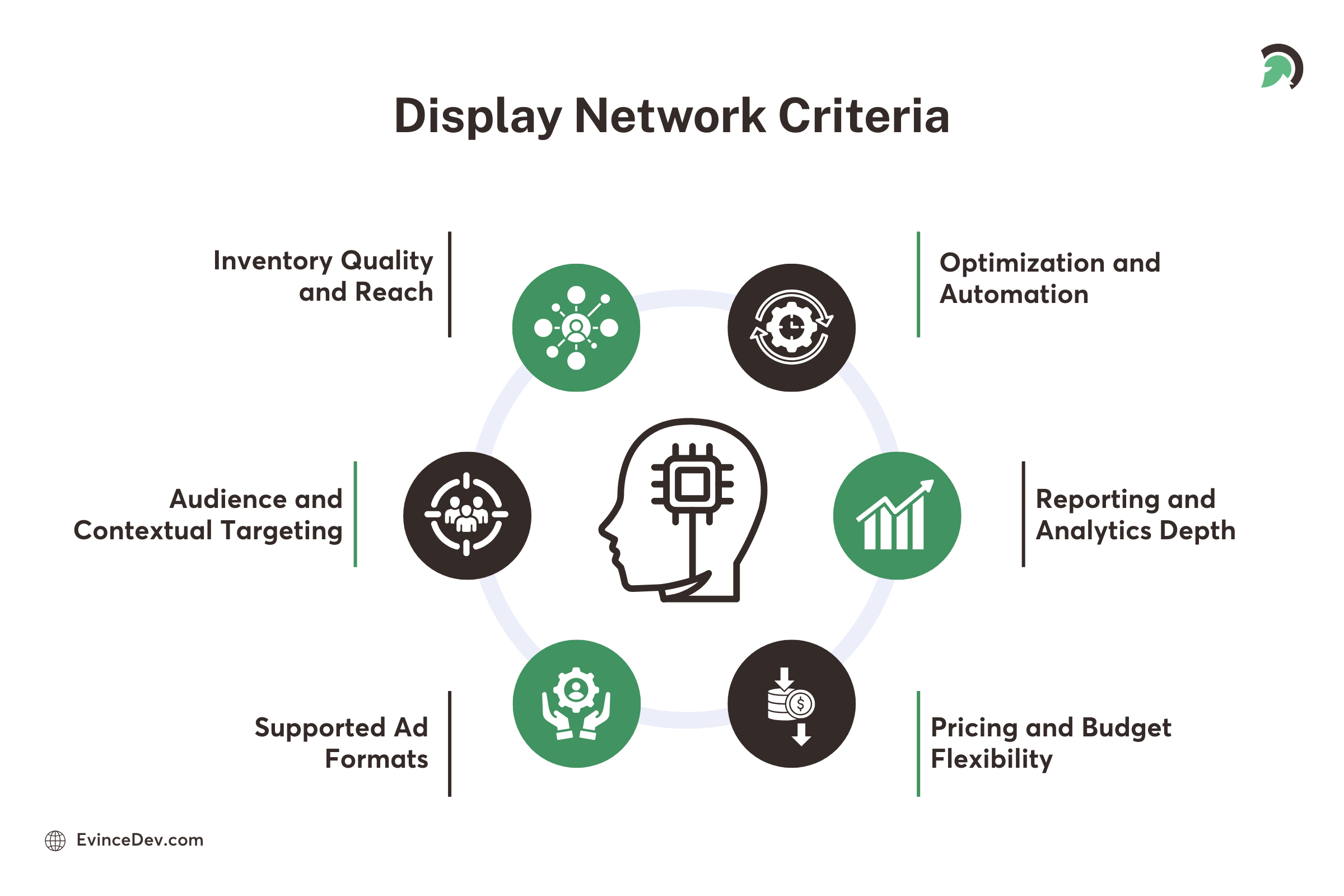
Evaluation Checklist for Display Advertising Network Selection
The best networks balance scale with control, automation with transparency, and performance with brand safety.
Market Insight:
IAB UK reports that the UK’s digital ad market hit £35.5bn in 2024, up 13% year on year, which is a useful signal that competition for attention is rising and that network choice and optimization matter more than ever.
What Types of Display Advertising Networks Should You Understand First?
Not all display networks are built the same. Most fall into one or more of these categories:
- Mass-reach display networks that prioritize scale across millions of sites
- Mobile and in-app networks optimized for app environments
- Native and discovery networks that blend ads into content feeds
- Programmatic DSPs that provide access to multiple exchanges and premium inventory
- Performance-focused networks that emphasize conversions and testing
Understanding these categories helps you align network choice with your marketing goals.
What Are the 10 Best Display Advertising Networks of 2026?
Below is a comprehensive breakdown of the top display advertising networks in 2026, using a consistent evaluation framework to help you compare them effectively.
1. Google Display Network
Google Display Network remains one of the most widely used display advertising platforms in the world. It provides access to a massive ecosystem of websites, mobile apps, and owned properties such as Gmail and YouTube placements.
- Best for: large-scale awareness, remarketing, and performance campaigns
- Key strengths: unmatched reach, advanced automation, seamless integration with Google Ads
- Ad formats: responsive display ads, image banners, rich media
Google’s strength lies in its machine learning capabilities. Campaigns automatically optimize toward conversions or value, reducing manual workload. However, advertisers must actively manage placements and creative performance to avoid inefficiencies.
Best practice: Start with tightly defined audiences and expand gradually using performance data and exclusions.
2. Meta Audience Network
Meta Audience Network extends display advertising beyond social feeds into third-party mobile apps. It is especially effective for reaching mobile-first users through immersive ad formats.
- Best for: mobile app users, gaming audiences, and performance-driven campaigns
- Key strengths: strong in-app inventory, immersive formats, integration with Meta’s ad ecosystem
- Ad formats: interstitials, native placements, rewarded video
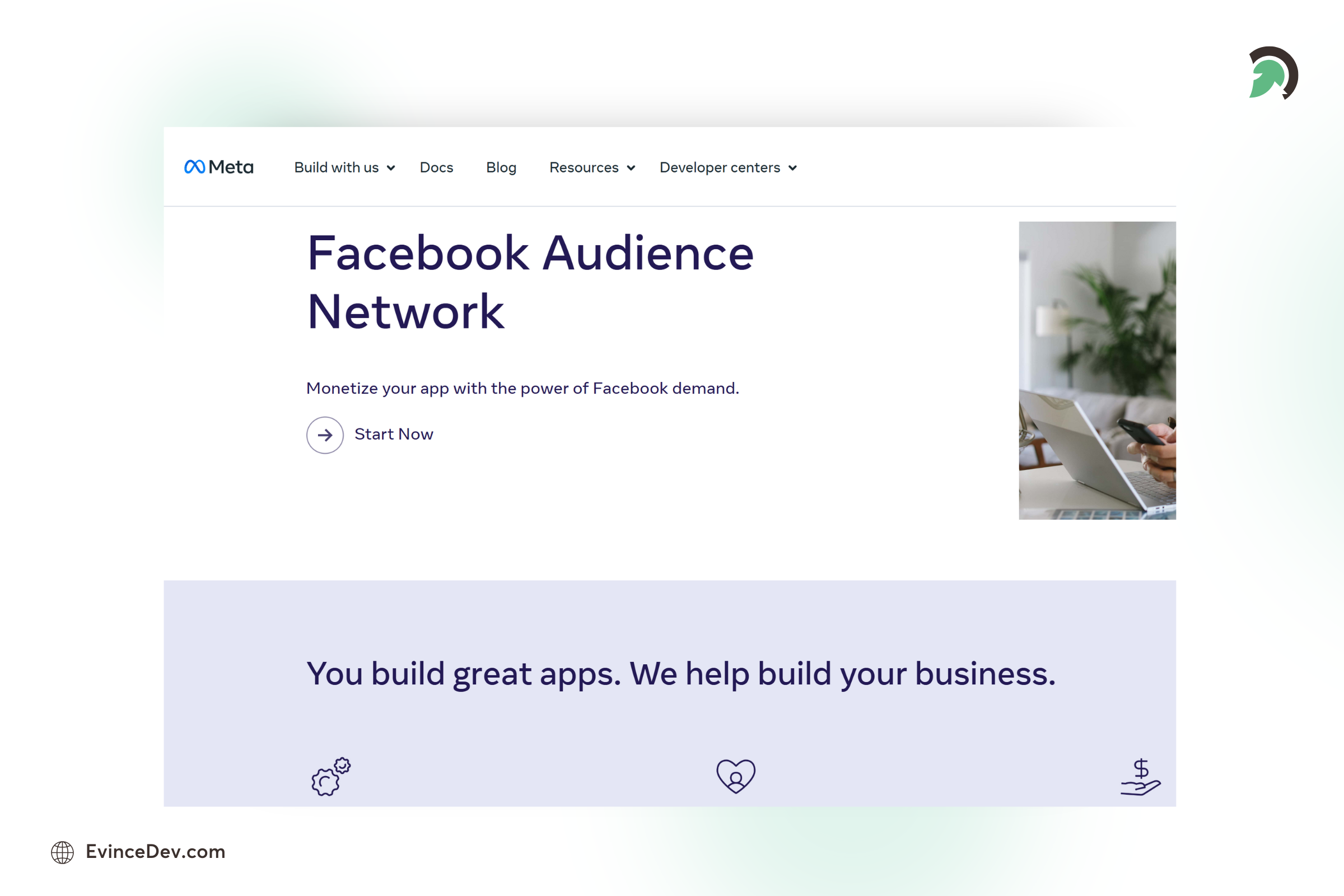
Facebook Audience Network Overview
Creative quality plays a significant role in success on this network. Ads must be designed specifically for mobile experiences to achieve strong results.
Best practice: Develop mobile-native creatives and track post-click engagement carefully.
3. Microsoft Advertising Network
Microsoft Advertising Network offers display and native placements across Microsoft-owned properties and premium publisher partners. It often attracts professional and desktop-oriented audiences.
- Best for: B2B awareness, professional services, and brand-safe environments
- Key strengths: high-quality placements, transparent reporting, audience uniqueness
- Ad formats: display and native-style ads
Microsoft’s network is frequently used as a diversification channel alongside Google Display Network, offering incremental reach and strong contextual alignment.

Microsoft Advertising Targeting Overview
Best practice: Test Microsoft display as a secondary channel with tailored messaging for productivity-focused users.
4. Amazon DSP
Amazon DSP allows advertisers to reach audiences based on shopping behavior across Amazon properties and third-party sites. It is especially valuable for brands operating in ecommerce.
- Best for: retail brands, product launches, and lower-funnel display strategies
- Key strengths: commerce-driven targeting, strong intent signals, full-funnel capabilities
- Ad formats: programmatic display and video
Amazon DSP excels when campaigns are aligned with clear purchase paths. It is less effective for abstract brand storytelling without transactional relevance.
Best practice: Combine prospecting with retargeting and measure assisted conversions, not just last-click performance.
5. Apple Ads
Apple Ads focuses on high-intent placements within the App Store and is expanding its advertising footprint across Apple’s ecosystem.
- Best for: App installs, subscription growth, App Store visibility
- Key strengths: High-intent search placements, strong privacy positioning
- Ad formats: App Store search ads
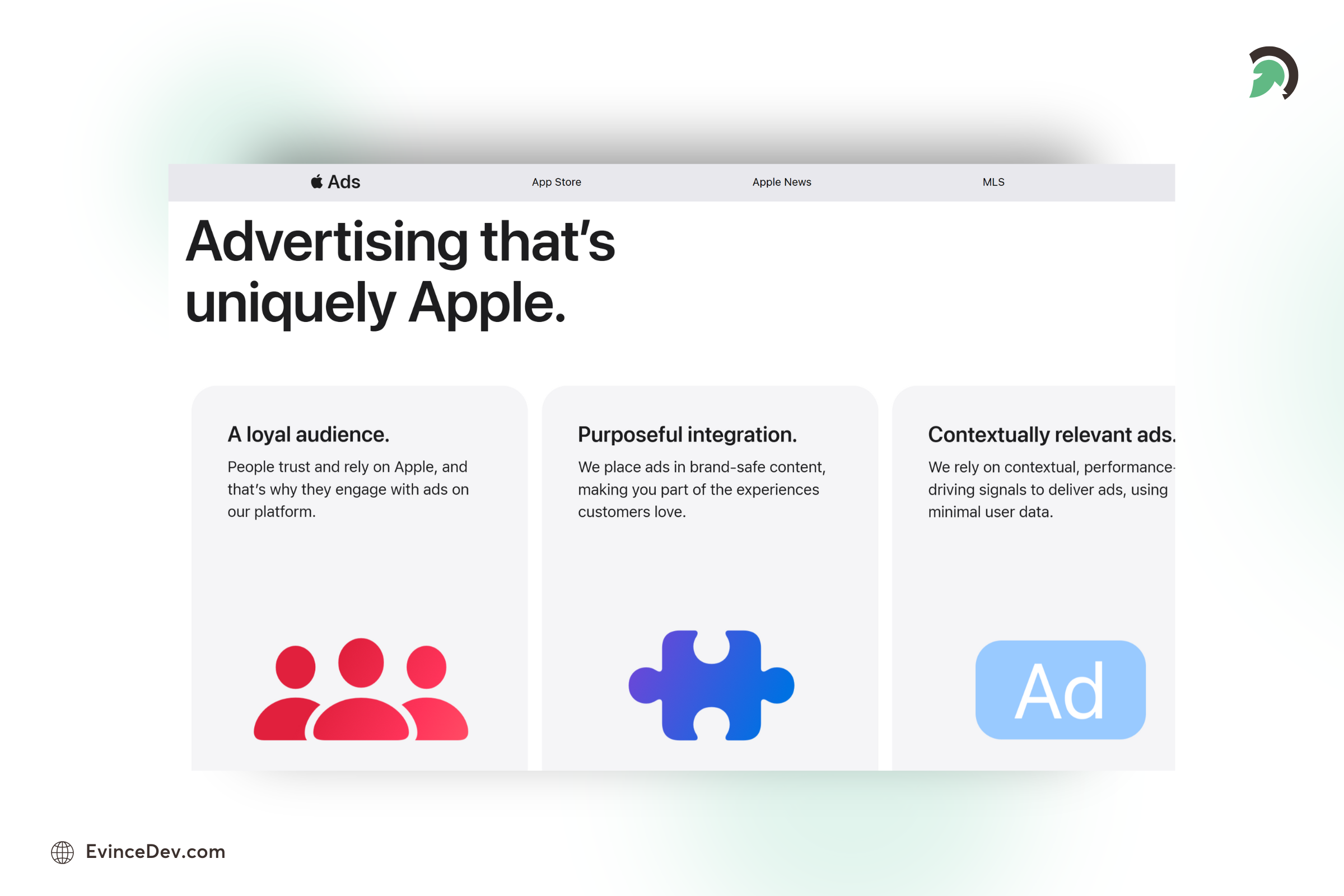
Apple Ads Targeting and Formats
While limited in scope compared to Google or Meta, Apple Ads delivers strong conversion rates for app-focused advertisers.
Best practice: Align keywords and creatives tightly with user search intent.
6. Outbrain
Outbrain is another major player in the native and discovery advertising space. It focuses on distributing content across premium publisher environments.
- Best for: brand discovery, thought leadership, and top-of-funnel traffic
- Key strengths: premium publishers, strong engagement when content aligns
- Ad formats: native discovery units
Optimization is essential, as traffic quality can vary by publisher category and creative angle.
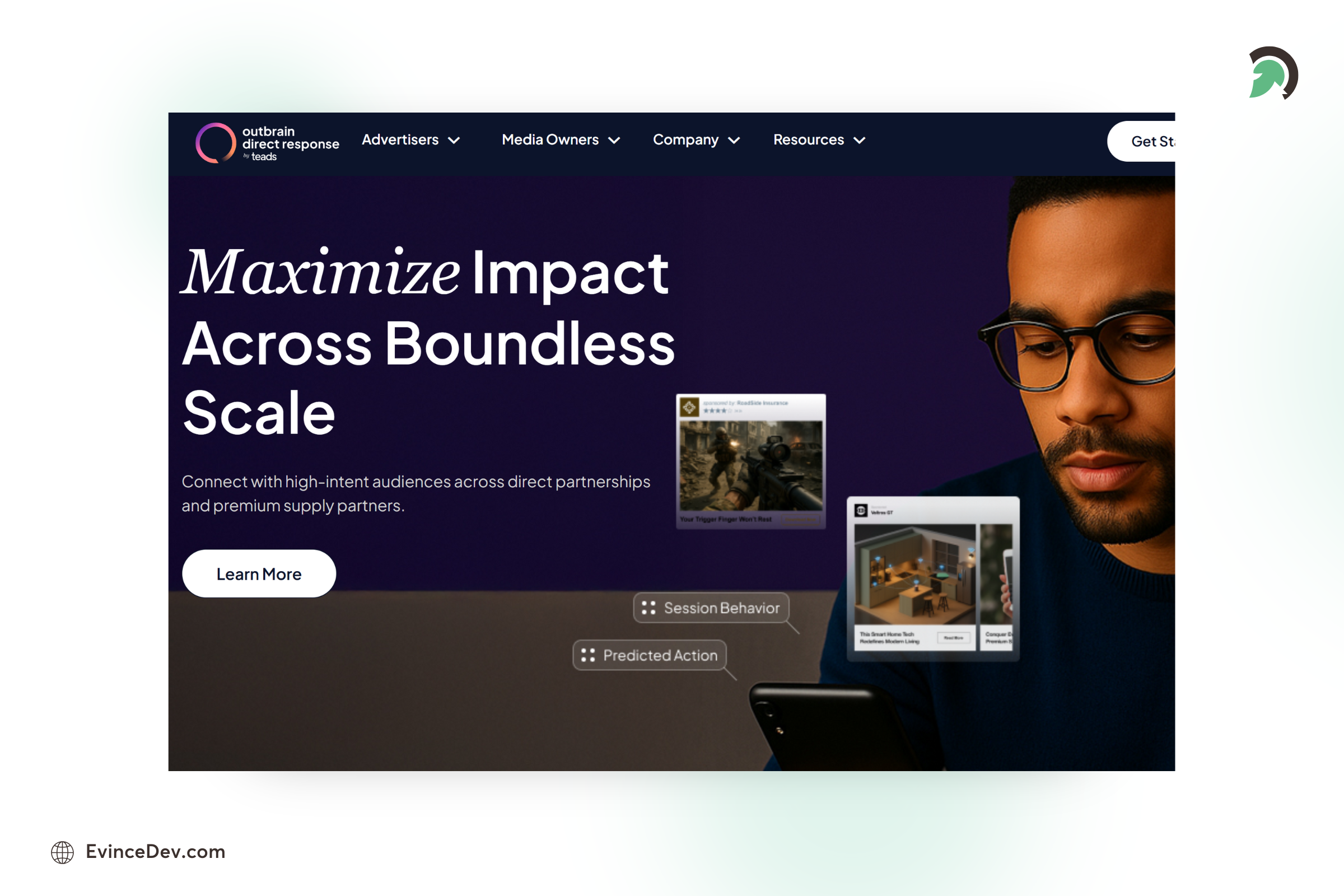
Outbrain Native Ads Overview
Best practice: Optimize based on engagement metrics such as scroll depth and time on site, not just clicks.
Quick Stat:
In a Google Cloud customer story, Outbrain is described as delivering 275 billion recommendations to 600 million+ unique users every month, which explains why it works well for large-scale discovery when the content and targeting are aligned.
7. Taboola
Taboola operates one of the largest native discovery networks globally, placing content-style ads across thousands of premium publisher sites. It helps brands scale awareness and mid-funnel engagement by matching headlines and visuals to relevant audiences through recommendation-driven placements.
- Best for: Scalable content discovery and audience expansion
- Key strengths: Massive publisher reach, strong discovery algorithms
- Ad formats: Native recommendation units
Taboola works best when ads lead to valuable content, not direct sales pages.
Best practice: Use content-driven landing pages, then retarget engaged users.
8. The Trade Desk (TTD)
The Trade Desk is a leading independent demand-side platform that enables advertisers to buy display inventory across the open internet through a single, unified interface. It provides access to premium publishers and multiple exchanges beyond walled gardens.
- Best for: advanced advertisers, omnichannel and multi-channel display strategies, Connected TV and premium open-web inventory
- Key strengths: unified programmatic buying, strong frequency and reach control, advanced audience targeting and optimization
- Ad formats: display, rich media, video, native, connected TV
The Trade Desk requires more programmatic expertise than self-serve ad networks, but it offers significantly greater transparency, control, and scalability across channels.
Best practice: Start with a focused objective such as retargeting or CTV awareness, then expand into broader programmatic strategies using first-party audiences and controlled supply paths.
9. Criteo
Criteo focuses heavily on commerce-driven display advertising using dynamic product creatives.
- Best for: ecommerce brands and catalog-based advertising
- Key strengths: product relevance, dynamic ads, strong conversion rates
- Ad formats: product-focused display ads
Performance depends heavily on feed quality and tracking accuracy.

Criteo Display Ads Platform
Best practice: Treat your product feed as a core creative asset and keep it clean and updated.
10. AdRoll
AdRoll is a performance-focused display advertising platform built around retargeting and cross-channel customer journey tracking. It helps brands re-engage visitors across the open web, social platforms, and email using unified audience data.
- Best for: retargeting, ecommerce growth, lifecycle, and abandoned cart campaigns
- Key strengths: strong retargeting engine, cross-channel attribution, easy setup for mid-market brands
- Ad formats: display ads, dynamic product ads, social retargeting units
AdRoll is most effective when used to support lower-funnel strategies rather than broad awareness campaigns.
Best practice: Segment audiences by intent and recency, rotate creatives frequently, and align display retargeting with email and social touchpoints for better conversion lift.
How Should You Choose the Best Display Advertising Network for Your Business?
When it comes to choosing a display ad network, it has little to do with which ad network has the most users and much to do with which one best aligns with what you’re trying to accomplish with your ad efforts and what you’re capable of spending with it. An ad network that may be great for ecommerce retargeting may not be ideal for a B2B awareness campaign, and a more expensive network may not be feasible if quick scale is needed with a low budget.
Here are the key questions to guide your choice:
- What stage of the funnel are you targeting?
Awareness needs reach and strong environments, while conversions need sharper targeting, retargeting, and optimization based on conversion data. - Where does your audience spend time online?
Some networks are stronger on websites, others in mobile apps, and others in discovery-style placements. Pick based on real audience behavior. - Do you need scale, precision, or premium placements?
Scale helps you reach more people, precision improves efficiency, and premium environments protect brand perception. Decide what matters most. - How strong is your tracking and analytics setup?
Better tracking allows smarter optimization and deeper testing. If tracking is limited, start with simpler platforms and build from there. - How much control do you need over placements and frequency?
If you want hands-on control, prioritize transparency and site-level insights. If you prefer automation, choose networks with strong algorithmic optimization.
What Should You Do After Selecting a Display Advertising Network?
Once you pick a network, your results depend on how you test, measure, and optimize. Use this simple rollout plan to get clean learnings and scale safely.
- Start with a controlled test budget:
Run a short test phase with enough spend to gather data, without risking large losses early. - Launch multiple creative variations immediately:
Test different visuals, headlines, offers, and calls to action. Display performance is often decided by creativity, not bidding. - Separate prospecting and retargeting campaigns:
Prospecting brings new users and should be judged differently from retargeting, which targets warm audiences and should prioritize efficiency. - Review performance and placements weekly:
Check which segments, creatives, and placements are driving meaningful actions. Exclude poor placements and reallocate the budget to winners. - Optimize for business outcomes, not clicks:
Track what matters: qualified leads, purchases, revenue, cost per acquisition, and strong engagement signals. Clicks alone can be misleading. - Keep improving consistently:
Steady testing and disciplined optimization usually beat switching networks frequently.
Conclusion
Display advertising is one of the most effective ways to gain visibility, relevance, and competitiveness on the open internet. When combined with proper targeting and optimization, a well-chosen display ad network can help you reach the right audiences and support the stages of a funnel.
Rather, the challenge is finding the platform that is, for your purposes, ‘best’ and matching it with your audience behavior and measurement setup. Display advertising can continue to deliver positive results in 2026 and beyond with diligent testing and optimization.
As someone reviewing networks and thinking about what you’re going to do next, EvinceDev is what you need to convert display into a repeatable growth channel with the depth of execution you expect from a reputable digital marketing agency.